

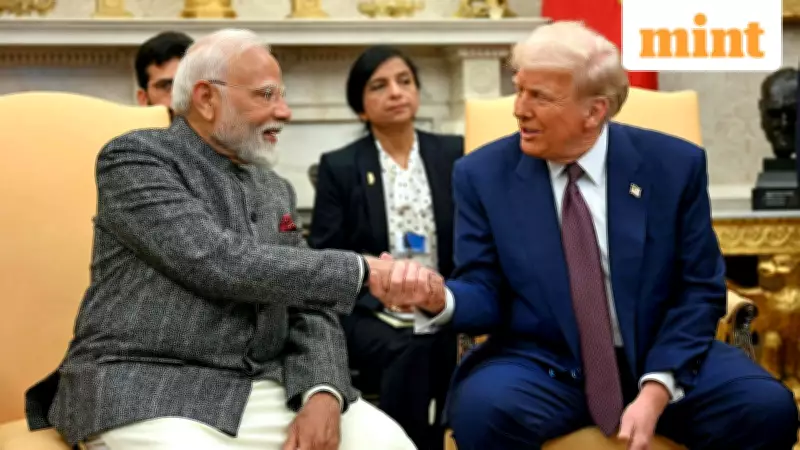
India-US Trade Agreement Announced Amid Ongoing Tensions
Following months of escalating tariff disputes and prolonged negotiations that tested diplomatic relations between the two nations, India and the United States announced a long-awaited free trade agreement on February 2, 2026. While the first phase of this bilateral pact has secured lower tariffs for Indian exports to the US market, recent details released by Washington and statements from President Donald Trump have raised significant questions about the deal's long-term viability.
Three Core Challenges Threatening the Trade Pact
Three critical issues sit at the heart of concerns surrounding the sustainability of this landmark trade agreement. First, can India realistically fulfill its commitment to purchase $500 billion worth of US goods over the next five years? Second, has New Delhi made any binding pledge to halt oil imports from Russia as part of this arrangement? Third, does this agreement provide India with genuine protection against future tariff hikes or trade restrictions imposed by the United States?
Each of these questions highlights the substantial gap between the ambitious promises outlined in the trade framework and the practical economic and political challenges that lie ahead for both nations.

The $500 Billion Import Target: Aspirational Versus Realistic
As part of the bilateral framework, India has committed to dramatically increase its imports from the United States, targeting $500 billion by the fiscal year 2031. This represents an extraordinary compound annual growth rate of nearly 57% from the FY26 baseline of approximately $52 billion. This target appears particularly steep when considering that US imports to India have grown at an average rate of just 11% annually over the past decade.
At this historical growth pace, imports would likely reach only around $90 billion by FY31, falling dramatically short of the ambitious target. Even accounting for potential market openings and increased access, the mathematical feasibility remains questionable.
Madhavi Arora, chief economist at Emkay Global, estimates that in an optimistic best-case scenario, India's imports from the US might reach $125-140 billion, representing a more realistic compound annual growth rate of 20%. A significant portion of this import commitment involves the purchase of Boeing aircraft, which itself presents challenges.
"India currently operates about 200 Boeing aircraft. Even if airlines were to add another 200 planes at approximately $300 million each, that would amount to only about $60 billion spread over five years—and this assumes airlines purchase exclusively from Boeing, which is unrealistic given competition from Airbus and commercial considerations," Arora explained.
While India could potentially scale up imports in several key sectors including oil, natural gas, defense equipment, and electronic goods—where the US share of total imports might increase to 10-15% over the next five years—the $500 billion target remains exceptionally ambitious.
The Russian Oil Question: Ambiguous Commitments and Monitoring Mechanisms
The United States has stated that India committed to halt Russian oil imports as part of the trade agreement, with Washington establishing mechanisms to monitor compliance. However, India has offered little clarity on whether such a binding pledge was actually made during negotiations.
Washington has hinted that tariff relief provisions could be reversed if terms are not followed, creating potential leverage. Despite months of punitive tariffs and diplomatic pressure, India continues to source nearly 30% of its oil from Russia, highlighting the practical challenges of any rapid transition away from this established supply relationship.
Russia's share of Indian oil imports has grown incrementally from just 2.3% in FY22 to 16.4% in FY23, settling at approximately 28% in FY24 before moderating to 20% in December 2025. While Russia was not a significant oil source for India before the Ukraine conflict, and a shift away from Moscow remains theoretically possible—particularly if Venezuela's supplies resume—such a transition is unlikely to occur quickly or without economic consequences.

Energy experts suggest India could reduce its dependence on Russian oil without significantly affecting costs or refining margins, but only if New Delhi provides clear clarification regarding its official stance and establishes a realistic timeline for any transition.
The Caveat Crisis: Unpredictable Tariff Policies Under the Trump Administration
India's trade agreement with the United States comes with several significant caveats that fit into a broader pattern emerging from Washington's trade negotiations with multiple countries. The experience of South Korea offers a particularly instructive example of this dynamic.
In April 2025, President Trump announced a 25% tariff on South Korean imports despite the existing KORUS free trade agreement between the two nations. Following intense protests and subsequent negotiations, a revised deal emerged in July where tariffs would drop to 15% in exchange for $350 billion in US investments and $100 billion in energy purchases from South Korea.
However, this reprieve proved short-lived. Trump later accused South Korea of "not living up" to the agreement and raised tariffs back to 25%, demonstrating the volatility of trade relations under this administration.
The European Union experienced similar uncertainty. After Trump threatened a 50% tariff, negotiations produced an agreement involving $750 billion in US energy purchases and $600 billion in EU investment by 2028, accompanied by a 15% tariff reduction. Yet tariff threats persisted, even extending to unrelated disputes such as those concerning Greenland.
Japan and China, despite having established trade agreements in place with the United States, also face ongoing uncertainty regarding future tariff policies. Under President Trump's distinctive approach to trade diplomacy, tariff risk is rarely eliminated—it is merely postponed or temporarily mitigated.
This analysis reveals that while the India-US trade agreement represents a significant diplomatic achievement, its long-term sustainability faces substantial challenges related to unrealistic economic targets, ambiguous energy commitments, and unpredictable policy environments.





