

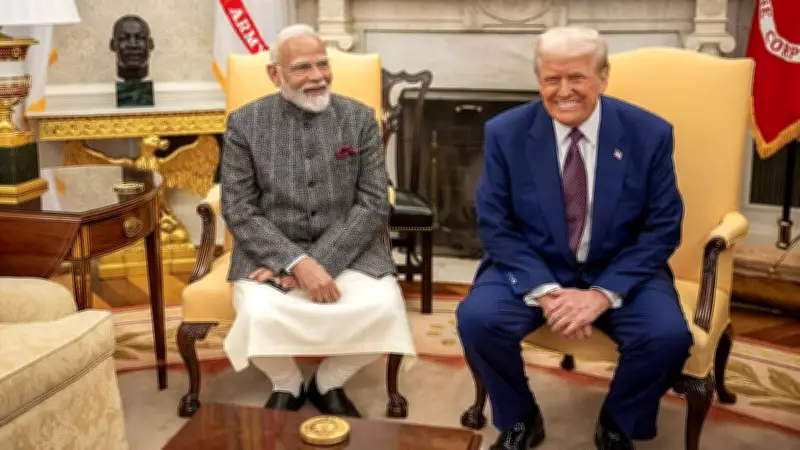
India and United States Forge Landmark Trade Agreement with Tariff Reductions
In a significant development for international trade relations, India and the United States have announced a breakthrough bilateral trade agreement that promises to reshape economic cooperation between the world's largest democracies. The deal, finalized during a phone conversation between Prime Minister Narendra Modi and US President Donald Trump, centers on substantial tariff reductions and enhanced market access commitments.
Trump Announces Immediate Tariff Reduction to 18%
President Donald Trump made the formal announcement of the trade agreement through social media platforms, revealing that Washington would immediately reduce reciprocal tariffs on Indian goods from 25 percent to 18 percent. The US leader framed this decision as a gesture of friendship and respect toward Prime Minister Modi, stating the reduction would take effect immediately following their discussion.
"Out of friendship and respect for Prime Minister Modi and, as per his request, effective immediately, we agreed to a trade deal between the United States and India," Trump declared. "The United States will charge a reduced reciprocal tariff, lowering it from 25 percent to 18 percent."

The American president further outlined additional components of the agreement, noting that India would reciprocate by reducing its own tariffs and non-tariff barriers against US products to zero. Trump also revealed that India committed to purchasing American goods, including energy products, worth more than $500 billion while agreeing to cease purchasing Russian oil.
Modi Expresses Delight at Trade Breakthrough
Prime Minister Narendra Modi confirmed the tariff reduction and expressed his satisfaction with the outcome of the bilateral discussions. Taking to social media platform X, the Indian leader thanked President Trump on behalf of India's 1.4 billion citizens for what he described as a "wonderful announcement."
"Wonderful to speak with my dear friend President Trump today," Modi posted. "Delighted that Made in India products will now have a reduced tariff of 18 percent. Big thanks to President Trump on behalf of the 1.4 billion people of India for this wonderful announcement."
The Prime Minister emphasized the mutual benefits of strengthened cooperation between the two nations, noting that when large economies and democracies collaborate, it creates opportunities for both populations. Modi also praised Trump's global leadership, stating that India fully supports the American president's efforts toward international peace and stability.
Strategic Implications and Broader Commitments
The trade agreement extends beyond simple tariff adjustments, encompassing several strategic dimensions that reflect the deepening partnership between New Delhi and Washington:
- Energy Cooperation: India has committed to significantly increasing purchases of American energy products while reducing dependence on Russian oil supplies
- Market Access: Both nations have agreed to reduce barriers to trade, with India pledging to eliminate tariffs and non-tariff barriers against US goods
- Global Security: The leaders framed the agreement as contributing to international stability, with Trump suggesting it would help resolve the conflict in Ukraine
- Economic Transformation: Indian officials described the deal as transformative for bilateral relations and economic development
Reactions from Key Officials and Political Figures
The announcement prompted responses from various stakeholders on both sides of the agreement:
Piyush Goyal, India's Commerce Minister, hailed the agreement as a landmark achievement that reflects the power of like-minded democracies working together for shared prosperity. He emphasized that the deal would create unprecedented opportunities for Indian farmers, small businesses, entrepreneurs, and skilled workers while facilitating technology transfer from the United States.

Nirmala Sitharaman, India's Finance Minister, had previously signaled India's approach to global tariffs during her Budget 2026 presentation, indicating the country would seek to enhance export competitiveness through simplified customs duties—a strategy that appears to have informed the final negotiations.
US Trade Representative Jamieson Greer noted during earlier negotiations that the United States was addressing globalization challenges, while US Ambassador to India Sergio Gor confirmed the 18% tariff rate and emphasized India's strategic value to Washington.
Political Opposition and Critical Perspectives
The Indian National Congress offered a contrasting perspective on the agreement, with party communications head Jairam Ramesh criticizing what he characterized as Prime Minister Modi's capitulation to American demands. The opposition party questioned the timing and announcement details of the deal, suggesting that President Trump appeared to have significant leverage in the negotiations.
Despite these criticisms, the overall reception from government officials and business communities has been overwhelmingly positive, with many viewing the agreement as a historic turning point in India-US relations that will accelerate economic growth and strengthen strategic partnership between the two nations.
The trade deal represents a concrete manifestation of the personal diplomacy between Modi and Trump, both of whom have emphasized their ability to "get things done" in contrast to what they perceive as less effective approaches by other global leaders. As implementation begins, observers will be watching closely to assess the agreement's impact on bilateral trade volumes, economic cooperation, and the broader strategic relationship between India and the United States.





