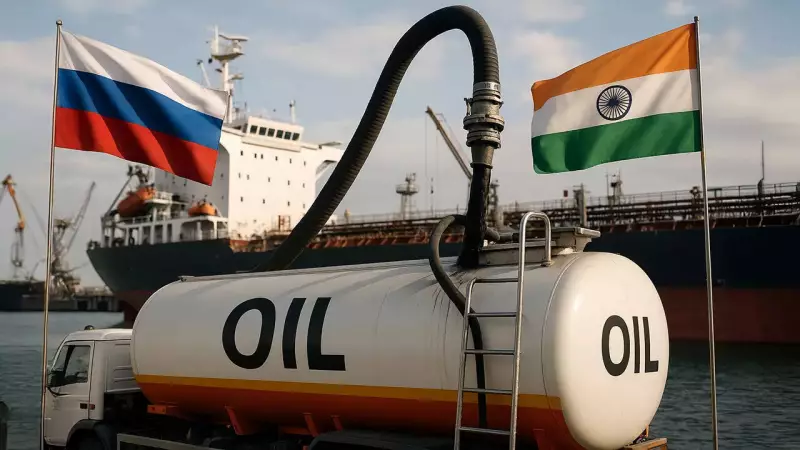
India-US Trade Negotiations Hit Impasse Over Russian Oil Concerns
High-stakes trade discussions between India and the United States have failed to produce a breakthrough agreement, with the contentious issue of Russian oil imports continuing to dominate negotiations. The Trump administration has maintained its position that India must address outstanding concerns regarding its purchases of Russian crude before any tariff relief can be considered.
The Tariff Standoff and Russian Oil Connection
India currently faces substantial 50% tariffs on its exports to the United States, with approximately 25% of these duties directly linked to New Delhi's continued imports of Russian crude oil. The Trump administration has consistently argued that these purchases indirectly finance Russia's military actions in Ukraine, creating a significant diplomatic and economic challenge for bilateral relations.
US Trade Representative Jamieson Greer has been particularly vocal about this issue, stating clearly that India needs to take more substantial steps toward reducing its reliance on Russian oil if it hopes to obtain relief from the punishing tariffs. "They like the discount that you get from Russian oil," Greer noted in a recent interview, highlighting the economic incentives that make a complete shift away from Russian supplies particularly challenging for India.

Negotiation Timeline and Current Status
Officials from both nations have been engaged in intensive negotiations for several months, focusing primarily on reducing the 50% duty imposed by President Donald Trump last year. Despite these ongoing discussions and what Greer describes as "regular engagement" and a "strong working relationship" with his Indian counterparts, meaningful progress remains elusive.
The situation presents a complex dilemma for Indian policymakers. On one hand, discounted Russian crude continues to account for a significant portion of India's oil imports, with analysts predicting this trend could extend well into 2026. On the other hand, the substantial tariffs imposed by the United States create considerable economic pressure on Indian exports.
Mixed Signals from Washington
The Trump administration has sent conflicting messages regarding the Russian oil-linked tariffs in recent weeks. US Treasury Secretary Scott Bessent indicated last week that Washington might consider rolling back the additional 25% tariffs imposed specifically on India, citing a "sharp decline" in New Delhi's imports of Russian crude.
"We put a tariff on India for buying Russian oil. Indian purchases of Russian oil have collapsed," Bessent stated, describing the outcome as "a check and a huge success." However, he simultaneously criticized European nations for what he characterized as indirectly sourcing refined Russian oil products through India.
India's Strategic Shift in Oil Sourcing
Recent data reveals a notable transformation in India's approach to crude oil procurement. The country is increasingly prioritizing supplies that offer lower risk profiles and greater delivery certainty. This strategic reorientation has strengthened the position of Middle Eastern grades in India's import mix, while Russian crude continues to feature but in a more measured and compliance-conscious manner.
According to real-time analytics from Kpler, Russian oil imports to India declined to approximately 1.1 million barrels per day during the first three weeks of January 2026. This represents a decrease from the previous month's average of 1.21 million barrels per day and a substantial reduction from the peak of over 2 million barrels per day recorded in mid-2025.
Analyst Perspectives and Future Projections
Sumit Ritolia, Lead Research Analyst for Refining and Modeling at Kpler, observes that "India's crude buying in January 2026 shows a clear shift toward lower-risk and more reliable supply, with Middle East barrels rising while Russian crude flows remain present but more selective and compliance-driven."
Ritolia further projects that India will likely continue purchasing Russian crude in early 2026, though at levels significantly below the record highs witnessed between 2023 and 2025. This anticipated moderation reflects both market dynamics and increasing regulatory pressures.

The European Union Factor
In a parallel development with potential implications for the India-US trade dynamic, India recently concluded a landmark free trade agreement with the European Union after nearly two decades of negotiations. Widely characterized as the "mother of all deals," this pact is viewed by many analysts as a strategic response to the Trump administration's increasingly protectionist trade policies.
Commenting on this significant development, Greer acknowledged that India stands to gain substantially from the EU agreement, noting enhanced market access and potential immigration benefits. He suggested that while the European Union appears to be reinforcing globalization principles, the United States remains focused on addressing what it perceives as the negative aspects of global trade arrangements.
Compliance Challenges and Market Realities
Fresh sanctions imposed by the United States on Russian suppliers have further complicated the landscape, slowing buying activity as concerns over regulatory compliance and logistical execution intensify. With India meeting nearly 90% of its crude oil requirements through imports, the country finds itself navigating increasingly complex geopolitical and economic currents.
The return to greater reliance on traditional Middle Eastern suppliers represents both a pragmatic adjustment to current realities and a strategic recalibration of India's energy security framework. As trade negotiations with the United States continue without resolution, Indian policymakers must balance economic considerations with diplomatic relationships in an increasingly volatile global environment.