

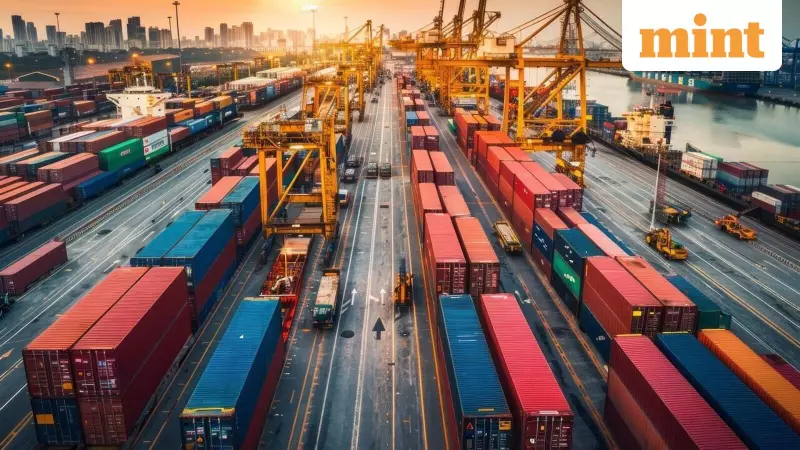
Confronted with punishing new tariffs from the United States, Indian exporters are executing a strategic pivot, accelerating shipments to America while simultaneously scouting for alternative global markets. This dual-track approach aims to cushion the economic blow, but questions linger about its long-term effectiveness in an increasingly protectionist world.
The Front-Loading Rush and the Tariff Hammer
Ahead of the new tariff regime announced by Washington on 2 April 2025—dubbed "Liberation Day"—Indian exporters engaged in a frantic front-loading of shipments. During the April-August 2025 period, they rushed goods to the US to exploit a temporary cost advantage before the higher rates kicked in. The strategy was clear: maximize revenue ahead of the impending pain.
The anticipated pain arrived in the form of a steep 50% tariff on a range of Indian exports. In the subsequent September-November 2025 quarter, the initial data revealed a tactical shift. While exports to the US showed "slight moderation," shipments to the Rest of the World (RoW) rose to $89.9 billion, up from $86.2 billion in the same period the previous year, as noted in a BoB Capital Market report dated 2 January 2026.

The Uneven Path of Diversification
However, the overall picture for the first eight months of FY26 (April-November 2025) reveals an uneven transition. Data from Emkay Global Financial Services shows exports to the US grew by a robust 11% year-on-year to $59 billion, driven by the earlier front-loading. In contrast, exports to the rest of the world saw a more modest 1% increase to $233 billion.
The silver lining has been sharp growth in non-traditional destinations. Exports to Spain, China, Vietnam, Hong Kong, and Brazil have shown notable improvement. Analysts at Emkay suggest this indicates not just genuine market diversification but also possible trans-shipment—where goods are rerouted through intermediate countries to reach the final destination, often to circumvent direct trade barriers.
"Thus, the beginning of the substitution effect has already started taking shape," the BoB report stated. Yet, experts caution that meaningful export diversification is a slow and long-drawn process requiring sustained government policy support, not just reactive corporate maneuvers.
Mounting Risks and Macroeconomic Concerns
The trade uncertainty for India is compounding from multiple fronts. There is little clarity on a formal India-US trade deal. More alarmingly, US Republican Senator Lindsey Graham recently indicated President Donald Trump approved a Russia sanctions bill proposing 500% tariffs on countries, including India, that purchase Russian oil.
Gaura Sen Gupta, economist at IDFC First Bank, warned, "As India’s services trade is much more concentrated in the US, the worrying aspect is that a 500% tariff could be applicable on both goods and services."
Adding to the precedent of rising protectionism, Mexico has decided to impose tariffs of 5% to 50% on imports from non-preferential partners like India and China. While India's exports to Mexico are a small 1.3% of the total, the move signals a risk that other nations may adopt similar tactics.
Despite new trade pacts with the UK and Oman in 2025, and the enactment of the India–European Free Trade Association agreement, the core question remains unresolved. Is India's export geography undergoing a structural, permanent change, or is this merely a tactical, short-term rerouting?
The answer is obscured by volatile recent trade data. The more immediate threat is macroeconomic: these disruptions heighten the downside risk to India's current account deficit, which could pressure the rupee and have broader economic repercussions. The success of 'Plan B' will depend on how deeply and quickly Indian exports can sink roots in new soil.






