

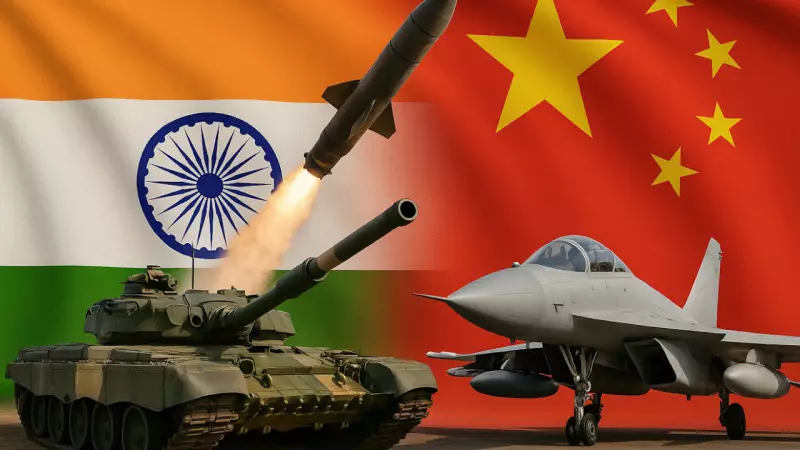
The global arms industry reached a new peak in 2024, with revenues soaring to an unprecedented $679 billion, marking a 5.9% increase in real terms. This data comes from the latest annual ranking by the Stockholm International Peace Research Institute (SIPRI), which tracks the world's top 100 arms-producing companies. While the surge was primarily fuelled by manufacturers in Europe and the United States, the Asia-Pacific region presented a contrasting picture, largely due to a significant downturn in China.
India's Steady March in Defence Production
Amidst the global arms boom, India's progress was quiet but consistent. The three Indian companies that made it to the SIPRI Top 100 list—Hindustan Aeronautics Ltd (HAL), Bharat Electronics Ltd (BEL), and Mazagon Dock Shipbuilders—collectively saw their arms revenue grow by 8.2% to reach $7.5 billion in 2024, up from $6.9 billion the previous year.
This growth is a testament to India's focused 'Atmanirbhar Bharat' (self-reliant India) campaign in defence manufacturing. The increase was driven overwhelmingly by domestic orders, aligning with the nation's military modernisation priorities. Bharat Electronics Ltd (BEL) led the charge with an impressive 24% revenue jump, earning $2.47 billion. This boost was powered by strong demand for indigenous radar systems and electronic warfare equipment.

Hindustan Aeronautics Ltd (HAL), ranked 44th globally and India's top defence firm, recorded revenues of $3.81 billion. Despite a marginal 0.3% dip attributed to delivery delays, HAL remains the cornerstone supplier for the Indian Air Force and Navy. Mazagon Dock Shipbuilders, specialising in naval platforms, posted a 9.8% year-on-year increase to $1.23 billion, supported by ongoing submarine and destroyer production projects.
China's Setback: Corruption Scandals Disrupt Growth
In sharp contrast to India's steady climb, China's defence sector experienced a notable reversal. For the first time in years, the combined arms revenue of the eight Chinese companies in the Top 100 fell by 10% to $88.3 billion. This decline is directly linked to a wave of high-profile corruption scandals and major contract delays that have shaken Beijing's defence establishment.
The report highlights that a host of corruption allegations in arms procurement led to contracts being postponed or cancelled in 2024. The state-controlled sector's opacity made it vulnerable to internal shocks from political purges. NORINCO, China's primary land systems manufacturer, saw its revenue plunge by a staggering 31%. Similarly, China Aerospace Science and Technology Corporation (CASC) faced a 16% drop following delays in military satellite programs and the removal of its president over graft allegations.
Nan Tian, director of SIPRI's military expenditure programme, confirmed that the corruption crackdown significantly disrupted China's procurement pipeline. Only two of China's eight major arms producers recorded growth, with China State Shipbuilding Corporation (CSSC) being a notable exception, rising 8.7% in line with the country's naval expansion.
The Global and Regional Arms Landscape
The SIPRI report paints a picture of a rapidly accelerating global arms race, driven by geopolitical tensions. United States firms continue to dominate, with 39 companies accounting for $334 billion in revenue—nearly half of the Top 100 total. However, major programmes like the F-35 fighter jet and Sentinel ICBM are plagued by delays and cost overruns, raising questions about budget efficiency.
In Europe, arms revenues surged by 13% to $151 billion, a direct response to Russia's war in Ukraine. Russia's own limited corporate footprint in the ranking—just two entities—saw a 23% jump to $31.2 billion, driven by massive domestic demand for artillery shells, missiles, and armoured vehicles for the Ukraine conflict.

Elsewhere in Asia, other powers filled the vacuum left by China's decline. South Korean arms producers saw a massive 31% increase to $14.1 billion, propelled by booming exports. Japan recorded the largest jump in the region, with a 40% rise across five firms to $13.3 billion, reflecting Tokyo's shift towards more proactive defence spending.
The Middle East also emerged as a new hub, with nine companies entering the Top 100 for the first time, generating combined revenues of $31.0 billion. Israeli firms alone accounted for $16.2 billion, a 16% increase fuelled by the Gaza war and global demand for drone and missile defence systems.
The Bottom Line: Discipline Over Dominance?
The 2024 rankings reveal a pivotal moment in Asia's defence industrial balance. India's model, characterised by transparent procurement, institutional trust, and alignment with long-term strategic plans, is yielding slow but stable growth. While China remains far ahead in sheer scale, its top-down system has shown vulnerability to internal political disruptions.
For India, the path forward involves a continued push under the Defence Acquisition Procedure (DAP) to boost local manufacturing and potentially expand exports. For China, recovery hinges on restoring integrity in procurement and managing the fallout from its anti-corruption campaign. In the evolving Asian security architecture, the events of 2024 suggest that consistent, scandal-free institutional discipline may prove more sustainable in the long run than sheer dominance prone to internal turbulence.





