

India's Aviation Evolution: From Single to Dual-Airport Systems
For decades, Indian aviation followed a predictable cycle: a city would have one airport that would expand slowly, passenger numbers would outpace expectations, congestion would become normal, and planners would announce expansions promising to solve problems for the next decade—only for the cycle to repeat. What is changing now is not just the scale of air travel but the fundamental thinking behind airport planning. India is no longer building airports merely to address present-day issues; it is constructing them in anticipation of a future where a single airport will be insufficient for major metropolitan regions. This shift marks a quiet but crucial transition toward a dual-airport model.
The Collapse of the Single-Airport Assumption
Cities like London, New York, and Tokyo have operated with multiple airports for decades, but India long resisted this idea. Air travel was limited to a relatively small population segment, and building a second airport required enormous investment and political will. The assumption that one large, well-equipped airport could handle an Indian metropolis's needs is now collapsing under pressure from numbers rising far faster than planners imagined.
The most dramatic example is in the National Capital Region (NCR). Delhi relied almost entirely on Indira Gandhi International Airport, which expanded repeatedly with new terminals, runways, and modernizations. Each expansion gave the impression of a permanent solution, but relentless growth in passenger numbers—fueled by low-cost airlines and enhanced connectivity to smaller cities—proved otherwise. Delhi-NCR and Mumbai are leading this shift, with Goa already testing it, and cities like Chennai and Bengaluru preparing for it. Together, these developments represent one of the biggest structural changes in India's aviation sector, reshaping city growth, airline networks, and India's position in the global aviation economy.

Delhi-NCR's Twin-Airport Strategy: A Gateway to the Future
Delhi's reliance on Indira Gandhi International Airport, one of the world's busiest, led to struggles for airlines to secure new slots, especially during peak hours. As Delhi spread southward toward Gurgaon and eastward toward Noida, these areas became hubs for corporate investment, jobs, and real estate, making Delhi-NCR home to an estimated 3.5 crore people—the world's second-largest urban agglomeration after Tokyo, with UN projections suggesting it will surpass Tokyo within four years.
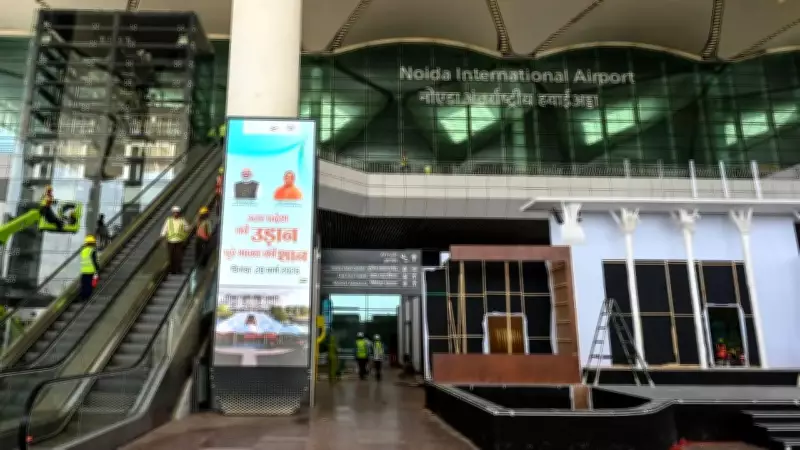
The inauguration of Noida International Airport signifies more than a new terminal; it heralds a dual-airport system that could eventually handle over 200 million passengers annually across the region. With nearly Rs 11,200 crore invested in the first phase alone, capable of handling 12 million passengers yearly, the airport is designed for gradual expansion to 70 million passengers and up to six runways. Backed by global investment from Zurich Airport International AG, it is among India's largest aviation infrastructure projects.
Industry experts, like Manoj Gaur, CMD of Gaurs Group, predict it will become "a powerful gateway for the state, significantly enhancing global connectivity and attracting investments across sectors." Real-estate analysts foresee sharp price increases along the Yamuna Expressway corridor, evolving the region into an aerotropolis—a city built around an airport.
Mumbai's Twin-Airport System: A Necessity-Driven Model
If Delhi represents expansion, Mumbai embodies necessity. Chhatrapati Shivaji Maharaj International Airport has operated near saturation for years, with intersecting runways allowing only one aircraft to take off or land at a time during peak hours. The Navi Mumbai International Airport, operated by the Adani Group, is essential for Mumbai's growth as an aviation hub. Unlike Delhi, Mumbai's twin-airport system will be run by a single operator, aiming for "independent but cohesive" functionality.
Jeet Adani, director of the group's airport division, suggests the airports may specialize, similar to models in New York or London, with one serving a major airline alliance like Star Alliance. Economists expect the new airport to transform the Mumbai Metropolitan Region, potentially creating one of Asia's largest aviation-driven urban clusters.

By the end of the decade, Delhi and Mumbai will each operate through twin-airport systems—Indira Gandhi International Airport with Noida International Airport, and Chhatrapati Shivaji Maharaj International Airport with Navi Mumbai International Airport. These four airports could turn both metros into major global aviation hubs, especially with record aircraft orders and expanded flying rights, such as with the United Arab Emirates.
Goa's Successful Test Case and Expanding Ambitions
While Delhi and Mumbai transition, Goa has demonstrated the dual-airport model's effectiveness. The Manohar International Airport began operations in 2023 alongside the older Dabolim Airport, increasing combined passenger traffic from 8.4 million to over 11 million annually. This shows that in a fast-growing market, a second airport expands demand rather than dividing it.
Chennai is preparing for a second airport at Parandur, a greenfield project spread across nearly 5,000 acres with an initial capacity of 20 million passengers yearly. Designed with two runways and multiple terminals for efficiency, it will connect to the Chennai-Bengaluru expressway and metro rail, reflecting a multi-airport mindset. Bengaluru is also moving toward a second airport, with the Karnataka government identifying sites and the Airports Authority of India examining locations, driven by the city's status as India's technology capital and a fast-growing aviation market.
The Aviation Vision and Driving Factors
These projects are part of a larger strategy outlined by Prime Minister Narendra Modi, who highlighted India's transformation into the world's third-largest domestic aviation market. From around 70 airports in 2014 to over 160 today, with a target of 400 by 2047, the focus is on making air travel a mass transportation system. The shift toward dual airports is driven by sheer demand, with India's aviation market growing rapidly; geographic sprawl of metropolitan regions like Delhi-NCR; and the changing nature of aviation, including cargo and logistics needs.
According to Crisil, India's operational and upcoming alternate airports are expected to handle 40 million passengers annually by year-end, rising to 45-50 million by 2030. Overall airport traffic is projected to grow from 415 million passengers in the current fiscal year to 580 million by fiscal 2030, at an 8-9% compound annual growth rate, driven by economic activity and easing capacity constraints.
A New Aviation Geography and Global Alignment
The long-term impact extends beyond aviation, as airports are engines of economic growth. Second airports often create new urban corridors, with developments around Noida, Navi Mumbai, and Chennai expected to include logistics hubs, manufacturing units, and residential townships. This could change how Indian cities grow, fostering multiple economic centers connected by infrastructure.
India is finally aligning its aviation infrastructure with global standards, moving away from single-airport systems in major cities. While challenges like connectivity and slot allocation remain, the direction is clear. Passenger traffic data shows Delhi and Mumbai airports operating at capacity ceilings, with newer airports like Bengaluru and Hyderabad recording faster growth. The Noida and Navi Mumbai airports are poised to correct this mismatch, sharing the load and supporting future demand.
Conclusion: A New Era of Aviation Planning
The emergence of dual-airport systems signals a country planning for long-term growth rather than reacting to short-term problems. From Delhi-NCR to Mumbai, and from Goa to Chennai and Bengaluru, India is preparing for a future where air travel becomes as common as rail travel once was. If successful, this will create a new aviation ecosystem capable of supporting economic growth, international connectivity, and the aspirations of millions of first-time flyers, marking a transformative chapter in India's aviation history.





