

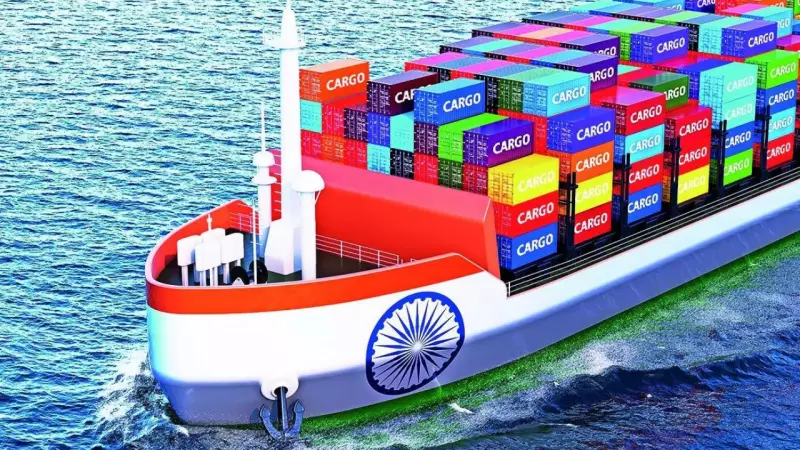
India's export sector demonstrated remarkable resilience in a turbulent 2025, navigating steep US tariffs, geopolitical disruptions, and global trade uncertainty. Exporters successfully adapted by diversifying into new markets and products, a strategy that officials and industry leaders believe will underpin steady growth through 2026.
Navigating Tariffs and Achieving Record Numbers
Despite the imposition of a hefty 50% duty by the United States on Indian goods during the year, exporters recalibrated their approach swiftly. A senior Commerce Ministry official encapsulated the sector's adaptive spirit, remarking that "trade is like water, it finds its own course." This agility helped cushion the impact of external shocks.
The data reveals a story of recovery and strength. After a dip to $389.5 billion in 2023, merchandise export momentum returned in 2024, climbing to $443 billion. In 2025, exports showcased their resilience, reaching $407 billion during the January–November period despite repeated global challenges.

Commerce Secretary Rajesh Agrawal revealed that India's combined exports of goods and services achieved a historic milestone, hitting a record $825.25 billion in the 2024-25 fiscal year. This marked a robust year-on-year growth of over 6%. The positive trend has extended into the current fiscal, with exports already at $562 billion for April–November 2025.
Strategic Diversification and Forthcoming FTAs
The government is actively pursuing a multi-pronged strategy to bolster exporters. Key measures include a Rs 25,060 crore export promotion mission, additional collateral-free credit of up to Rs 20,000 crore, debt repayment moratoriums, and extended export credit tenors. A central pillar of the strategy is leveraging Free Trade Agreements (FTAs).
Agrawal expressed optimism for the coming year, stating, "Based on current trends, India’s exports are poised to deliver solid growth in 2026 as well." He highlighted that three significant FTAs—with the United Kingdom, Oman, and New Zealand—are scheduled to come into force next year, which will significantly improve market access for Indian goods and services.
While US tariffs initially hurt shipments in September and October, a sharp rebound followed. Exports to America surged by 22.61% to $6.98 billion in November 2025. The industry is closely watching progress on a proposed India-US bilateral trade agreement and a potential deal with the European Union.
Sectoral and Geographic Shifts Driving Growth
Industry experts point to profound structural shifts strengthening India's export outlook. Rudra Kumar Pandey, Partner at Shardul Amarchand Mangaldas & Co, identified electronics as a key driver, with exports skyrocketing nearly 39% in November 2025, fueled by FDI-led capacity creation and deeper integration into global value chains. Engineering goods, pharmaceuticals, and automotive sectors are also contributing significant momentum.
Geographic diversification is another critical trend. While the US and UAE remain vital markets, exports are expanding vigorously across Europe, East Asia, and South Asia. For instance, shipments to Spain witnessed a staggering surge of nearly 150% in November, alongside strong growth to China and Bangladesh.
Ajay Sahai, Director General of the Federation of Indian Export Organisations (FIEO), noted that supply-chain realignments, expanding trade partnerships, and improvements in ease of doing business position exporters favorably for 2026. "With continued policy support and market diversification, we remain confident of a strong and stable export outlook in the coming year," he said.
Persistent Challenges on the Horizon
Despite the optimism, significant challenges persist. Sahai cautioned about ongoing geopolitical tensions, trade fragmentation, and rising protectionism through carbon measures and non-tariff barriers. Additional headwinds include currency volatility, high freight costs, and tighter global financing conditions, which particularly affect Micro, Small, and Medium Enterprises (MSMEs).

The Indian rupee added another layer of complexity, weakening by about 5% during 2025 and trading near 90 against the US dollar by the end of December. This volatility remains a key variable as India steps into 2026.
The global context also presents a mixed picture. The World Trade Organization has projected global trade growth of 2.4% in 2025 but has slashed its outlook for 2026 to just 0.5%, citing tariff uncertainty, slowing GDP growth, and weakening business confidence in developed economies.
Over the past five years, the NDA government has actively signed or implemented a series of FTAs with partners including Mauritius, Australia, the UAE, Oman, the UK, the European Free Trade Association (EFTA), and New Zealand, laying a broader foundation for future trade resilience.





