

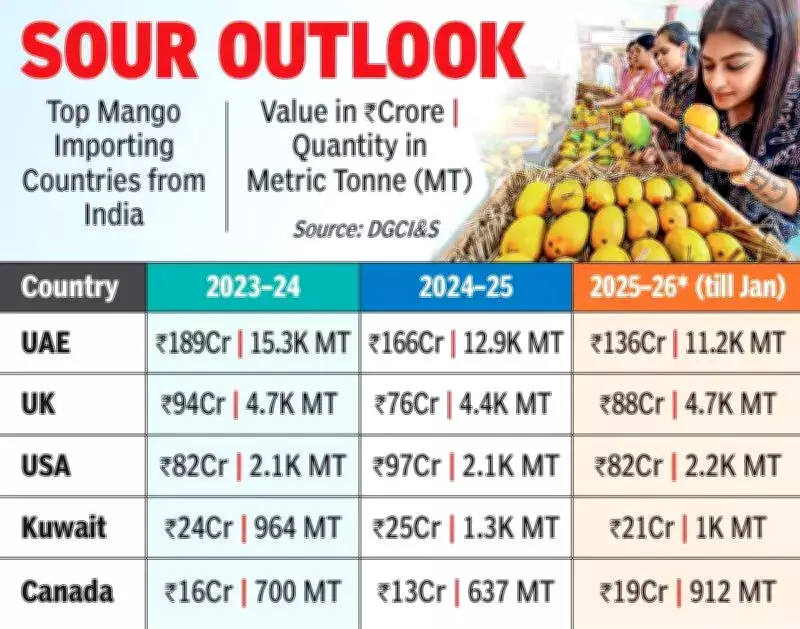
West Asia Crisis Severely Impacts India's Mango Export Season
The ongoing geopolitical tensions in West Asia have delivered a significant blow to India's lucrative mango export business this season, with industry sources reporting a sharp decline of 20% to 30% in shipments. The disruption has triggered a dramatic escalation in freight costs, creating formidable logistical hurdles for exporters across the country.
Telangana's Premium Mangoes Face Storage Crisis
Telangana, which typically exports approximately 7,000 metric tonnes of its premium mango produce to international markets—particularly the UAE, United States, and Canada—has been severely affected. Exporters in the region have been compelled to store their valuable stocks in cold storage facilities, anxiously waiting for the turbulent situation to stabilize before they can resume shipments.
Mangoes possess an extremely limited shelf life, ranging from just 19 to 25 days before they begin to deteriorate. "Redirecting these consignments to domestic markets is not a feasible solution," explained one exporter. "The fruit is cultivated specifically to meet rigorous international standards, grown organically without chemical sprays or artificial carbide ripening." These premium mangoes command high price tags of Rs 100 to Rs 150 per kilogram, making them less attractive to local consumers who generally prefer more affordable varieties priced between Rs 40 and Rs 60 per kilogram.

Export Season in Limbo as Orders Dry Up
Among Telangana's prized exports, the Banganapalle variety is the most sought-after, followed by Pedda Rasalu and Chinna Rasalu. With the export season scheduled to commence from April 15, exporters find themselves in a state of uncertainty due to a complete absence of orders from international importers and the disruption of regular belly cargo schedules.
According to R P Naidu, Assistant General Manager at the Agricultural and Processed Food Products Export Development Authority (APEDA), the surge in transportation expenses and persistent shipment delays are critically impacting exports of perishable commodities like mangoes. He emphasized that mangoes, which require precise temperature-controlled delivery within tight timelines, are exceptionally vulnerable to global logistics disruptions.
UAE's Dominant Import Role Under Strain
Naidu noted that India traditionally exports around 30,000 metric tonnes of mangoes annually to international markets, with the United Arab Emirates accounting for the largest share—averaging over 10,000 metric tonnes each year. However, this dominant trade relationship is now under severe pressure as exporters struggle with escalating costs and mounting uncertainty.
Freight rates have increased dramatically since the conflict intensified toward the end of February. Air cargo charges have skyrocketed from Rs 250 per kilogram to between Rs 800 and Rs 900 per kilogram, while container shipping costs have surged from $1,000 to $2,500. Exporters report that these steep increases have rendered many shipments financially unviable, especially for bulk consignments.
Naidu added that although adequate cold storage facilities are available in Telangana to preserve produce temporarily, prolonged delays could still compromise quality and marketability.
Buyer Reluctance and Global Freight Hikes
Kosuri Srinivas Rao, a pack house operator and exporter, stated that overseas buyers are exhibiting significant reluctance due to uncertainty over delivery timelines. "There is no confidence that shipments will arrive on schedule. Buyers fear substantial losses if deadlines are missed," he said, highlighting disruptions in scheduled cargo services, including flights operated by carriers such as Emirates.
Simultaneously, European airlines have increased freight rates to destinations like the United States and Canada, which have also surged from approximately Rs 300 per kilogram to over Rs 700 per kilogram, further straining exporters' financial viability.

"With exports nearly at a standstill, the entire value chain is suffering—from farmers and pack house operators to exporters like us," Srinivas Rao elaborated. "We invest heavily to meet strict international standards, but without shipments, there is no return on that investment. Mangoes are highly perishable; even under optimal cold storage conditions, their shelf life is only about 19 to 25 days. Every day of delay reduces quality and market value, and if this continues, a substantial portion of the crop will simply go to waste."
Government Measures and Industry Warnings
To mitigate the crisis, the Indian government has announced several measures, including a Rs 500 crore capital infusion into the Export Credit Guarantee Corporation and the launch of the ‘RELIEF’ scheme in March. This initiative aims to provide short-term support to exporters affected by disruptions in West Asia, with a particular focus on Micro, Small, and Medium Enterprises.
Industry stakeholders warn that if export volumes continue to decline, the impact will inevitably cascade down to the farm level, with growers bearing the brunt of reduced demand and price pressures during the peak harvest season. The situation underscores the fragile interdependence of global trade networks and the acute vulnerability of perishable agricultural exports to geopolitical instability.





