

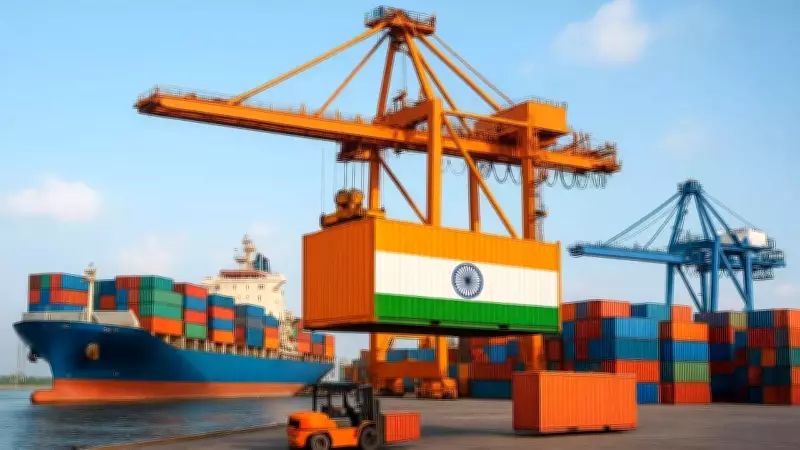
India's March Exports Decline 7.44% Amid Middle East Conflict Disruptions
India's merchandise exports experienced a significant year-on-year decline of 7.44% in March, dropping to $38.92 billion. This contraction has been directly attributed to severe disruptions in key international trade routes, primarily stemming from the ongoing conflict in the Middle East. The geopolitical tensions have created substantial headwinds for outbound shipments, affecting the flow of goods through critical maritime channels.
Imports Also Contract as Trade Deficit Widens
Parallel to the export downturn, India's imports also contracted by 6.51% during the same period, falling to $59.59 billion from $63.75 billion in March of the previous year. This dual decline reflects the broader impact of regional instability, particularly affecting strategic routes such as the Strait of Hormuz. According to government data cited by PTI, these disruptions have created a challenging environment for international trade logistics.
The combination of reduced exports and imports resulted in a trade deficit of $20.67 billion for the month of March. This figure represents the gap between what India sells abroad and what it purchases from international markets, highlighting the immediate economic consequences of geopolitical conflicts on trade balances.

Commerce Secretary Highlights Resilience Amid Challenges
Commerce Secretary Rajesh Agrawal, while briefing reporters, emphasized that India's export sector has demonstrated remarkable resilience despite facing multiple global challenges. He provided context by revealing that India's total exports of goods and services actually increased by 4.22% to reach $860 billion for the entire fiscal year 2025-26.
Breaking down the annual figures, merchandise exports during the April-March period of 2025-26 showed a modest increase of 1%, reaching $441.78 billion compared to $437.7 billion in the previous fiscal year. Meanwhile, imports for the same period rose more substantially to $774.98 billion from $721.2 billion, indicating continued domestic demand for foreign goods and materials.
Agrawal also highlighted the strength of India's services sector, with services exports estimated at $418.31 billion for the fiscal year. This robust performance in services helped offset some of the challenges faced by merchandise trade during periods of geopolitical instability.
Middle East Conflict Creates Severe Regional Trade Impact
The Commerce Secretary specifically identified the ongoing conflict involving the United States, Israel, and Iran, which began on February 28, as a primary factor significantly impacting regional trade flows. This conflict has created uncertainty and logistical challenges that have reverberated through global supply chains.
The data reveals particularly stark declines in trade with the Middle East region. India's exports to Middle Eastern countries plummeted by 57.95% in March alone, while imports from the region fell by 51.64% during the same period. These dramatic reductions underscore how regional conflicts can create immediate and severe disruptions to established trade relationships and patterns.
Future Trade Prospects and Agreements
Despite the current challenges, Agrawal indicated positive developments on the horizon for India's trade relationships. He suggested that the proposed free trade agreement between India and the United Kingdom could potentially come into force as early as next month. Such agreements represent strategic efforts to diversify trade partnerships and create more resilient economic connections beyond regions experiencing geopolitical instability.
The current trade data highlights the complex interplay between geopolitical events and economic performance. While India's annual export figures show overall growth, the monthly declines in March demonstrate how sudden regional conflicts can create immediate disruptions to trade flows. The resilience shown by India's export sector, particularly in services, provides a foundation for recovery once geopolitical tensions ease and trade routes stabilize.






