

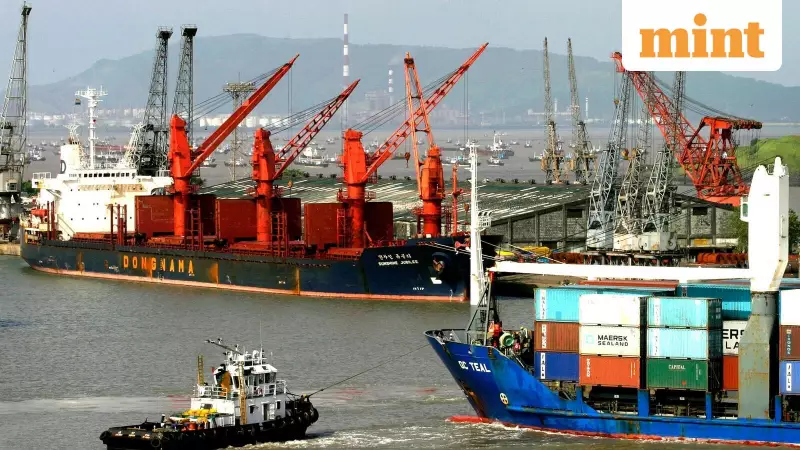
In a significant move to revitalize its maritime sector, the Indian government is preparing to launch a series of high-profile international roadshows. The ambitious plan, spearheaded by the Ministry of Ports, Shipping and Waterways, aims to attract crucial foreign investment and technology for shipbuilding, ship repair, and advanced maritime technology.
Charting a New Course for Indian Shipbuilding
The roadshows are scheduled for the last quarter of the current fiscal year and the early part of the next, targeting mature maritime markets in Japan, South Korea, and Scandinavian nations like Norway and Denmark. This initiative is a direct follow-up to the Centre's recent approval of a massive ₹70,000-crore financial package designed to build infrastructure and incentivize investment.
This marks a strategic shift in the government's approach. Instead of broad promotional visits, the focus is now on a mission-mode drive to secure concrete investment proposals and long-term partnerships. The goal is to persuade leading Korean and Japanese ship-leasing and shipbuilding companies to establish operations in India, either independently or through alliances with Indian public and private sector firms.

The Ambitious Vision and Financial Backing
This renewed push is anchored in the government's Amrit Kaal Vision 2047. The roadmap sets a clear target: to position India among the world's top 10 shipbuilding nations by 2030 and break into the top five by 2047. This vision acknowledges the need for India to reclaim its lost stature; during the early 2000s, the country was ranked among the top 10, but its global share has since dwindled to less than 1%.
The ₹70,000-crore package is the financial engine for this transformation. It is structured into several key components:
- A ₹25,000-crore Maritime Development Fund.
- A ₹25,000-crore New Shipbuilding Financial Assistance Scheme (SBFA).
- ₹20,000 crore for a Ship Cluster Development Programme.
Building a Self-Reliant Maritime Ecosystem
Industry experts have lauded the government's focused strategy. They emphasize that attracting established players from Japan and South Korea, who dominate the global shipbuilding market alongside China, is imperative. These companies can provide valuable technical upgrades and establish joint ventures with Indian shipyards, catering to both export and domestic markets.
The initiative extends beyond just building new ships. The government is also finalizing a comprehensive ship-building mission to create a complete ecosystem. This includes policy reforms, incentive schemes, and initiatives for ship recycling, such as expanding the Alang shipyard and developing new locations in Andhra Pradesh, Odisha, and West Bengal.
As one official stated, the focus of the upcoming roadshows will be to secure not just funding but also critical technology transfer, particularly in building green, fuel-efficient ships where Scandinavian nations excel. With these concerted efforts, India is decisively steering its maritime sector towards a more prominent and self-reliant future on the global stage.






