

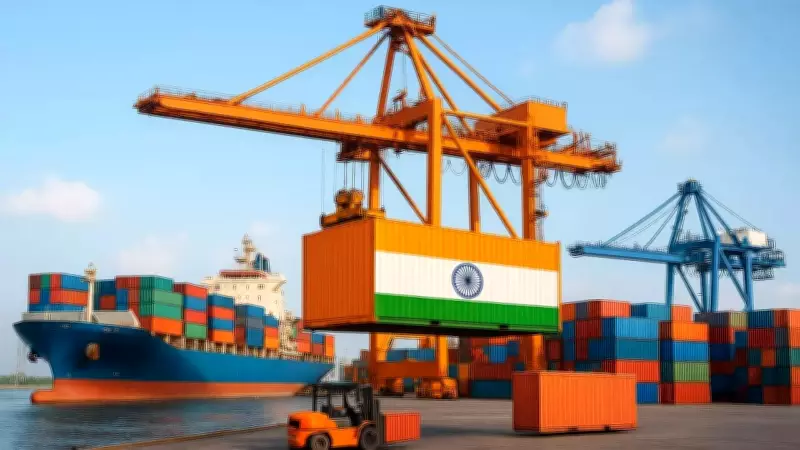
India's Trade Deficit Widens to $34.68 Billion in January Amid Import Surge
India's merchandise exports experienced a marginal increase in January, rising by 0.61% to reach $36.56 billion. In contrast, imports saw a sharp uptick, growing by 19.2% to $71.24 billion compared to $59.77 billion in the same period last year. This significant disparity led to a widening of the country's trade deficit, which expanded to $34.68 billion for the month.
Overall Export Performance and Projections
Exports have maintained an upward trajectory across both goods and services segments. Commerce Secretary Rajesh Agrawal highlighted that total exports of goods and services are projected to exceed $860 billion during the current financial year. For the April to January period, exports increased by 2.22%, totaling $366.63 billion.
Impact of US Tariffs on Exports
India's exports to the United States declined by 21.77% in January, amounting to $6.6 billion. This drop is largely attributed to the 50% tariffs imposed by the Donald Trump administration, which took effect from August 27. Following negotiations, the two countries concluded an interim trade arrangement. Under this deal, the US removed 25% penal tariffs on Indian products from February 7, with reciprocal tariffs set to be reduced from 25% to 18%. Despite this, India's exports remain competitively positioned among regional peers.

Exports had previously contracted in September, October, and December of last year, although a notable growth of 22.61% was recorded in November. Meanwhile, imports from the United States increased by 23.71% to $4.5 billion in January. Over the April to January period, India's exports to the US rose by 5.85% to $72.46 billion, while imports grew by 13.87% to $43.92 billion.
Trade Dynamics with China and Other Nations
Exports to China surged by 55.65% in January, reaching $1.63 billion, while imports from China rose by 16.67% to $12.23 billion. For the April-January fiscal period, exports to China increased by 38.37% to $15.88 billion, whereas imports expanded by 13.82% to $108.18 billion.
India's exports to several countries, including the UAE, Netherlands, Germany, Saudi Arabia, Italy, Hong Kong, Spain, Belgium, Malaysia, and Vietnam, recorded positive growth during January. Conversely, shipments to the UK, Bangladesh, Singapore, Australia, France, and Brazil declined.
On the import side, inflows decreased from countries such as Russia, Iraq, Korea, Germany, Thailand, and Australia. Imports increased from the UAE, Saudi Arabia, Switzerland, Singapore, Japan, and Indonesia. Notably, imports from Switzerland, primarily gold, jumped sharply by 836.85% in January to $3.95 billion.
Analysis of Export Diversification
According to the Global Trade Research Initiative (GTRI), the January 2026 trade figures reflect the significant impact of US tariffs on India's export performance, while also indicating early signs of market diversification. GTRI noted that shipments to the United States followed a three-phase pattern between April 2025 and January 2026. After a brief uptick in May, exports fell steadily from $8.3 billion in June to $5.5 billion in September as tariff pressures intensified. A short-lived recovery saw exports rise to $6.3 billion in October and $7.0 billion in November, but this rebound faded when hopes for a quick trade deal did not materialize. Exports slipped again to $6.9 billion in December and $6.6 billion in January.
With Washington expected to cut reciprocal tariffs on most Indian goods from 50% to 18% this week, GTRI anticipates a swift recovery in shipments. The broader data suggest that the slowdown is largely concentrated in exports to the US rather than reflecting a global decline. Exports to the rest of the world remained resilient, edging up from $29.9 billion to $30.0 billion, a growth of 0.3%. GTRI added that tariff barriers in the US market have driven India's recent export slowdown, even as exporters begin cautiously expanding beyond their largest single market.






