India's Strategic Trade Posture Explains the Critical Timing of the EU FTA
In today's geopolitical landscape, trade has transformed from a neutral instrument of economic prosperity into a powerful language of strategic influence and national security. The recent conclusion of negotiations for the long-delayed India-European Union Free Trade Agreement (FTA) represents more than just a conventional trade deal—it signifies a crucial architectural framework for India's economic future in an increasingly volatile global environment.
The Asymmetry That Demands Rules-Based Access
The headline trade numbers between India and the European Union certainly command attention. In 2024, bilateral trade in goods reached approximately €120.1 billion, while services trade accounted for about €66 billion, creating a substantial economic relationship. However, these impressive figures must be viewed with measured perspective—India represents only about 2.4 percent of the EU's overall goods trade, a modest slice compared to Europe's engagements with economic giants like the United States and China.
This fundamental asymmetry explains precisely why India requires robust, rules-based agreements that convert European interest into predictable, sustainable market access. While India matters to Europe, it does not hold the same indispensable position as America or China in European trade calculations. This reality makes formalized trade frameworks particularly vital for Indian businesses, especially those beyond the country's largest conglomerates who need structured pathways to European markets.

Strategic Context: From Prosperity Tool to Power Instrument
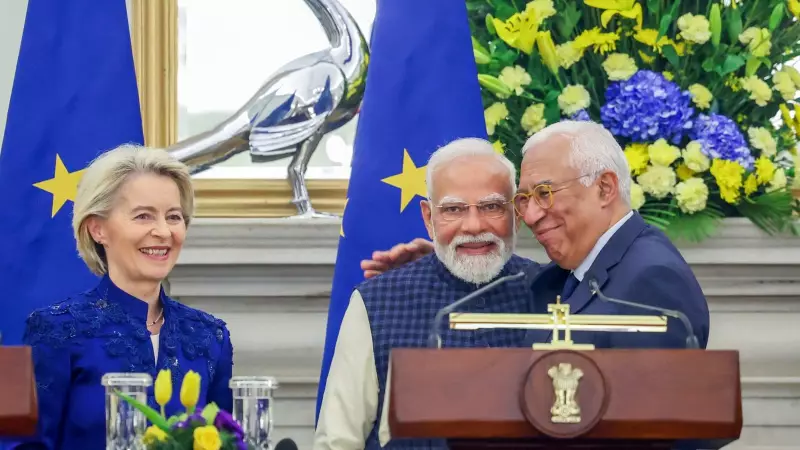
The backdrop to the EU-India Summit around Republic Day 2026, featuring visits by European Commission President Ursula von der Leyen and European Council President António Costa, reflects this transformed reality. Trade is no longer merely about economic exchange; it has become a strategic instrument where market access can be tightened at short notice and tariffs serve as signals of political intent.
For Europe, the pursuit of strategic autonomy has evolved from panel discussion slogan to urgent policy requirement. Brussels has developed sharper instruments to respond when other nations use trade and investment as leverage, including the EU's Anti-Coercion Instrument that came into force in late 2023. The objective is clear deterrence—making coercion costly, rule-bound, and politically manageable.
India has learned similar lessons through recent experience. The United States has employed punitive trade tools in recent years, including tariffs reaching 50 percent on Indian exports after late August 2025, linked to geopolitical pressure regarding Russian oil purchases. In such an environment, every major trade negotiation becomes a question of strategic optionality—how to secure market access without becoming hostage to subsequent demands.
Beyond Tariff Headlines: The Real Battleground
If the India-EU FTA is to deliver meaningful benefits, its success will not be determined solely by tariff reductions. While these remain politically significant—reports indicate India will reduce duties on select high-end European cars priced above €15,000 from 70-110 percent to 40 percent as an initial step—the decisive battleground lies elsewhere.
The real contest occurs behind the border in areas including:
- Product standards and conformity assessments
- Testing and certification capacity at scale
- Public procurement rules and digital governance
- Investment safeguards and professional mobility pathways
- Data governance frameworks and implementation mechanisms
This represents the "next generation" of trade agreements—rules that determine whether market access exists merely in legal text or translates into actual purchase orders and business relationships. A tariff reduction represents a promise, but a certification functions as a passport to market entry. India's ability to issue that passport efficiently and affordably will ultimately decide which businesses actually benefit from the agreement.

India's Calibrated Trade Strategy Evolution
India's broader trade posture explains why the EU agreement assumes particular importance at this juncture. When India stepped away from the Regional Comprehensive Economic Partnership (RCEP) in 2019, it did not exit the Indo-Pacific economy; rather, it rejected the premise that a single mega-bloc bargain could be absorbed domestically without significant political and economic costs.
New Delhi has since favored a more calibrated approach—developing smaller, sequenced agreements that can be safeguarded, upgraded, and aligned with domestic industrial policy. This strategic rationale finds support in recent trade data. India's politically salient trade deficit with ASEAN has strengthened arguments for tougher rules of origin and more enforceable review mechanisms within the India-ASEAN FTA.
Conversely, the EFTA agreement ties trade benefits to a reported $100 billion investment commitment over 15 years, linked to employment targets—creating a template for connecting international trade agreements to tangible domestic outcomes.
Critical Implementation Challenges Ahead
Two pivotal issues will determine whether the India-EU FTA becomes a foundation for confidence or a source of controversy:
Climate-Linked Trade Mechanisms: The EU's Carbon Border Adjustment Mechanism (CBAM) shifts climate policy directly into the domain of market access, with its definitive phase beginning in 2026. Indian exporters in emissions-intensive sectors like steel and aluminum worry that climate-conditioned access may function as a non-tariff barrier, while European counterparts argue they are merely leveling costs with domestic producers. The workable response requires not rhetoric but readiness—credible measurement, reporting, and verification systems, plus negotiated transition arrangements that preserve competitiveness while meeting environmental constraints.
Domestic Implementation Capacity: Multiple trade agreements create multiple rulebooks. Differing standards and rules of origin can raise compliance costs and inadvertently exclude smaller exporters. If India wants trade preferences to translate into actual orders and employment opportunities, international trade diplomacy must be matched by enhanced domestic trade facilitation. This requires:
- Strengthened testing infrastructure and certification capabilities
- Simplified customs processes with predictable refund mechanisms
- Enhanced logistics networks and supply chain efficiency
- Exporter-facing compliance support accessible to MSMEs without requiring extensive legal teams
The Ultimate Test: From Summit Stage to Factory Floor
Trade negotiations can be concluded and diplomatic summits can be staged with appropriate ceremony. However, the real test occurs at the file counter and factory floor—whether an apparel manufacturer in Tiruppur, an engineering exporter in Pune, or a services firm in Bengaluru can utilize the agreement's promised pathways predictably and at meaningful scale.
In an increasingly coercive global trading order, India's strategic advantage will derive not merely from signing substantial agreements, but from building the domestic capability—standards infrastructure, logistics networks, and industrial upgrading—that makes each agreement deliver tangible results. The India-EU FTA represents a critical step in this direction, but its ultimate success depends on implementation that reaches beyond conference rooms to actual commercial relationships.