

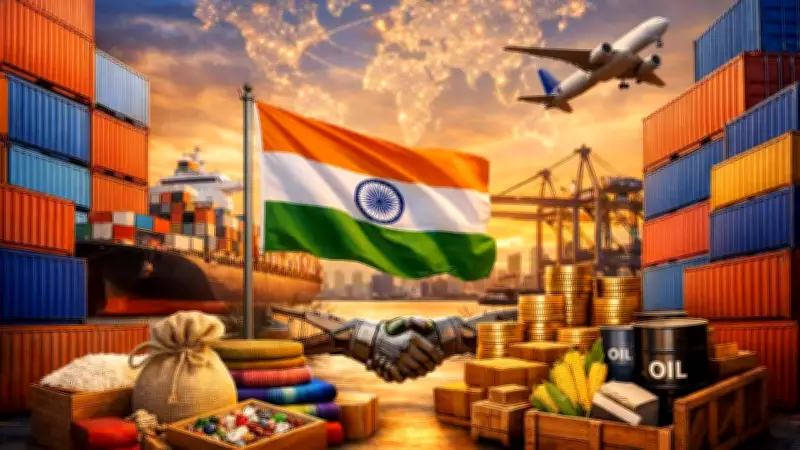
India's Calculated Response to US Tariff Onslaught
When former US President Donald Trump declared "Liberation Day" from the White House lawn, announcing sweeping reciprocal tariffs that sent shockwaves through global capitals, India found itself squarely in the crosshairs. The 47th President of the United States imposed a 25% reciprocal tariff on Indian goods, later escalating to a punitive 50% rate, partly in retaliation for New Delhi's continued purchases of discounted Russian oil. Markets trembled, trade ministries worldwide scrambled, and allies rushed to assess the damage as tariffs returned as a blunt geopolitical weapon.
A Restrained Diplomatic Posture
Remarkably, India's response was characterized by notable restraint. There was no immediate retaliation, no public escalation, and no desperate scramble for exemptions. This calm was deliberate and strategic. For several years preceding this crisis, India had been quietly preparing for precisely this kind of global uncertainty—a world of fractured supply chains, weakened multilateral institutions, and increasingly transactional great-power politics. Trade agreements, once viewed primarily through commercial lenses, had been systematically repurposed as tools of strategic insulation.
By the time Trump's tariffs landed, India was already deep into negotiating and concluding a complex web of bilateral deals across Europe, the Gulf, and the Pacific. These pacts were meticulously designed to:

- Diversify export markets comprehensively
- Lock in preferential access to key economies
- Attract substantial long-term investment
- Reduce vulnerability to any single economic partner
The India-US Tactical Compromise
On February 2, President Trump abruptly announced a deal with India to ease the tariff conflict. The understanding reduced US tariffs on Indian exports from an effective 50% down to 18%, broadly aligning India with its Asian peers on tariff rates of 15–19%. In return, India agreed to lower its own barriers on American goods and halt purchases of discounted Russian oil.
US officials revealed that Prime Minister Modi pledged to "BUY AMERICAN at a much higher level", including potential purchases worth up to $500 billion in US energy, agriculture, and technology products. Trump further claimed India would reduce tariffs and non-tariff barriers on US goods "to ZERO", though precise timelines and scope remain undefined.
Analyst Perspectives on the Mini-Deal
JNU professor Rajan Kumar characterizes the 18% tariff as "the second best deal" India could secure under Trump's administration, noting that expecting preferential treatment was "wishful thinking" given Trump's uniform tariff approach toward all partners. Kumar emphasizes that even a modest agreement unlocks deeper cooperation in critical areas:
- Critical minerals and semiconductor collaboration
- Data governance and technology partnerships
- Joint political engagement on China-related issues
The Wall Street Journal reported that Trump's higher tariffs aimed to punish India for "refusing to stop buying Russian oil", which his administration linked to financing the Ukraine conflict. After negotiations, the US agreed to lift a 25% penalty tariff imposed via a "Russia tariff" alongside the 25% reciprocal rate, resulting in the 18% compromise.
The European Union: India's "Mother of All Deals"
Even before resolving tensions with Washington, New Delhi struck a landmark agreement with Brussels. In late January, India and the European Union announced conclusion of a comprehensive Free Trade Agreement that would unite the world's fourth- and second-largest economies under a modern, rules-based trade framework.
Under the draft deal, Indian exporters gain duty-free access on more than 99% of India's export value to the EU, covering:

- Labor-intensive sectors: textiles, leather, gems and jewelry
- Engineering goods and pharmaceuticals
- Electronics and medical devices
- Chemicals, plastics, and handicrafts
- Agricultural products including tea, spices, and marine items
Commerce Minister Piyush Goyal called the agreement "game-changing and transformational", while the Indian government's official fact sheet termed it the "mother of all deals", opening unparalleled opportunities in a combined market of two billion people.
Commonwealth and Pacific Partnerships
India has simultaneously pursued strategic agreements with Commonwealth and Pacific partners:
India-United Kingdom FTA: Signed in July 2025 during PM Modi's London visit, this pact aims to treble trade by 2030, with 99% of Indian exports to the UK entering tariff-free. Key features include:
- Substantial gains for labor-intensive sectors
- New agricultural access for Indian food items
- Liberalized services and professional mobility
- Updated Social Security agreements
New Zealand FTA: Concluded in December 2025, this agreement grants 100% duty-free access on all Indian products to New Zealand, complemented by sweeping movement of people provisions and a $20 billion investment pledge over 15 years.
Gulf Cooperation: Strategic Economic Partnerships
India has prioritized the Gulf region through Comprehensive Economic Partnership Agreements:
India-UAE CEPA: India's first agreement with an Arab country eliminated tariffs on approximately 97% of tariff lines, potentially doubling bilateral trade from $60 billion to $100–115 billion within five years.
India-Oman CEPA: Provides Indian exporters duty-free access to over 98% of Oman's tariff lines, particularly benefiting labor-intensive sectors while expanding professional mobility and investment opportunities.
Gulzar Didwania, Partner at Deloitte India, described the India-UAE CEPA as "the most comprehensive illustration of India's evolving FTA framework", promoting employment generation, technology collaboration, and supply-chain resilience simultaneously.
Implementation Challenges and Strategic Outlook
As Agneshwar Sen, Trade Policy Leader at EY India, notes, "the real test begins" after negotiations conclude. Key challenges include:
- Complex rules of origin requirements and compliance costs
- Rising standards and sustainability pressures in EU-style agreements
- Institutional coordination across multiple government ministries
- MSME capacity to leverage FTA benefits effectively
Professor Rajan Kumar argues that bilateral FTAs have become "a real option" for India, with success depending less on headline signings and more on execution, competitiveness, and domestic reform.
Strategic Repositioning in Global Trade
By pursuing nine major trade pacts spanning six regions within a few years, New Delhi is attempting a fundamental repositioning—from a tariff-heavy economy to a central node in global supply chains. As strategic affairs expert Harsh V Pant observes, these agreements "signal to the world" that India and its partners are pursuing agendas independent of both US and Chinese dominance.
In practical terms, the deals achieve multiple strategic objectives:
- Diversifying India's export destinations significantly
- Reducing reliance on any single market substantially
- Locking in long-term access for key manufacturing and services sectors
- Anchoring India more firmly in global value chains
The trade agreements reflect a deliberate reimagining of economic statecraft where tariffs, once central to New Delhi's trade posture, are being supplanted by agreements designed to manage risk, expand strategic options, and signal reliability to partners across regions. In an era where trade policy is increasingly subordinated to geopolitics, India has chosen flexibility over confrontation, insulating itself from global shocks while building substantial economic leverage.





