For the third consecutive day, passengers across India grappled with severe disruptions as the IndiGo flight schedule crisis continued, bringing travel plans to a standstill. While the number of cancellations at Delhi's Indira Gandhi International Airport (IGIA) saw a slight dip compared to the previous day, the scene at terminals remained one of distress, confusion, and financial strain, with airfares skyrocketing despite a government directive.
Passenger Plight: Long Queues and Shattered Plans
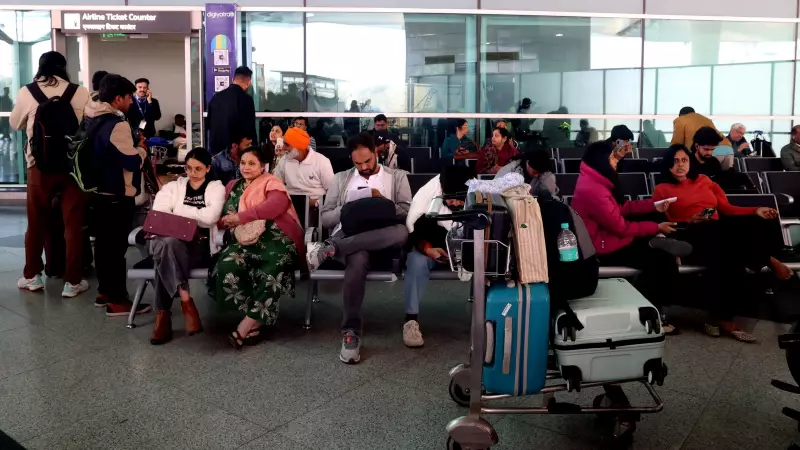
The human cost of the operational meltdown was starkly visible at Terminal 1 of IGIA on Saturday, December 7, 2025. Among the hundreds stranded was Shubham Panda (26), who had travelled from Vrindavan with his family, including his 60-year-old mother with a spinal injury, to catch a flight back to Bhubaneswar. "They cancelled my flight… but on the website, it still shows that the flight is delayed," Panda said, scrambling for alternatives after hours in a queue.
The anxiety was palpable as passengers stared at flight information screens, dreading the word "cancelled" next to their flight number. In a poignant scene, a newly-wed woman in her red wedding saree was seen sleeping on a luggage trolley near Gate 5. She was supposed to fly to Odisha with her in-laws hours after her wedding. Bhagwan Sharma (58), a relative, expressed frustration: "We were at the wedding… How will we know that flights were being cancelled? If we had known earlier, we would have figured out another way."

Fare Caps Ignored: Passengers Face 'Absurd' Pricing
In response to the crisis, the Ministry of Civil Aviation (MoCA) issued an official directive on Saturday mandating all airlines to strictly adhere to fare caps. The ministry stated the objective was to maintain pricing discipline, prevent exploitation, and ensure vulnerable travellers like senior citizens and patients are not financially burdened.
However, on the ground, this directive seemed to have little effect. Shubham Panda revealed that while his family's four tickets booked in October cost around Rs. 27,000, the price for return tickets had ballooned to an absurd Rs. 2 lakh. "This is absurd. I'm not travelling to another country. We, Indians, are facing a crisis," he lamented.
Other passengers echoed this sentiment. A businessman needing to reach Bengaluru found all flights booked till December 9 and eventually secured a ticket for Rs. 65,000. "Nobody is following the guidelines, they all are extorting money," he alleged, criticizing IndiGo's unresponsive customer care. Another passenger noted that Air India was showing fares of Rs. 70,000 for Bengaluru, accusing all airlines of taking advantage.
Systemic Failures and Lost Trust
The chaos was compounded by apparent systemic failures. Passengers reported a poor number of staff at reservation counters to manage the swelling crowds of affected travellers. Aryan Dev, a second-year college student from Nepal with exams in Dehradun, stood in a long queue after his flight was rescheduled. "This is the first and the last time I'm travelling with IndiGo," he declared, a sentiment likely shared by many.
Despite around 106 IndiGo flights being cancelled at IGIA on Saturday—a reduction from Friday's numbers—the crisis is far from over. The continued sale of tickets for cancelled flights and the blatant disregard for fare regulations point to a deeper breakdown in oversight and passenger communication. As the ministry's directive remains in force until the situation stabilizes, the coming days will be a critical test for India's aviation sector to restore order and passenger confidence.