

The year 2025 has witnessed a seismic shift in Japan's economic engagement with India, marked by a record-breaking surge in high-value investments. This wave of capital, flowing primarily into India's banking, finance, and steel sectors, signals a profound strategic realignment as Tokyo actively seeks to diversify its economic dependencies and build a meaningful counterweight to China's regional dominance.
A Surge of Capital: The Major Deals of 2025
Japanese corporate giants have opened their wallets for India in an unprecedented manner. The landmark transactions of the year include Sumitomo Mitsui Banking Corp.'s agreement to acquire a 20% stake in Yes Bank for $1.58 billion. In the steel sector, JFE Steel Corp. purchased a 50% stake in Bhushan Power & Steel. The financial services space saw Mizuho Securities pick up a majority stake in Avendus, while MUFG acquired 20% of Shriram Finance Ltd for a massive $4.4 billion.
A simple calculation reveals that just the deals finalized in December 2025 alone amount to roughly $7.2 billion. This staggering figure suggests that when the official data for Japanese Foreign Direct Investment (FDI) in India for fiscal 2026 is compiled, it will dwarf the $2.48 billion recorded in 2024-25. This milestone underscores a dual narrative: Japanese businesses are pivoting to India for robust returns, and Tokyo is finally translating decades of diplomatic dialogue into concrete, strategic economic action.

Why Japan is Turning to India Now
The driving forces behind Japan's newfound zeal for India are both economic and geopolitical. Domestically, Japan grapples with a shrinking and ageing population, low interest rates, and limited growth prospects, pushing its banks and corporations to seek opportunities abroad. India, with its projected GDP growth of 6.6% in 2025 (as per the IMF's October Outlook), a young median age of 28, and a stable government, presents a compelling alternative.
Geopolitically, the landscape has become increasingly uncertain. China's assertive posture under President Xi Jinping has unsettled Japan, despite deep economic ties. Simultaneously, the return of US President Donald Trump and his transactional approach to alliances has injected volatility into traditional security frameworks. This perfect storm of factors makes a deeper partnership with India not just attractive but strategically imperative for Japan.
The contrast with the past is stark. During India's balance-of-payments crisis in the early 1990s, Finance Minister Yashwant Sinha was reportedly kept waiting for an appointment by his Japanese counterpart. Today, the engagement is on a completely different footing, with India's economy now nearly the same size as Japan's—$4.13 trillion versus Japan's $4.28 trillion.
Promise Meets Challenge: The Road Ahead
Despite the optimistic inflow of capital, significant hurdles remain that will test the sustainability of this momentum. Japan may see potential in India, but it faces intense competition from Southeast Asian nations like Vietnam, Thailand, and Indonesia. In 2024, Vietnam hosted about 2,000 Japanese companies, compared to fewer than 1,500 in India, thanks to faster approvals and more predictable environments.
Within India, persistent issues around land acquisition, regulatory clearances, and infrastructure bottlenecks continue to concern investors. The Japan Chamber of Commerce and Industry in India (JCCII) had suggested some 70 measures last year to improve ease of doing business, highlighting areas like tax reforms and customs procedures. While India has overhauled its labour laws, more work is needed to attract Japanese small and medium enterprises in a big way.

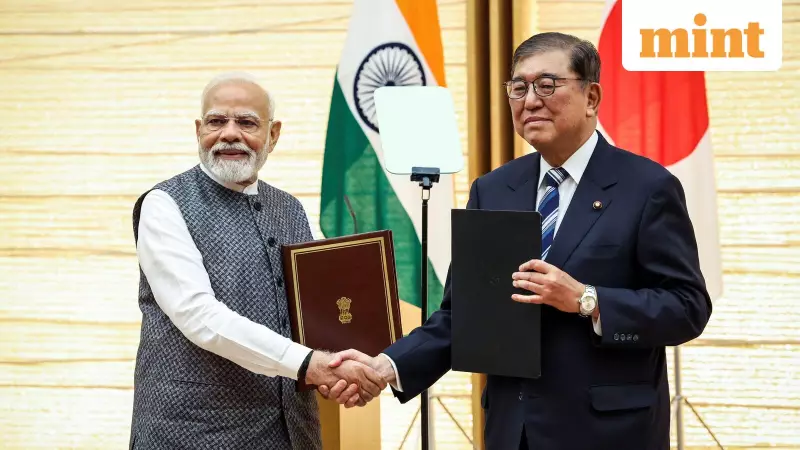
The strategic intent is clear. The Japan-India Economic Security Initiative, launched during Prime Minister Narendra Modi's visit to Japan in August 2025, aims to fortify supply chains in critical goods and collaborate on emerging technologies. Japan has also doubled its investment pledge to ¥10 trillion in private capital over the next decade. The framework for a transformative partnership is in place. However, its ultimate success will depend less on intent and more on India's ability to execute reforms and streamline its investment landscape.





