

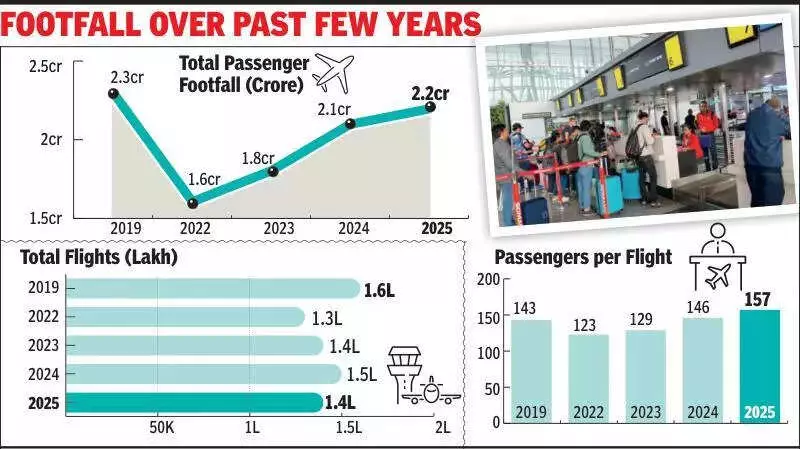
Netaji Subhas Chandra Bose International Airport in Kolkata registered its most robust performance since the pandemic in 2025, yet narrowly missed surpassing its pre-Covid passenger record. The shortfall is attributed to a series of major disruptions that coincided with peak travel seasons throughout the year.
By the Numbers: A Strong Recovery with a Caveat
The airport managed a footfall of approximately 2.2 crore (22 million) passengers in 2025. This figure represents a 1.1% growth over the 2024 traffic and stands as the airport's strongest annual performance since Covid-19 devastated air travel. However, it remains slightly below the pre-pandemic peak of 2.3 crore passengers handled in 2019, which continues to be the airport's all-time high.
Officials pointed to three critical incidents that derailed momentum during high-demand periods: the Pahalgam terror attack in April, the Ahmedabad plane crash in June, and a two-week-long operational crisis at IndiGo in December. These events triggered widespread delays, cancellations, and operational bottlenecks, ultimately hampering the overall passenger throughput.

"We witnessed a steady passenger flow for most of the year and had an exceptionally strong first quarter," explained a senior airport official. "However, the pace began to decelerate due to external factors. While traveller numbers remained consistent and flights operated with high occupancy, the sequential disruptions—particularly the IndiGo situation during the crucial holiday season—significantly slowed our progress toward the pre-Covid milestone."
Record-High Efficiency Amid Fewer Flights
Despite falling short on the headline passenger count, the airport achieved a remarkable feat in operational efficiency. The average passenger count per flight soared to 157, setting a new record for Kolkata airport. This number surpasses the 2019 average of 143 passengers per flight and also exceeds the post-Covid figures of 129 (2023) and 146 (2024), indicating that airlines operated with consistently high load factors throughout 2025.
This efficiency gain occurred even as the total number of flights decreased. Detailed data shows the airport handled 2,14,46,781 passengers across 1,36,616 flights between January and December 2025. In comparison, 2024 saw 2,12,17,064 passengers on 1,45,650 flights. This translates to 9,034 fewer flights year-on-year, a decline of 6.2%, despite the marginal increase in passenger numbers.
The reduction was seen in both domestic and international segments. Domestic flights fell from 1,26,772 in 2024 to 1,21,154 in 2025. International flights also dropped from 18,888 to 15,462 over the same period.
The Path Forward: International Connectivity Holds Key
The year began on a promising note. During the January to June period, the airport's footfall reached 1,10,27,180 passengers, coming within just 8,647 passengers of the first-half 2019 figure of 1,10,35,827. However, flight movements have yet to return to their pre-pandemic scale.
Industry experts acknowledge the challenges but see potential in expanding international routes. Anil Punjabi, Chairman of the Travel Agents Federation of India (East), commented, "The aviation sector absorbed a triple blow last year. Even under those circumstances, Kolkata airport's overall performance was commendable. The real growth opportunity now lies in enhancing international connectivity. While some older routes like Guangzhou and Hong Kong have resumed, there are active efforts to restore more connections, including destinations such as London and Colombo."
The 2025 data ultimately paints a picture of resilience and efficiency for Kolkata's aviation hub. While external shocks prevented a full return to the 2019 peak, the airport demonstrated an ability to move more passengers with fewer flights, setting a new benchmark for occupancy that could define its recovery strategy in the coming years.






