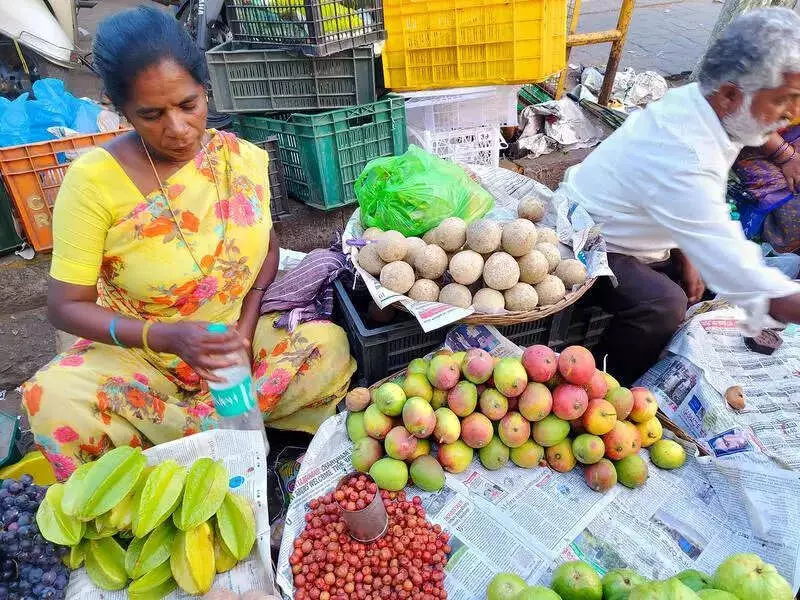
Residents of Mysuru are witnessing an unusual sight in their city markets this December: a plentiful supply of mangoes, a fruit traditionally associated with the peak of summer. The markets are currently flooded with off-season mangoes that have arrived from neighbouring Tamil Nadu, leaving locals both intrigued and hesitant.
A Market Full of Off-Season Fruit
This unexpected availability has created a sense of confusion among buyers. Many are unsure whether to purchase the fruit, with most being clueless about how mangoes can be available during the winter months. The primary varieties on offer are Neelam, priced at Rs 160 per kg, and Banganapalli at Rs 150 per kg, sourced from parts of Tamil Nadu.
Despite the novelty, sellers report a significant challenge: extremely low demand. Timmanna, a seller from the iconic Devaraja market, explained the situation. "These are naturally grown and ripe mangoes. However, there is not much demand. Everyone fears that they are artificially ripened mangoes," he said. He added that high prices are another key factor contributing to the poor sales, even though customers show initial curiosity.

The Science Behind the Winter Harvest
According to BN Gnanesh, senior scientist and head of genetics and plant breeding at ICAR JSS Krishi Vigyan Kendra in Suttur, while mangoes are a summer staple, demand exists even in December and January. To meet this demand, farmers in regions like Tamil Nadu and Andhra Pradesh cultivate specific varieties—including Neelam, Malgova, and Bangalora—as off-season crops. These orchards can yield an impressive three crops in two years.
The key to this off-season production is a scientific approach. Farmers use a permitted plant growth regulator called paclobutrazol. The chemical is applied through soil drenching near the root zone, where it is absorbed. Its function is to suppress vegetative growth and promote early flowering. When applied in June or July, flowering begins within two to four months, allowing for a fruit harvest between October and December.
Gnanesh clarified that the use of paclobutrazol is allowed, provided it is applied at the recommended doses. When used optimally, it does not contaminate the soil or leave harmful residues in the fruit. In some areas, particularly Kanyakumari and Chittoor, favourable climatic conditions can even trigger off-season flowering naturally, without any chemical application.
Targeting Premium Prices and Market Dynamics
The primary motivation for growers to undertake off-season cultivation is economic. By producing mangoes when they are scarce in the market, farmers aim to fetch premium prices. However, as the Mysuru market scenario shows, connecting this supply with consumer trust and willingness to pay remains a hurdle. The fear of artificial ripening, coupled with the higher price point, is currently dampening the potential of this unique winter harvest.
This phenomenon highlights the evolving nature of agriculture and supply chains, where technology and specific climatic advantages are being leveraged to break traditional seasonal barriers for fruits like the beloved mango.