

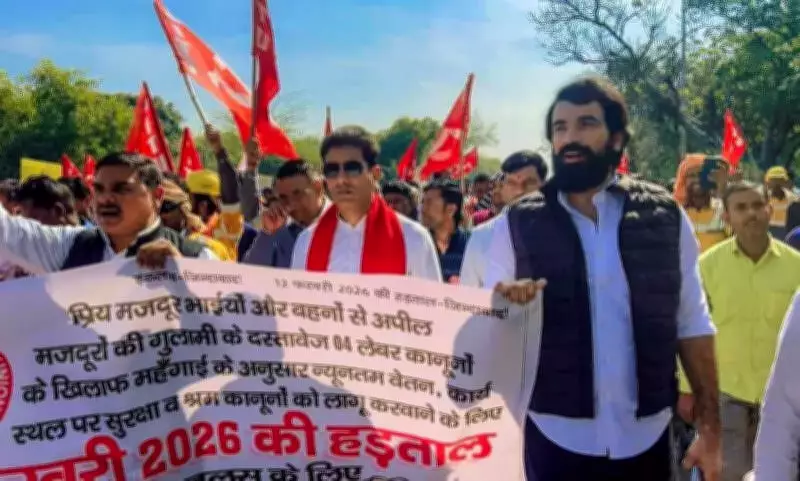
Noida Farmers Stage Protests Against India-US Trade Agreement
Farmers and labor organizations in Noida and Greater Noida held significant demonstrations on Thursday, voicing strong opposition to the recent trade deal between India and the United States. The protests occurred at the magistrate's office in Noida and the collectorate in Greater Noida, with participants submitting memorandums addressed to the President of India.
Concerns Over Agricultural Market Access
The protestors expressed deep concerns that opening India's agricultural market to US products at zero tariff would create a severe threat to the livelihood of Indian farmers. They argued that the agreement would primarily benefit large foreign agricultural corporations while imposing the heaviest burden on small and marginal farmers across the country.
These demonstrations formed part of a nationwide campaign announced by farmer unions under the Samyukt Kisan Morcha, specifically targeting the framework for an interim India-US trade deal signed the previous week. The unions have labeled the pact as a direct threat to agriculture, dairy, and rural livelihoods, organizing protests leading up to a general strike on Thursday.

Protest Activities and Leadership Statements
At the Greater Noida Collectorate, members of the Kisan Sabha, Bharatiya Kisan Union (BKU), and several labor unions conducted a procession before gathering outside the administrative block. Kisan Sabha district president Rupesh Verma addressed the crowd, stating, "This agreement is being presented as a trade reform, but for farmers it is a direct threat to livelihood. If zero-duty imports are allowed while our produce struggles for fair prices, small farmers will be pushed out of farming."
Verma questioned why farmers were not consulted before proceeding with the agreement, highlighting a perceived lack of democratic process in trade negotiations affecting agricultural sectors.
Simultaneously, another faction of the BKU staged a demonstration at the magistrate's office in Noida's Sector 19. Protestors raised slogans against the central government and symbolically burned copies of the trade agreement to register their opposition. BKU district president Ashok Bhati addressed farmers at this location, emphasizing, "The villages are the backbone of this country. Before signing any trade pact that affects agriculture, the government must ensure farmers' consent and security. This agreement threatens both."
Scale of Protest and Future Plans
Hundreds of farmers, including office-bearers from both organizations, participated at the two protest sites. The groups issued a clear warning that if the central government fails to cancel the agreement and address their concerns, they would intensify their agitation in the coming days.
The demonstrations coincided with Chief Minister Yogi Adityanath's visit to the city for a private event, though there was no direct interaction reported between the protestors and the Chief Minister's delegation.
Official Response and Agreement Revisions
District officials confirmed they received the memorandums and would forward them to appropriate authorities for consideration. Meanwhile, the United States has made revisions to its factsheet on the trade deal with India, removing a specific reference to "pulses" among the wide range of US food and agricultural products on which India will eliminate or reduce tariffs.
The US also modified wording regarding India's commitment, changing from stating India was "committed" to make a purchase of $500 billion from the country to saying India "intends" to make such purchases. These revisions suggest ongoing negotiations and potential adjustments to the trade framework that has sparked such significant farmer opposition in Noida and across India.






