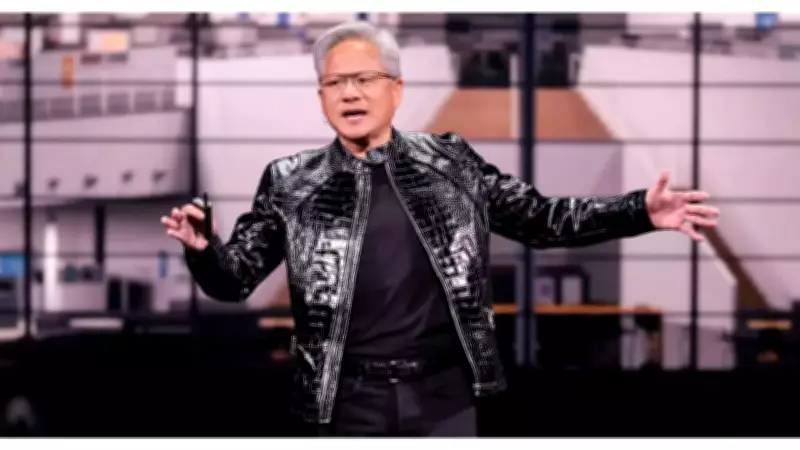
Nvidia CEO Jensen Huang has provided a significant update regarding the sales of the company's advanced H200 AI chips to China, clarifying the current regulatory landscape. While the United States government has already granted approval for these shipments, the ultimate decision now lies with Chinese authorities in Beijing.
Huang's "Win-Win" Vision for H200 Chips
Speaking to reporters at Taipei's Songshan Airport following his recent trip to mainland China, Huang described the H200 GPU as a potential "win-win" scenario for both the American and Chinese artificial intelligence markets. The high-performance chip has become a focal point in ongoing US-China trade tensions, representing both technological advancement and geopolitical considerations.
"The H200, the actual license for H200 is being finalized," Huang explained to the gathered media. "And I'm hoping that also the Chinese government would allow Nvidia to sell the H200, so they have to decide. And I'm looking forward to a favourable decision."

Awaiting Formal Approval from Chinese Authorities
The Nvidia CEO confirmed that his company is currently awaiting formal approval from the Chinese government that would allow domestic firms to import these sophisticated semiconductors. Huang emphasized the dual benefits of the technology transfer, stating that the H200 chips would support American technological leadership while simultaneously benefiting the Chinese market where customers have expressed strong interest.
"I think that H200 is very good for American technology leadership. It's also very good for the Chinese market. And the customers would very much like to have H200. And so I'm looking forward to a good decision. And so we just have to wait patiently," Huang added during his airport remarks.
Conditional Approvals for Chinese Tech Giants
Recent reports have indicated that several prominent Chinese technology companies, including industry leaders ByteDance, Alibaba, and Tencent, have received conditional approvals to purchase a combined total exceeding 400,000 H200 chips. However, these approvals reportedly come with restrictions that might prove too limiting for the companies to convert them into firm purchase orders.
When questioned about these reports, Huang stated that Nvidia has not received official confirmation of such approvals. He also acknowledged the competitive landscape in China's semiconductor industry, noting that "China has many strong chip companies and Nvidia needed to compete quite vigorously."
Supply Chain and Manufacturing Considerations
Addressing practical business considerations, Huang emphasized that "the first thing that we need is orders" while assuring that Nvidia has sufficient supply capacity to support existing customers. When specifically asked about managing packaging capacity with manufacturing partner TSMC (Taiwan Semiconductor Manufacturing Company), the CEO outlined a clear plan.
"If H200 is approved, we will work with TSMC to schedule and plan the supply and deliver as fast as we can," Huang stated, indicating that Nvidia has prepared contingency plans for rapid deployment should Chinese authorities grant the necessary approvals.
The situation highlights the complex interplay between global technology commerce, national security concerns, and competitive market dynamics. As artificial intelligence continues to advance rapidly, access to cutting-edge hardware like Nvidia's H200 chips remains a critical factor for technology development worldwide, particularly in markets with ambitious AI initiatives like China.