

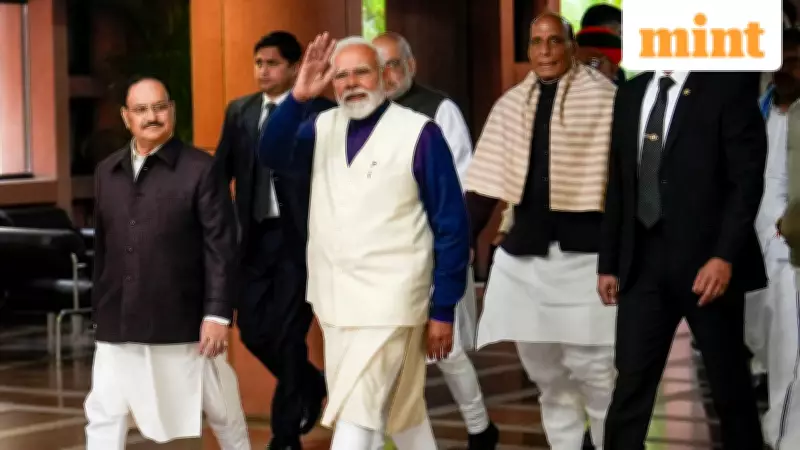
Prime Minister Modi Stresses Strategic Importance of India-US Trade Agreement
During the National Democratic Alliance's Parliamentary Party meeting, Prime Minister Narendra Modi highlighted the profound relevance of the recently concluded India-United States trade deal. The Prime Minister addressed NDA leaders, emphasizing that the coalition's electoral successes across various levels—from local body polls to national elections—stem directly from its people-centric policies and unwavering dedication to hard work.
Modi's Call for Continued Diligence and Strategic Patience
Parliamentary Affairs Minister Kiren Rijiju conveyed to reporters that Prime Minister Modi cautioned NDA Members of Parliament against complacency despite their recent electoral victories. He urged them to persist with their diligent efforts and maintain the momentum of good governance. The Prime Minister specifically pointed to the India-US trade agreement as a testament to the government's patient and calculated approach to international negotiations.
According to reports, PM Modi described the trade deal as "the result of sustained patience," noting that initial criticisms regarding tariff negotiations have now transformed into positive outcomes. He explained that the agreement has fostered a favorable economic environment and reflects the administration's consistent, measured strategy in global trade discussions. "People criticised the tariffs, but we remained patient, and the results are now visible," the Prime Minister stated during his address.

Recognition and International Context of the Trade Deal
At the meeting, NDA leaders honored Prime Minister Modi for successfully finalizing trade agreements with 39 countries, with particular recognition for the landmark India-US deal. This felicitation occurred a day after US President Donald Trump announced that the United States and India had agreed to a trade deal. President Trump revealed that Washington would reduce reciprocal tariffs from 25 percent to 18 percent, a move he attributed to "friendship and respect" for Prime Minister Modi.
In his first public remarks following President Trump's announcement, Prime Minister Modi expressed gratitude for the tariff reduction. He remarked, "Wonderful to speak with my dear friend President Trump today. Delighted that Made in India products will now have a reduced tariff of 18%. Big thanks to President Trump on behalf of the 1.4 billion people of India for this wonderful announcement." This statement underscores the mutual respect and collaborative spirit between the two nations.
Parliamentary Proceedings and Political Dynamics
The NDA Parliamentary Party meeting saw the presence of several key figures, including Union Ministers Ashwini Vaishnaw and Bhupender Yadav, BJP leaders CR Patil and Giriraj Singh, AIADMK Rajya Sabha MP M Thambi Durai, and BJP MP Ashok Chavan. However, the trade deal also sparked controversy in Parliament.
On Tuesday, the Lok Sabha was adjourned for an hour due to protests and sloganeering by opposition members over the India-US trade agreement. Opposition parties alleged that the Union government had neither issued an official statement nor consulted Parliament regarding the deal. Both Houses of Parliament resumed discussions on the motion of 'Thanks to the President's address' during the ongoing Budget Session, which began with President Droupadi Murmu's address to a joint sitting on January 28.
Additionally, the Lok Sabha witnessed a heated exchange between NDA and INDIA bloc MPs during Leader of the Opposition Rahul Gandhi's address. Gandhi referenced an unpublished memoir by former Army Chief General MM Naravane concerning border tensions with China, prompting strong objections from BJP members who claimed he violated House rules. This led to the adjournment of the Lok Sabha for the day, highlighting the intense political climate surrounding the session.
The India-US trade deal continues to be a focal point of national discourse, reflecting both diplomatic achievements and domestic political challenges as the government navigates complex international relations and parliamentary scrutiny.






