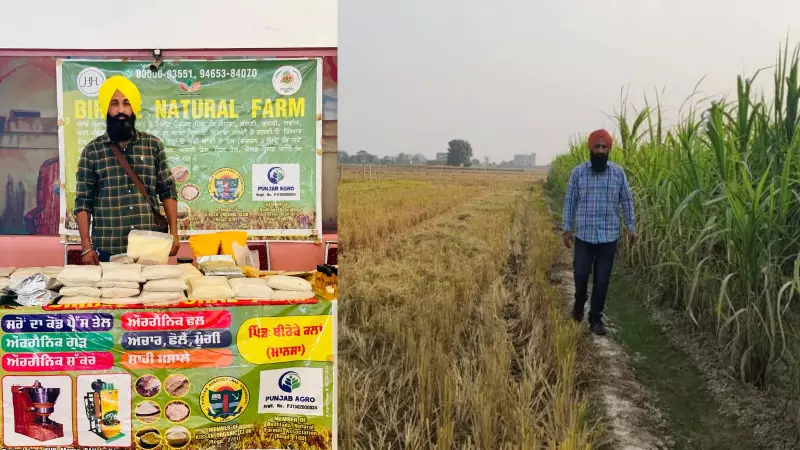
In the heart of Punjab's Mansa district, a progressive farmer has rewritten the narrative around agricultural stubble, transforming what was once considered waste into a remarkable success story. Sukhjit Singh, a 38-year-old graduate from Biroke Kalan village, has demonstrated how sustainable practices can yield impressive financial and environmental returns.
From Tragedy to Transformation
Sukhjit's journey toward sustainable farming began in 2012 following two life-altering realizations. The first was ecological - he observed farm-friendly insects being decimated by the widespread practice of stubble burning. The second was deeply personal - his brother's newborn son was diagnosed with a congenital disease that doctors at PGIMER, Chandigarh linked to nutrient-depleted soil caused by excessive agrochemical use.
This dual awakening prompted Sukhjit to make a solemn vow: eliminate chemicals completely and stop burning crop residue. Since 2013, he and his brother have worked tirelessly to transform their eight-acre family land into a model of sustainable agriculture that has become an inspiration for farmers across the region.

The Stubble Management Revolution
Sukhjit's approach centers on innovative stubble management through mulching and soil incorporation. By using a super seeder to incorporate stubble directly into the soil, he has achieved remarkable improvements in soil health that he verifies through bi-annual soil testing.
The financial benefits have been substantial. Conventional wheat farming costs approximately Rs 10,000 per acre, but Sukhjit has slashed this to just Rs 4,000 per acre. Similarly, while typical paddy cultivation costs range between Rs 15,000-20,000 per acre, his expenses remain between Rs 8,000-10,000 per acre, representing a dramatic 40-50% reduction in cultivation costs.
This cost efficiency, combined with the adoption of natural farming practices, has resulted in an impressive 20-30% increase in overall income. The brothers now generate a net income of approximately Rs 11.70 lakh annually from their eight-acre operation, with significant potential for future growth.
Crop Diversification and International Recognition
Stubble management served as the gateway to broader agricultural innovation for Sukhjit. "Stubble management led me to natural farming, then crop diversification," he explains of his evolving approach.
While maintaining wheat-paddy cultivation on four acres, the brothers have diversified the remaining land with millets, pulses, sugarcane, and notably turmeric, where stubble mulching has dramatically increased yields. They've preserved agricultural heritage by using the ancient Sonamoti seed variety for wheat while finding their most profitable crop in turmeric.
Beyond field cultivation, Sukhjit has ventured into value-added products through his home-based store. His brand "Natural Drops Aajeevika Self Help Group" now sells millet flour, biscuits, turmeric powder, organic spices, oils, and jaggery both locally and online.
The success has garnered official recognition, with his products scheduled to represent Punjab at the 44th India International Trade Fair in Delhi's Pragati Maidan from November 14-27, where they will showcase processed millets. His organic products have already found markets beyond Punjab, reaching customers across India and exporting to approximately six foreign countries including Canada, USA, and New Zealand.
A Model for Sustainable Agriculture
Navjot Kaur, Deputy Commissioner of Mansa, acknowledges Sukhjit as a guiding light for other farmers. "He has shown the way by managing stubble and adopting organic farming using new technologies like bed planting, super seeder, etc. He is not just a progressive and successful farmer but a thriving entrepreneur in organic farming," she stated, confirming that the district administration has formally honored his achievements.
Sukhjit Singh's story demonstrates that sustainable agriculture and economic prosperity aren't mutually exclusive. His model offers a viable alternative to stubble burning while proving that environmental stewardship can yield tangible financial rewards, making him a true role model for farmers throughout Mansa and beyond.