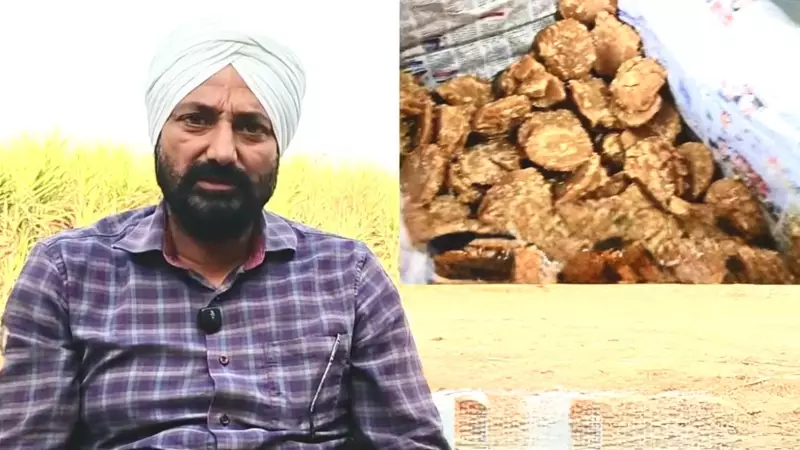
In a remarkable story of agricultural entrepreneurship, a farmer from Punjab's Jalandhar district has built such a loyal customer base for his organic products that his sugarcane-derived goods are completely sold out until March 2027. While many farmers across India grapple with market uncertainties and demand for Minimum Support Price (MSP), Amarjit Singh Bhangu (54) has created his own assured and thriving market.
From Global Dreams to Organic Fields
Amarjit's journey is one of conscious choice. After spending six years working in Abu Dhabi during the 1990s, he returned to his roots in Charke village. Despite having the opportunity to go abroad again, he decided to stay. "I saw enough of the world. My father needed me and farming needed attention. So I stayed," he recalls. This decision marked the beginning of a transformative chapter for his family's land.
The shift to organic farming was deeply personal, inspired by his father, Avtar Singh Bhangu, after a family tragedy. Following the death of Amarjit's cousin from blood cancer in 2004, Avtar established a vermicompost unit. The family began their organic transition on 2.5 acres of their 12-acre land in 2006. By 2012, they had fully converted all their land to organic practices and made a complete shift from traditional wheat and paddy to sugarcane cultivation.

Building a Brand Through Persistence and Quality
The initial years were challenging. Without the aid of modern social media, Amarjit and his younger brother Karamjit Singh employed grassroots marketing. They would visit towns with samples of their jaggery, convincing local kirana shopkeepers to try it in tea to demonstrate its purity—it wouldn't curdle the milk. They asked shopkeepers to sell small portions to consumers, slowly building trust.
Their persistence paid off. They began processing their own cane, producing jaggery, shakkar (jaggery powder), and jaggery candy using an electric crusher. They strategically focused on retail customers and local families rather than bulk wholesale buyers, even turning down large orders from abroad. "Our strength is local families," Amarjit emphasizes.
This consumer-centric approach has resulted in extraordinary demand. Locals book their annual supply between February and March for year-round consumption. Amarjit does not take advance payments, maintaining a policy of trust, and has a long waiting list for his products.
Economics of Organic Entrepreneurship
The financial model of Amarjit's organic venture starkly contrasts with conventional cane farming. From one acre of sugarcane, yielding 200-250 quintals of cane, they produce 25-30 quintals of jaggery or shakkar. This generates an approximate revenue of Rs 3.50–3.90 lakh per acre, with a profit margin of over 50% after costs. In comparison, selling the cane to a mill at the State Assured Price (SAP) would fetch only about Rs 1.60 lakh per acre.
"Why run after SAP when you can create your own market through quality?" Amarjit asks rhetorically. This success has allowed him to expand the family's landholding from 12 to 17 acres using farming income alone, a counter-narrative to the trend of farmers selling land.
His farming system is diverse and integrated. On the additional five acres acquired between 2015 and 2024, he grows turmeric on two acres. The remaining land supports fodder crops, organic basmati (grown on demand), dairy, and poultry operations. All 17 acres are completely organic.
The turmeric, grown using the mulching method and processed carefully to retain curcumin oil, sells for Rs 400 per kg, generating Rs 6-7 lakh revenue per acre. He also runs a large, fully automatic poultry unit with 50,000 birds, started from a modest 300-bird operation in the late 1990s.
Amarjit's model also generates local employment, providing jobs for 15 permanent workers. His philosophy is clear: "We keep rates reasonable so more people can buy pure food." His efforts have been recognized with multiple awards, including the State Award for Organic Farming from two former Punjab Chief Ministers and accolades from Punjab Agricultural University.

Amarjit attributes his forward-thinking approach to his parents' values. In a final act of giving, the family donated both his father's body in 2017 and his mother's in 2022 to the Punjab Institute of Medical Sciences (PIMS) in Jalandhar for medical research.
"We don't just sell food," Amarjit concludes. "We want people to know what they should eat and what they shouldn't. When consumers demand quality, producers will be forced to grow quality." His story stands as a powerful testament to the potential of value-added organic agriculture in India.