

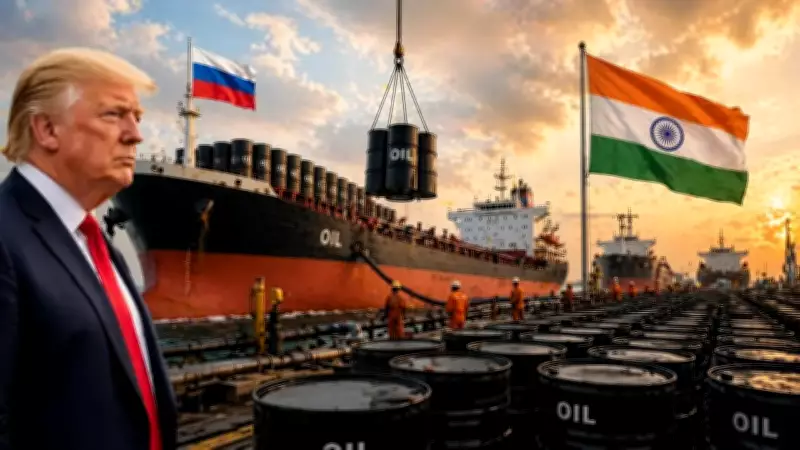
Russia Emerges as India's Oil Lifeline Amid Middle East Supply Crisis
In early March 2026, India faced a potential crude oil supply emergency when escalating tensions between the United States and Iran effectively closed the Strait of Hormuz. This critical maritime chokepoint typically facilitates the transit of approximately twenty percent of global crude oil shipments. The sudden disruption threatened to severely impact India's energy imports and refinery operations.
Russian Crude to the Rescue
Russian crude oil emerged as a crucial support system for India's petroleum needs during both March and April 2026. Import volumes surged dramatically, approaching the record highs witnessed during the period when India secured Russian crude at substantial discounts following the Ukraine conflict. This strategic pivot occurred despite previous financial challenges.
Late last year, US President Donald Trump imposed sanctions on two major Russian oil companies, creating significant financial complications for Indian refiners. While unsanctioned oil continued flowing, the economic viability of maintaining previous purchase levels diminished considerably.

Sanctions Waiver Fuels Aggressive Procurement
The landscape transformed in March 2026 when a US sanctions waiver took effect, enabling Indian refiners to aggressively procure millions of barrels of Russian crude without legal concerns. This development reinforced Russia's position as India's largest crude oil supplier, a status maintained since the Russia-Ukraine war began.
According to analysis from the Centre for Research on Energy and Clean Air (CREA), India's total crude imports decreased by four percent in March 2026, yet Russian imports astonishingly doubled during the same period. State-owned refineries demonstrated particularly dramatic increases, with Russian imports soaring one hundred forty-eight percent month-over-month.
"The biggest shift was in state-owned refineries' imports from Russia, which saw a massive 148% month-on-month increase," CREA reported. "Their imports were in fact 72% higher than March 2025, presumably due to Russian barrels being more available in the spot market, which serves as the primary source of imports for them."
From Discounts to Premiums: A Price Reversal
A remarkable transformation occurred in pricing dynamics. During the initial phase following the Ukraine war, Indian refiners enjoyed steep discounts on Russian crude, sometimes paying twenty to thirty dollars below Brent benchmark prices. By March 2026, the situation had completely reversed.
Indian refiners are currently paying a premium of approximately four to six dollars per barrel over Brent benchmark prices for Russian crude, according to Sourav Mitra, Partner for Oil and Gas at Grant Thornton Bharat. These represent some of the highest delivered premiums since Russia began redirecting substantial crude volumes to Asian markets.
"This shift is attributed to intense competition for prompt Russian cargoes as disruptions to Middle Eastern supply routes pushed refiners to prioritise assured deliveries over price," Mitra explained. "The premium contrasts starkly with February 2026, when Indian buyers were still securing Russian crude at discounts of roughly $12–$15 per barrel, shortly before conditions deteriorated in the Strait of Hormuz."
Expert Analysis on Market Dynamics
Sourav Mitra provided detailed context about Russia's evolving role in India's energy strategy. Following the Ukraine conflict, Russia's share in India's crude basket surged dramatically, peaking at forty-two to forty-five percent during May-June 2023 and displacing traditional suppliers like Iraq and Saudi Arabia.
"Against this backdrop, the rebound seen in March 2026 effectively matches the 2023 peak, although the underlying drivers differed," Mitra noted. "The latest spike largely reflects supply disruptions in West Asia that curtailed Gulf inflows and compelled refiners to rely more heavily on available Russian cargoes. We expect that while March marks a return to near-record dependence on Russian crude, such elevated levels are unlikely to persist once Middle Eastern supply chains stabilize."

Future Outlook and Strategic Considerations
Despite expectations of normalization, experts agree that Russian oil will remain integral to India's energy portfolio. Ivan Mathews, Head of APAC Analysis at Vortexa, anticipates month-over-month declines in Russian crude imports for April 2026 as discounts become less competitive during the sanctions waiver period.
Sumit Ritolia, Manager of Modelling and Refining at Kpler, emphasized that Russian crude has become well-integrated into India's refining infrastructure. Current imports track around 1.6 million barrels per day, approximately 375,000 barrels per day lower than March levels, though this dip partially reflects maintenance at the Nayara refinery.
"The flows are expected to range between 1.5-2 mbd with a slight dip possible due to ongoing infrastructure issues in Russia due to the conflict with Ukraine," Ritolia projected.
Ritolia clarified a crucial distinction often overlooked in discussions about Russian oil imports: "A key point that is often missed is that Russian oil itself is not sanctioned but certain entities, vessels, and financial channels are."
He outlined three essential compliance requirements for continued procurement without sanctions waivers:
- No involvement of sanctioned sellers or intermediaries
- Use of non-sanctioned vessels
- Fully compliant financial, insurance, and trading channels
Diversification Remains Central to Energy Strategy
While Russia maintains importance, India has significantly diversified its crude sourcing to include over forty countries. Sushil Mishra, Director at Crisil Intelligence, highlighted how improved refinery flexibility enables processing of diverse crude grades from American, Russian, and Middle Eastern sources.
"India continues to strengthen its energy resilience by diversifying crude sourcing and maintaining a pragmatic sourcing strategy driven by price, availability, and energy security considerations," Mishra stated. "This approach allows flexibility to adjust sourcing patterns in response to changing global market conditions and geopolitical developments."
The March 2026 surge in Russian crude imports represents a strategic response to immediate supply disruptions rather than a permanent realignment. As Middle Eastern supply chains eventually stabilize, India's crude basket will likely rebalance, though Russian oil will remain a significant component of the country's diversified energy security framework.





