

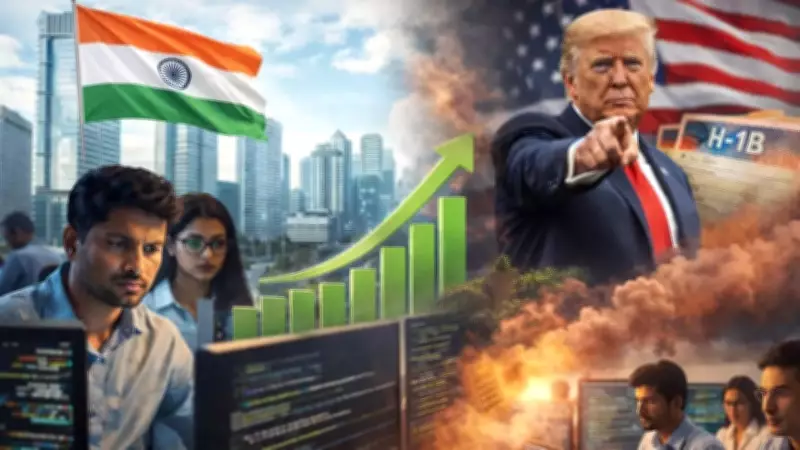
Trump's H-1B Visa Fee Hike: Limited Impact on India's Resilient IT Sector
Former US President Donald Trump's increase in H-1B visa fees, a critical program for skilled workers, is expected to have a constrained effect on India's IT industry, which heavily utilizes this visa provision. Trump has implemented a weighted selection criteria for H-1B visas and raised the application fee to $100,000. According to a new report from Moody's Ratings, India's distinctive talent reservoir will serve as its primary asset in navigating the US immigration crackdown.
Moody's Analysis on US Immigration Policy Changes
US immigration policy revisions, including the $100,000 H-1B visa application fee, are projected to decelerate growth in India's services-sector exports. Operating expenses for India's IT services sector, constituting approximately 80% of total services exports, will escalate. However, the sector's elevated profitability, robust financial standings, and persistent skill deficits in the US will partially counterbalance the influence of new restrictions, as per Moody's.
The Resilience of the Indian IT Sector
Dependence on H-1B visas is pronounced in the computer-related technology sector, which represented nearly 70% of H-1B visas issued over the past five years, making it the largest consumer of the H-1B program. Indian IT giants such as TCS and Infosys are among the top sponsors of H-1B visas, with other major users including HCL Tech, Wipro, Tech Mahindra, LTIMindtree, and Mphasis. The operational model involves deploying staff from offshore locations like India, which boasts a vast supply of skilled talent, to on-site client sites in the US, explaining the heavy reliance on H-1B visas.

Moody's asserts that most IT sector firms can absorb the higher visa costs without significant deterioration in their operating or financial profiles. Companies like TCS, Infosys, Wipro, and HCL Technologies benefit from substantial operating scale and rank among the world's largest IT service providers by revenue. Their EBITA margins of 19%-26% surpass those of global peers, which range from 10%-17%. This higher profitability enhances their capacity to tolerate incremental cost increases. Even if Indian IT companies maintain historical H-1B visa sponsorship levels, the resulting operating expense rise—estimated by Moody's at $100 million to $250 million—will constitute only about 1% of revenues.
Even with the full cost burden, the EBITA margin impact would be limited to around 100 basis points, ensuring Indian IT services companies remain more profitable compared to global counterparts. Additionally, many of these firms maintain substantial net cash positions, reinforcing their financial strength. However, small and mid-sized companies may struggle to absorb these extra costs.
Implications for India's Services Exports
The Indian IT sector forms the backbone of the country's services exports, which have grown at a compound annual growth rate (CAGR) of 12% from fiscal year 2016-17 to 2024-25. Services exports now account for almost half of India's total exports and may surpass goods exports by 2030, according to the India Brand Equity Foundation. Technology-related services and other business services comprise the majority of services exports, with these two sectors accounting for nearly 80% of the total and experiencing CAGRs of 12% and 16%, respectively, during the same period.
Trump administration immigration policy changes are likely to increase costs for Indian IT companies, potentially impacting services exports and constraining growth prospects in the US market. Nonetheless, Moody's indicates that negative effects will be partially offset by increased local hiring in the US, nearshoring, and the expansion of global capability centers (GCCs) in India due to continued US demand for skilled IT labor.
Currently, the United States is India's largest market for services exports, exposing the IT sector to risks from Trump's immigration policies. Exports of software services by Indian companies increased 7.3% during fiscal year 2024-25 to $204.7 billion, with on-site services subject to visa restrictions accounting for about 10% of total software services exports. Higher growth in exports to Europe and increased local hiring in the US will mitigate some impact.

The share of exports to Europe rose to 33% in the most recent fiscal year from 23% in fiscal 2016-17, while the US share declined to 53% from around 60%. On-site services have decreased to 9.3% of total software services exports from 17.2% over eight years, indicating reduced visa reliance. The recently announced India-EU free trade agreement could further boost India's services exports to the EU, benefiting IT services providers.
India's Unique Talent Advantage
India is uniquely positioned to bridge the talent gap in the US, which faces increasing labor shortages due to declining birthrates and an aging population. The US Bureau of Labor Statistics projects the labor force participation rate will remain below pre-pandemic levels through the next decade, even as demand for skilled labor rises. For instance, the US computer and information technology sector will have about 300,000 job openings annually through 2034, driven by digitalization and AI adoption, but only around 100,000 computer science graduates with US citizenship or permanent residency enter the workforce yearly, creating a shortfall of 200,000 positions annually.
Foreign talent, particularly from India, will continue to play a crucial role in US economic growth. Since 2020, Indian nationals have accounted for 70%-75% of all H-1B visas issued, reflecting India's significant share in meeting US skilled labor demand. India produces approximately 2.5 million STEM graduates annually, compared to about 850,000 in the US, highlighting its role as a key talent supplier. Even as US firms explore alternatives like nearshoring or GCC expansion, domestic shortfalls ensure foreign talent from India remains critical for US technology growth, sustaining demand for Indian IT services despite tighter immigration policies.
The GCC Advantage for India
Moody's notes that US tech companies' need for skilled workers may increase their appetite to establish GCCs in India, bolstering foreign direct investment. India's current account deficit will widen moderately due to weaker services export growth and reduced remittances from skilled workers in the US. Remittances ranged between 7% and 10% of current account receipts over the last five fiscal years, but rising demand for skilled workers in other countries can partially offset negative impacts. Additionally, the potential return of highly skilled IT workers to India could boost the IT ecosystem and attract more business to India-based GCCs.
The Role of AI-Driven Automation
Moody's believes the role of H-1B visas will diminish over time, driven by faster adoption of Artificial Intelligence tools. Indian IT giants like TCS and Infosys are investing in generative AI for offerings such as maintenance, testing, and routine coding. Increased AI investments will reduce the need for employees, especially in on-site customer locations. However, AI investments entail capital and strategic costs, with spending on infrastructure, training, and partnerships growing. For example, TCS plans to invest $6 billion-$7 billion to build one gigawatt of data center capacity over the next few years.
Over the medium term, AI adoption will improve delivery efficiency, reduce reliance on visa-dependent on-site roles, and create additional revenue streams. Nonetheless, timing mismatches between upfront investment and productivity gains may pressure free cash flow over the next 1-2 years as companies balance these outlays with shareholder returns and wage inflation.





