

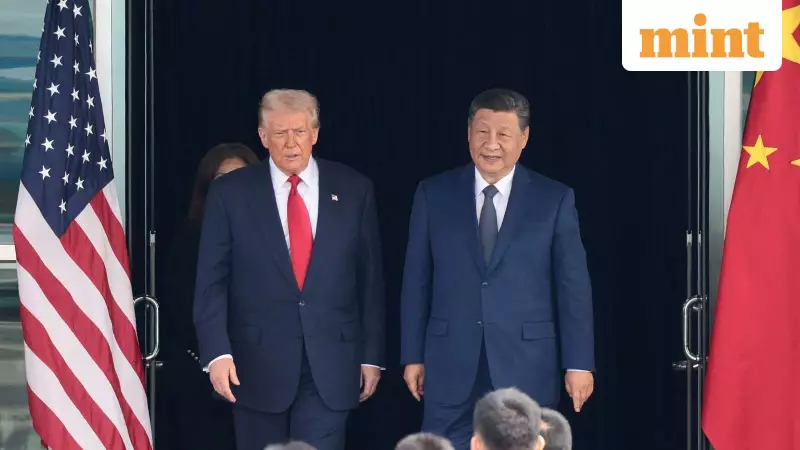
Trump and Xi Strike Trade Truce in South Korea Meeting
United States President Donald Trump and Chinese President Xi Jinping have reached a trade truce. The two leaders finalized the agreement during a meeting at a South Korean airbase on October 30th. This development comes after months of intense negotiations and threats between the world's two largest economies.
Key Elements of the Agreement
The truce involves several immediate actions from both sides. China will delay new restrictions on rare earth exports for one year. In return, America will not impose an additional 100% tariff on Chinese goods starting November 1st. The United States will also postpone reciprocal tariffs set for November 10th.
America will halve a 20% tariff related to fentanyl chemicals. President Trump stated China promised to do more to curb this trade. China has resumed purchasing American soybeans, which it stopped in May. Both countries agreed to expand their agricultural trade.

"We have a deal," President Trump told reporters aboard Air Force One after leaving Busan. He mentioned discussing Ukraine extensively with President Xi, agreeing to work together for peace there.
What Remains Unclear
The final details of the agreement still need clarification. President Trump confirmed he did not discuss Taiwan during the meeting. He also did not agree to sell Nvidia's advanced Blackwell AI chips to China. However, he mentioned discussing access to some of Nvidia's other chips.
Neither leader mentioned TikTok's American operations during their public remarks. China's commerce ministry said it would work with America to resolve the TikTok issue permanently.
Positive Tone from Both Leaders
President Trump called President Xi "a great leader of a great country." He expressed optimism about their future relationship. President Xi acknowledged they don't always agree but said such friction is normal between major economies.
President Xi praised President Trump's peace efforts in Gaza and Southeast Asia. Both leaders emphasized the importance of being "friends and partners."
Global Reaction and Remaining Concerns
Global markets responded positively to the news of the truce. Many companies and governments caught in the trade war felt relief. Taiwan welcomed President Trump's statement that the island was not discussed.
However, significant concerns remain. The deal does not end the trade war completely. America maintains a 47% tariff rate on Chinese goods. China's rare earth export delay doesn't eliminate implementation worries.
President Trump suggested the deal could be renegotiated annually, creating potential for ongoing instability. The agreement focuses heavily on immediate issues like soybeans and TikTok rather than fundamental problems like China's industrial policy.
Negotiation Background and Future Risks
Trade talks between America and China have experienced multiple ups and downs since May. Treasury Secretary Scott Bessent and Chinese Vice-Premier He Lifeng led negotiations. They outlined the agreement during a two-day meeting in Malaysia ending October 26th.
Three major risks threaten the truce:
- The current framework could collapse due to interpretation differences
- The deal may not address deeper structural relationship problems
- An unexpected crisis in another area could disrupt the agreement
Military tensions remain high in the South China Sea and around Taiwan. Just before meeting President Xi, President Trump announced nuclear testing plans with Russia and China. While the trade truce represents progress, stable ground between the two powers remains distant.






