

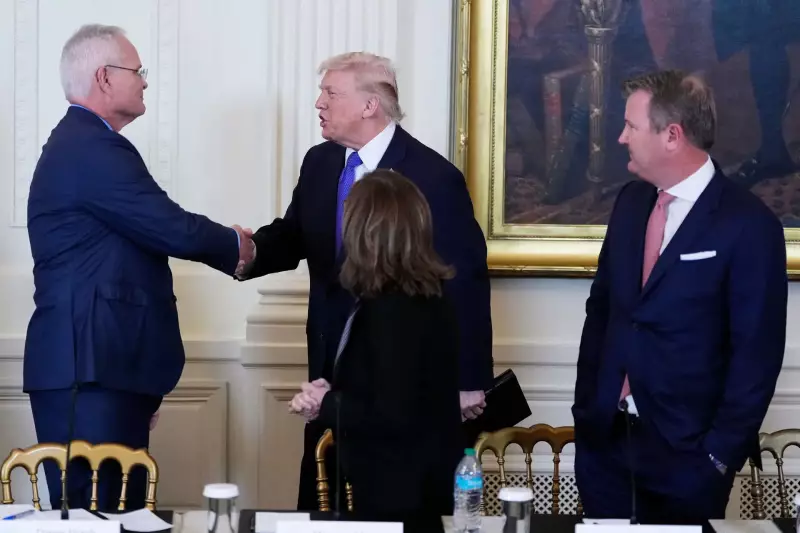
In a high-stakes meeting, former US President Donald Trump made an ambitious pitch to senior executives from the world's largest oil companies, urging them to channel massive investments into Venezuela's beleaguered energy sector. The message from the White House was one of opportunity and security, aiming to redirect US capital to a nation sitting on the world's largest proven oil reserves.
Venezuela's Oil Paradox: Riches Without Production
The core of Trump's argument rested on a stark geological fact: Venezuela holds an estimated 303 billion barrels of proven crude oil reserves, accounting for roughly 17% of the global total. This dwarfs the reserves of even the wealthiest Middle Eastern nations. Historically, the country was a production powerhouse, pumping over 3 million barrels per day in the late 1990s.
Today, that figure has plummeted to below 1 million barrels daily. Decades of economic mismanagement, crippling international sanctions, and severe underinvestment have decimated infrastructure and driven away skilled personnel. For the oil executives listening, the challenge is not simply turning valves back on. It would require a multi-billion dollar, decades-long effort to rebuild pipelines, upgraders, refineries, and the entire support ecosystem.

Industry Response: Admiration Without Commitment
Despite Trump's promises of "total security" and the potential for quick deals worth up to $100 billion, the industry response was notably restrained and grounded in hard experience.
ExxonMobil's CEO delivered the most blunt assessment, labelling Venezuela's current climate as "uninvestable." The company, which has had assets seized twice by the Venezuelan state, most recently under Hugo Chávez, emphasised that for projects requiring tens of billions over 20-30 years, durable legal protections are non-negotiable. While open to sending technical teams, Exxon stopped well short of any capital commitment.
Chevron struck a slightly more optimistic but limited tone. Already operating there under special licenses, Chevron suggested it could boost output from its existing joint ventures by 50% within 18-24 months. However, this growth is based on optimising current assets, not launching new mega-projects, and its production remains a fraction of Venezuela's historical output.
Other players echoed this conditional interest. Shell acknowledged several billion dollars in potential opportunities but only if sanctions waivers and regulatory clarity are sustained long-term. Service companies like SLB expressed readiness to ramp up operations, but their risk is lower as equipment providers. Continental Resources founder Harold Hamm, a Trump ally, called Venezuela's reserves a "real jewel" but declined to commit any investment.
The Bottom Line: Stability Before Capital
The meeting ultimately highlighted a fundamental divide. The White House sees a strategic and economic opportunity to counter Russian and Chinese influence while securing energy resources. Big Oil, however, sees a high-risk proposition where the economics are challenged by the need for heavy oil extraction and the political landscape remains volatile.
The consensus from the boardrooms is clear: Venezuela's resource potential is undeniable, but enthusiasm will only follow stability. Until companies are confident that contracts will be honoured across political cycles and policies will remain predictable, large-scale, long-term capital will stay on the sidelines. The meeting underscored that for global energy giants, measured interest and limited deployment are the prudent path forward in Venezuela.






