

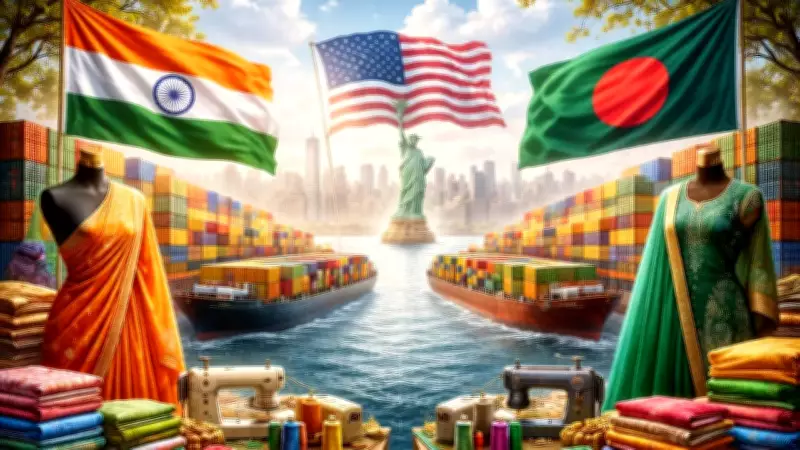
US-Bangladesh Trade Agreement Introduces Zero-Tariff Clause, Raising Concerns for Indian Textile Sector
The recently announced trade deal between the United States and Bangladesh, unveiled on Tuesday, carries significant implications that may indirectly challenge the export aspirations of India's textile industry. While the agreement reduces the general tariff rate on Bangladeshi goods to 19%—marginally higher than the 18% rate applied to Indian products under the Trump administration—a specific clause within the joint statement is poised to substantially boost Bangladesh's textile exports to the US, potentially eroding some of the competitive advantage India had anticipated.
Zero-Tariff Mechanism: A Game-Changer for Bangladesh
The pivotal clause in the US-Bangladesh joint statement commits the United States to establishing a mechanism that will grant a zero reciprocal tariff rate for certain textile and apparel goods from Bangladesh. This mechanism stipulates that a specified volume of apparel and textile imports from Bangladesh can enter the US market at this reduced tariff rate, with the volume determined in relation to the quantity of textile exports, such as US-produced cotton and man-made fiber inputs, from the United States to Bangladesh.
This provision has sparked considerable concern within the Indian textile industry, which had been celebrating a lower tariff rate compared to Bangladesh as part of the India-US trade deal just last week. Commerce Secretary Mahbubur Rahman of Bangladesh highlighted that ready-made garment exports, particularly those manufactured using cotton and synthetic fibers imported from the United States, would benefit from zero reciprocal duty under this arrangement.

Impact on India's Textile Export Ambitions
The India-US trade framework was widely viewed as a crucial breakthrough that could enhance access to America's substantial $118 billion textile and apparel import market. The United States already stands as India's largest destination for textile exports, accounting for approximately $10.5 billion in shipments. According to industry reports, apparel constitutes nearly 70% of this total, while made-ups contribute about 15%.
At the industry level, exporters in Tiruppur, India's largest knitwear cluster, initially responded with strong optimism following the India-US announcement. K M Subramanian, president of the Tiruppur Exporters' Association, projected that garment exports to the US could potentially double to Rs 30,000 crore within three years, alongside the creation of nearly five lakh new jobs. Another exporter, M Rathinasamy, founder of Starrlight Exporters, anticipated that orders previously routed to Bangladesh and other competing countries would shift back to Tamil Nadu due to the agreement.
The 18% reciprocal tariff on Indian goods was expected to remove a long-standing competitive handicap, positioning Indian exporters more favorably against major rivals like Bangladesh, China, Pakistan, and Vietnam, which faced higher tariff levels. However, the new zero-tariff clause for Bangladesh may now undermine this competitive edge.
Market Reaction and Investor Concerns
Shares of several Indian textile firms experienced selling pressure on Tuesday, reversing earlier gains driven by expectations linked to the India-US trade arrangement. Companies including Gokaldas Exports, KPR Mill, Arvind, and Pearl Global Industries declined by more than 5% at one point during the trading session. This negative market response reflected investor apprehensions that preferential provisions extended to Bangladesh under the new trade deal could weaken the competitive advantage Indian exporters were anticipated to enjoy in the US market.
The possibility of zero-tariff entry for select Bangladeshi textile and apparel exports has moderated the earlier optimism surrounding Indian exporters. Market participants are concerned that even limited tariff-free access could reduce the competitive benefit India appeared to gain in the US market.

Uncertainties and Broader Context
Despite these concerns, several key aspects of the zero-tariff exemption remain uncertain. The agreement does not clearly outline which categories of textile or apparel products would qualify for duty-free treatment, the quantity of exports that would be covered, or when the provision would come into effect. Additionally, the arrangement is tied to Bangladesh's use of textile inputs sourced from the US, a condition that may restrict its scope or increase costs for Bangladeshi manufacturers.
Because of these unresolved details, the zero-tariff provision may ultimately have a limited impact on India's competitive standing. Furthermore, as India and the US continue discussions to finalize the details of their trade arrangement following last week's framework announcement, there remains room for India to maintain a distinct advantage over Bangladesh, or at least remain on par, in the American textile market.
In a broader context, India has already achieved a significant milestone in Europe. The EU-India trade agreement announced on January 27 provides Indian textile exports with immediate duty-free access to the European Union's $263 billion textile market, with tariffs set to be fully removed under the pact. This development offers a counterbalance to the challenges posed by the US-Bangladesh deal, highlighting the dynamic and competitive nature of global textile trade.





