

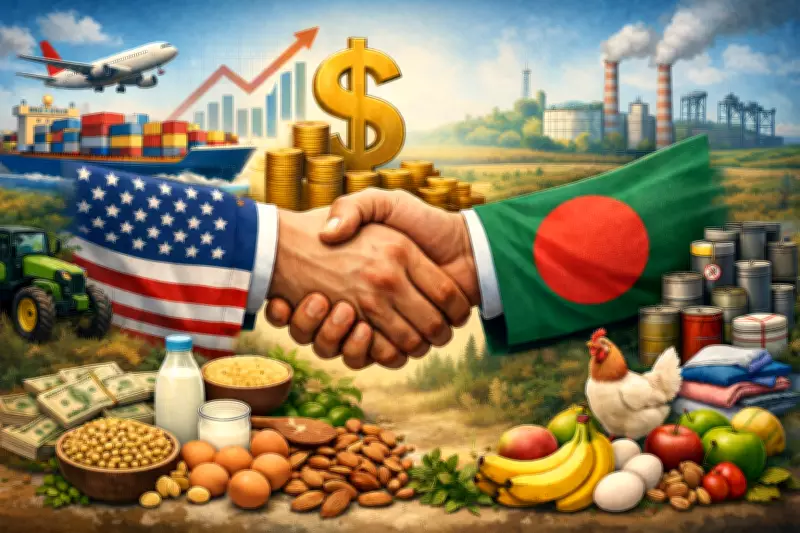
US and Bangladesh Seal Historic Reciprocal Trade Agreement
The United States and Bangladesh have officially concluded negotiations and signed the landmark United States–Bangladesh Agreement on Reciprocal Trade, marking a significant milestone in strengthening bilateral economic relations between the two nations. The signing ceremony took place on Monday, with high-level officials from both countries in attendance to formalize the pact.
Key Tariff Reductions and Market Access Provisions
Under the newly established framework, Bangladeshi exports destined for the American market will now face a tariff rate of 19%. This represents a marginal decrease from the 20% rate implemented in August and a substantial reduction from the original reciprocal tariff of 37%. The agreement was formally executed by US Trade Representative Jamieson Greer and Bangladesh's Adviser for Commerce, Textiles and Jute, and Civil Aviation and Tourism, Sheikh Bashir Uddin, witnessed by Bangladesh Commerce Secretary Mahbubur Rahman and Assistant US Trade Representative Brendan Lynch.
Substantial Benefits for Bangladesh's Export Sector
The United States has committed to several key concessions that will directly benefit Bangladesh's economy:

- Washington will reduce the reciprocal tariff imposed under Executive Order 14257 to 19% on a wide range of Bangladeshi goods.
- Selected products listed in Annex III of Executive Order 14346 will qualify for complete duty-free access with a zero-tariff rate.
- A dedicated mechanism will be established allowing certain textile and apparel products from Bangladesh to qualify for zero reciprocal tariffs.
- A specific volume of garments and textile imports from Bangladesh will be permitted to enter the US market at the reduced rate, though this volume remains to be finalized and will be linked to Bangladesh's imports of American textile inputs like US-produced cotton and man-made fibers.
Enhanced Market Access for American Products
In return, Bangladesh has agreed to grant extensive preferential entry to US industrial and agricultural products across multiple sectors:
- Chemical products and medical devices
- Machinery, automobiles, and automotive components
- Information and communications technology equipment
- Energy supplies and related infrastructure products
- Agricultural commodities including soy items, dairy products, beef, poultry, nuts, and various fruits
Comprehensive Trade Facilitation and Regulatory Reforms
Both governments have committed to addressing non-tariff barriers that have historically impeded trade and investment flows. Bangladesh will implement several significant reforms:
- Recognition of vehicles meeting US federal safety and emission standards
- Acceptance of US Food and Drug Administration certificates and prior approvals for pharmaceuticals and medical devices
- Elimination of import restrictions and licensing requirements for US remanufactured products and parts
- Enabling trusted cross-border data flows and supporting a permanent WTO ban on customs duties for electronic transmissions
- Adoption of science- and risk-based systems for safe American food and agricultural imports
- Opening the insurance sector to greater foreign participation
- Digitizing customs procedures and implementing sound regulatory practices
Labor, Environmental, and Governance Commitments
The agreement includes substantial commitments on labor rights and environmental protection:
- Bangladesh will take concrete actions to uphold internationally recognized labor rights
- Prohibition of imports produced through forced or compulsory labor
- Legislative amendments to secure freedom of association and collective bargaining rights
- Enhanced enforcement of labor standards and regulations
- Maintenance of strong environmental safeguards and implementation of environmental laws
- Improvement of trade facilitation at border crossings
- Addressing market distortions linked to subsidies and state-owned enterprises
- Reinforcement and application of comprehensive anti-corruption legislation
Intellectual Property and Economic Security Cooperation
On intellectual property matters, Bangladesh has committed to:

- Pursuing stronger protection and enforcement mechanisms
- Ratifying or joining specific global intellectual property treaties
- Introducing provisions on geographical indications to ensure continued US market access, particularly for producers of cheese and meat products that use common names
The two countries will also align more closely on economic and national security matters, working together to strengthen supply chains, foster innovation, combat unfair trade practices, prevent duty evasion, manage export control risks, and exchange information on inbound investment.
Financial Support and Commercial Agreements
American financial institutions including the Export-Import Bank and the US International Development Finance Corporation may consider supporting investments in priority Bangladeshi sectors alongside US private firms, subject to eligibility and legal requirements.
The agreement acknowledges several recent and upcoming commercial deals spanning multiple sectors:
- Procurement of aircraft from American manufacturers
- Purchase of approximately $3.5 billion worth of American agricultural commodities including wheat, soy, cotton, and corn
- Energy imports estimated at $15 billion over the next 15 years
Implementation Timeline and Next Steps
Both sides have committed to proceeding promptly through their respective internal processes to complete the formalities required for the Agreement on Reciprocal Trade to take full effect. The comprehensive nature of this agreement reflects the deepening economic partnership between the United States and Bangladesh, with potential to significantly boost bilateral trade and investment flows in the coming years.





