

US-India Trade Pact Update: India Commits to Remove Digital Taxes, Negotiate Rules
In a significant development within the US-India trade agreement, Washington has announced that India has pledged to eliminate its digital services taxes and engage in negotiations aimed at establishing trade rules that tackle discriminatory or burdensome practices, along with other obstacles to digital commerce. This declaration was made in a White House factsheet released on Monday, US time, which also clarified that the interim trade framework does not propose any immediate alterations to India's domestic e-commerce regulations, including restrictions on foreign investment in inventory-based retail.
Digital Trade Negotiations and Customs Duties
The negotiations will encompass rules that prohibit customs duties on electronic transmissions, a key priority for the United States in global digital trade discussions, as outlined in the factsheet. Digital trade refers to cross-border transactions involving electronically delivered products and services. For India, the joint statement issued on Saturday remains the primary document regarding the India-US trade agreement, according to a source familiar with the matter who requested anonymity.
If implemented, rules prohibiting customs duties on electronic transmissions would prevent India from imposing import duties or similar charges on software downloads, apps, cloud services, digital media, e-books, online subscriptions, or data transmitted over the internet, provided they are delivered electronically and not as physical goods.

Expert Insights and WTO Context
An expert noted that the overall impact of the proposed changes could be positive if they are put into effect. The moratorium on customs duties for digital trade remains a contentious issue at the World Trade Organization, with India and the United States holding divergent positions, as highlighted by Bipin Sapra, partner and indirect tax policy leader at consultancy EY India. For example, he stated, "the levy of GST on digital products under Online Database Retrieval Services has posed significant challenges, and its removal would help resolve several ongoing disputes."
WTO Position and Big Tech Regulations
This latest development occurs against the backdrop of a recent presentation by India at the World Trade Organization, where its delegation opposed the current moratorium that prevents countries from imposing customs duties on digital products, including software, video games, and audio-visual content delivered across borders. India has also faced antitrust cases against Big Tech, such as Play Store levies, and a December proposal to tax artificial intelligence companies for using training data came as a surprise.
In August 2024, India abolished a 2% equalisation levy on e-commerce supplies and a 6% Equalisation Levy on online advertising, often referred to as the "Google tax" since its introduction in 2016. The removal, effective from April 1, 2025, was viewed as part of efforts to address US concerns about discriminatory digital taxes.
An industry body representing Indian communications and technology companies commented that the White House update aims to ensure that digital trade, including e-commerce, cloud computing, and cross-border digital services, can flow without new taxes or border charges. R.K. Bhatnagar, director general of Voice of Indian Commtech Enterprises, explained, "For India, it is sensitive because it limits future policy space to tax or regulate digital flows, which is why the issue is being framed in the fact sheet as something to be negotiated, not already agreed."
Broader Trade Framework and Economic Implications
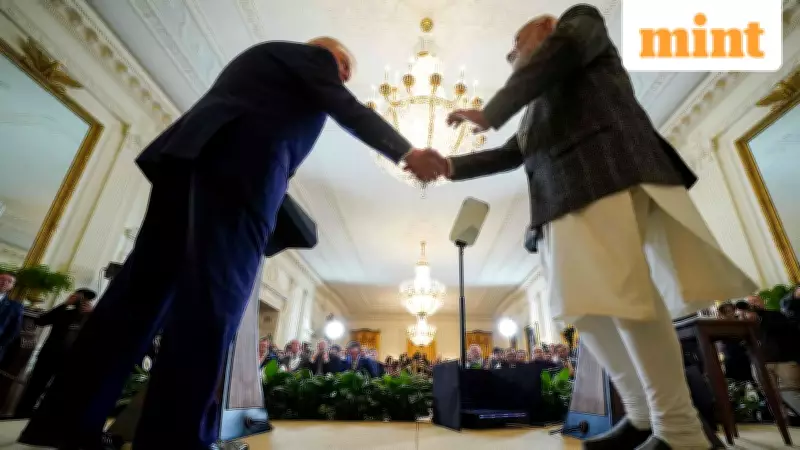
The digital trade initiative is part of a wider interim trade framework announced in a joint statement late on Saturday, following a call last week between US President Donald Trump and Prime Minister Narendra Modi. Both nations reaffirmed their commitment to negotiations on a comprehensive US-India Bilateral Trade Agreement.

India is poised to gain zero-duty access for goods valued at approximately $44 billion, nearly half of its merchandise exports to the US, under the first phase of the agreement, as stated by commerce and industry minister Piyush Goyal on Saturday. The US has agreed to reduce tariffs on Indian produce to 18%, with an executive order signed last Friday to formalize this move. The US indicated that this followed New Delhi's commitment to cease purchasing crude oil from Russia.
However, on Monday, ministry of external affairs secretary Vikram Misri emphasized that India's "approach is to maintain multiple sources of supply and diversify them as appropriate to ensure stability" without specifically mentioning Russia. The US has not yet responded to this statement.
India has also agreed to address non-tariff barriers in priority areas, negotiate rules of origin, and enhance cooperation on supply-chain resilience, investment reviews, export controls, and technology trade. Key product commitments include dried distillers' grains, red sorghum, tree nuts, soybean oil, certain pulses, and wines and spirits.
Among these commitments, pulses are particularly notable. India's lentil imports from the US surged to $78.43 million in FY25 from $21.11 million in FY24. It remains unclear what duties will apply to the "certain pulses" mentioned in the factsheet; currently, India imposes a 30% duty on yellow peas imports and 10% on lentils.
Bilateral trade in goods between India and the US increased to $131.84 billion in FY25, up 10% from FY24, with Indian exports to the US rising 11.6% to $86.51 billion.





