U.S. Oil's Return to Venezuela Faces Political and Economic Hurdles
The anticipated return of global U.S. oil companies to Venezuela is turning into a prolonged and challenging process, according to analysis by business professor Jerry Haar. Despite efforts by the Trump administration to encourage investment, significant obstacles remain in the country's political and economic landscape.
Political Uncertainty Clouds Investment Prospects
Secretary of State Marco Rubio recently outlined a three-stage plan for Venezuela's transition from what he described as a "narco-kleptocracy" under President Nicolás Maduro to an open-market democracy. However, Rubio acknowledged this transition won't happen quickly, stating "It's not even been four weeks" since the U.S. seized on Maduro's government.
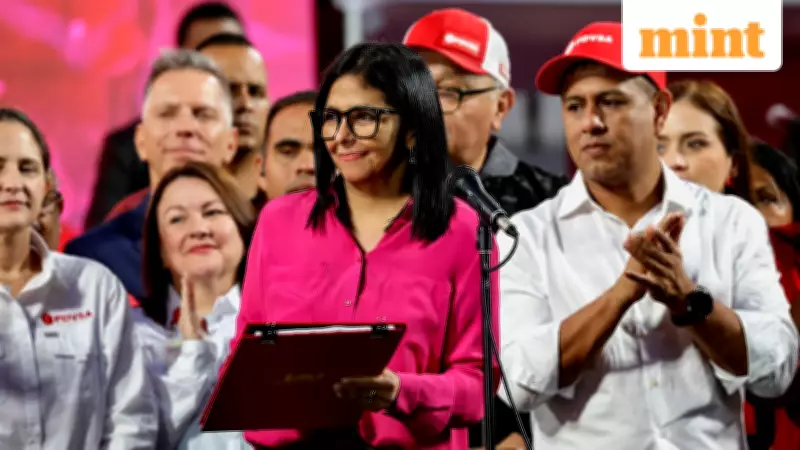
The political situation remains unstable, with Maduro's loyalists in key positions showing no signs of budging. Opposition leader Maria Corina Machado lacks the armed support to challenge interim President Delcy Rodriguez, who recently held a copy of new oil law reform during protests by Venezuelan oil workers.

Corporate Hesitation and Historical Baggage
During a White House meeting earlier this month, President Donald Trump lobbied oil executives to invest $100 billion to resuscitate Venezuela's oil industry. The response was less than enthusiastic. Exxon CEO Darren Woods declared the Venezuelan market "uninvestable" in its current state, citing the 2007 seizure of Exxon and Conoco assets and billions in outstanding arbitration claims.
Trump responded by suggesting he might sideline Exxon in favor of more willing participants, but as Haar notes, Exxon has fiduciary responsibilities to shareholders that take precedence over presidential preferences.
Corruption: A Deep-Rooted Problem
The most significant warning for potential investors is Venezuela's entrenched corruption. Transparency International ranks Venezuela 178 out of 180 countries on its corruption scale. Political elites have historically treated the country "as a giant piñata," embedding corruption throughout all branches of government.
This tradition dates back to Símon Bolívar and continued through subsequent administrations, most notoriously with former President Carlos Andrés Pérez, who famously asked during infrastructure negotiations: "Y cómo quedo yo?" (What's my cut?).
Economic and Technical Challenges
Beyond political issues, several economic factors complicate Venezuela's oil recovery:
- Global Oil Surplus: The International Energy Association projects a significant global oil surplus for 2026, with prices dropping from $80 per barrel in 2020 to $65 currently.
- Technical Requirements: Venezuelan crude consists of heavy oils requiring specialized refineries with coking and desulfurization units, which less than half of U.S. refineries possess.
- Capital Flight: An estimated $150-400 billion has left Venezuela since Hugo Chávez's election in 1998, with $9 billion exiting in 2002 alone.
- Human Capital Drain: Approximately 8 million Venezuelans have fled, including many educated professionals in engineering, health, business, and information systems.
Current Economic Reality
The combination of nationalizations, strict currency controls, and reliance on oil imports has caused Venezuela's economy to implode. With working capital scarce and bank lending rates exceeding 60%, both foreign and domestic firms find themselves in a difficult position.
Potential Amidst Uncertainty
Despite the challenges, Rubio struck an optimistic note in his testimony, stating: "There is no guarantee that something will change in Venezuela, but there is the opportunity that something will change."
Haar agrees that Venezuela offers significant potential for foreign investors across various sectors, not just oil. However, he emphasizes that until stability is achieved and accommodation reached between political factions, the private sector—both domestic and foreign—will likely remain cautious.

The path forward requires a clear political resolution and economic reforms that address Venezuela's deep-seated issues. Until then, U.S. oil's return to Venezuela will continue to face substantial headwinds, making the recovery process slower and more complex than initially anticipated.