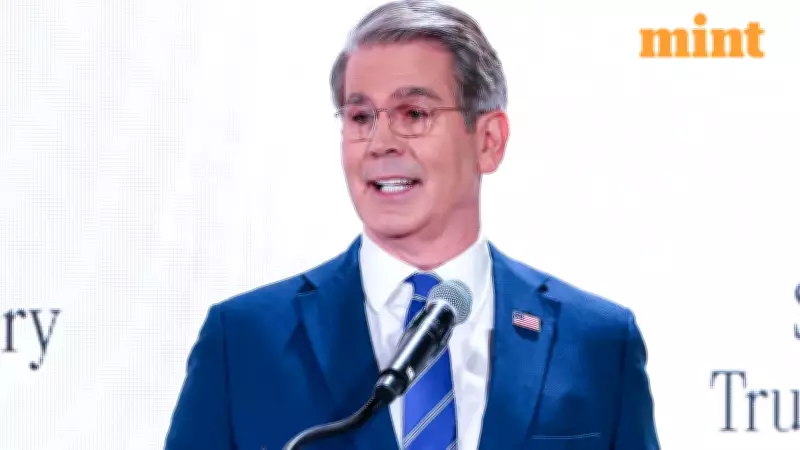
US Treasury Secretary Scott Bessent has launched a sharp critique against the European Union's recently concluded free trade agreement with India, asserting that the deal demonstrates Europe's troubling preference for commerce over humanitarian support for Ukraine. His remarks came just one day after India and the EU finalized the landmark trade pact during a high-level summit in New Delhi.
Bessent's Disappointment with European Priorities
Speaking to CNBC on Wednesday, Bessent expressed profound disappointment with Europe's stance, stating, "They should do what's best for themselves, but I will tell you, I found, I find the Europeans very disappointing." He argued that Brussels had chosen trade interests despite the ongoing war in Ukraine, directly contradicting its stated support for the Ukrainian people.
The Treasury Secretary's comments followed the January 27, 2026 announcement that India and the European Union had concluded negotiations on a comprehensive free trade agreement. This pact will see the EU eliminate tariffs on 99.5% of items India exports to the region, with most tariffs dropping to 0% immediately upon implementation. In return, India has granted tariff concessions on 97.5% of the traded value between the two economies.

Signing Ceremony and Economic Implications
The joint political declaration was signed by Union Commerce Minister Piyush Goyal and European Commissioner for Trade and Economic Security Maroš Šefčovič in New Delhi. The ceremony was attended by Prime Minister Narendra Modi, European Commission President Ursula von der Leyen, and European Council President António Costa. This agreement is projected to potentially double EU exports to India by 2032 and save European companies approximately 4 billion euros in duties.
Connecting Trade Deal to Previous Tariff Decisions
Bessent suggested that the India-EU trade agreement explains why European nations declined to align with Washington's decision to impose higher tariffs on India last year. "The Europeans were unwilling to join us, and it turns out, because they wanted to do this trade deal," he remarked. "So every time you hear a European talk about the importance of the Ukrainian people, remember that they put trade ahead of the Ukrainian people."
Accusations of Indirect War Financing
The Treasury Secretary further accused European countries of indirectly funding Russia's war effort by purchasing refined fuel products derived from Russian crude oil processed in India. "The Russian oil goes into India, the refined products come out, and the Europeans buy the refined products," Bessent stated. "They are financing the war against themselves."
This criticism echoes Bessent's earlier comments in an interview with ABC News, where he highlighted that Washington had imposed 25% tariffs on India for purchasing Russian oil, while Europe proceeded with its trade agreement. He reiterated this point, emphasizing the perceived inconsistency in European actions.
Comparing US and European Approaches to Ukraine Conflict
Bessent also claimed that the Trump administration has applied greater pressure on Moscow than its European counterparts in efforts to resolve the Russia-Ukraine conflict. "Trump has worked to negotiate a settlement on the Russia-Ukraine conflict," he said, adding that the United States had made "much bigger sacrifices" than Europe in addressing the crisis.
Historical Context and Next Steps for the Trade Deal
The conclusion of negotiations on the India-EU FTA marks the end of a two-decade-long process that began with talks in 2007. Negotiations resumed in 2022 with both sides agreeing to exclude previously contentious issues. According to officials quoted by various media outlets, the next steps involve cleaning up the document's language over 10-15 days, followed by legal review. The agreement will then be translated and sent to all 27 EU member states before ratification by the European Parliament, with implementation expected in 5-6 months.

Prime Minister Narendra Modi hailed the agreement as historic, stating, "Today, India has concluded the largest Free Trade Agreement in its history." This development occurs against a backdrop of complex geopolitical tensions and differing international approaches to balancing economic interests with humanitarian concerns.