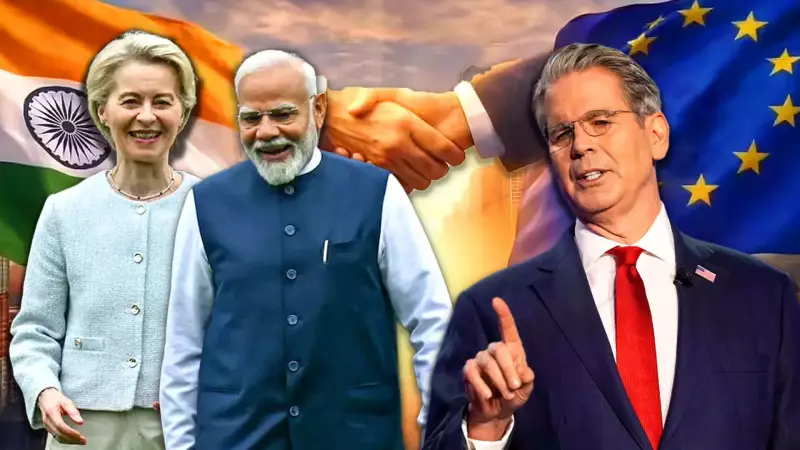
The recently signed India-European Union free trade agreement, often described as the "mother of all deals," has unexpectedly drawn sharp public criticism from the United States government. This development highlights the complex geopolitical and economic tensions emerging in global trade relations.
US Treasury Secretary's Strong Accusations
US Treasury Secretary Scott Bessent has made rare public statements condemning the trade pact between India and the European Union. He specifically claims that Europe is indirectly funding the ongoing Russia-Ukraine conflict through its trade arrangements with India.
The Refined Fuel Controversy
According to Bessent's allegations, European nations are purchasing refined petroleum products from India that are manufactured using Russian crude oil. This arrangement, he argues, effectively channels financial resources toward Russia's military efforts in Ukraine, despite Western sanctions intended to limit Moscow's war funding capabilities.

India's Position in Western Contradictions
Meanwhile, India finds itself in a challenging diplomatic and economic position, caught between conflicting Western policies. While the United States continues to impose significant tariffs on Indian goods, the European Union has simultaneously negotiated this comprehensive trade agreement with New Delhi.
Economic Implications of the Trade Deal
The India-EU free trade agreement represents one of the most substantial economic partnerships in recent history, connecting markets encompassing nearly two billion consumers. This pact is particularly significant as it strengthens international supply chains during a period of increasing global trade fragmentation and protectionist tendencies.
India's Declining Russian Oil Imports
An important context to this controversy is India's gradually decreasing imports of Russian crude oil. Despite this trend, the current backlash from Washington underscores New Delhi's growing economic influence on the world stage and its ability to navigate complex international relationships.
More Than Just a Trade Agreement
Analysts suggest this agreement transcends conventional trade considerations. It represents a strategic declaration of economic independence by India in an increasingly polarized global landscape, where nations are forced to balance relationships between competing power blocs.
The situation reveals the intricate web of modern international relations, where trade agreements carry significant geopolitical implications beyond their economic dimensions. As global powers realign their strategic partnerships, India's position as a major emerging economy continues to gain prominence in these complex diplomatic equations.