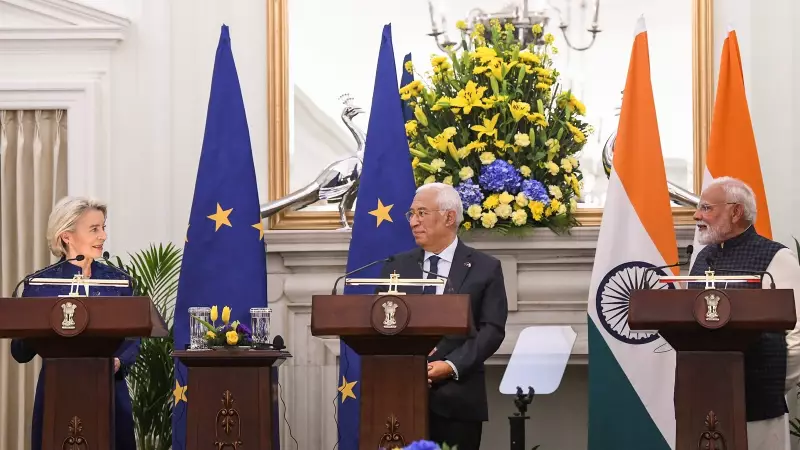
In a significant development, the United States has issued its first official reaction to the recently signed India-European Union trade agreement, with U.S. Trade Representative Jamieson Greer asserting that India emerges as the primary beneficiary of this pact. Speaking in an interview with Fox Business on Wednesday, Greer highlighted that India stands to gain substantially from enhanced market access and potential immigration advantages within European markets.
India's Strategic Advantage in the EU Trade Deal
Greer explicitly stated, "I think India comes out on top on this, frankly. They get more market access in Europe. It sounds like they have some additional immigration rights. I don't know for sure, but President von der Leyen of the EU has talked about mobility for Indian workers into Europe. So I think on net, India's gonna have a heyday with this. They have low-cost labour." This assessment comes at a crucial juncture when trade negotiations between New Delhi and Washington remain deadlocked, creating an atmosphere of uncertainty in bilateral economic relations.
Criticism of EU's Globalization Approach
The U.S. trade representative did not mince words when criticizing the European Union's economic strategy. Greer pointed out that Brussels appears to be "doubling down on globalization" precisely when the United States under President Donald Trump's administration is attempting to address what it perceives as the negative consequences of globalization within American borders. This fundamental philosophical divergence in trade policy approaches has created significant friction between the two Western economic powers.

Broader Context of US-EU Trade Tensions
Greer elaborated on the strategic implications of current U.S. trade policy, explaining that "because President Trump has prioritised domestic production and essentially started charging a fee for other countries to access our market, these countries are trying to find other outlets for their overproduction." He specifically noted that the European Union, being heavily trade-dependent, has turned to India as an alternative market since it cannot continue sending all its products to the United States under the current tariff regime.
This commentary follows recent criticism from U.S. Treasury Secretary Scott Bessent, who accused the European Union of failing to pressure India regarding Russian oil purchases. Bessent claimed that American tariffs effectively reduced Indian purchases of Russian oil, while European allies avoided taking similar action because they were pursuing a major trade agreement with India. In a striking observation, Bessent noted that European countries were ironically purchasing refined petroleum products from Indian refineries that processed Russian crude oil, thereby indirectly financing the conflict in Ukraine.
Uncertainty in US Trade Policy Driving India-EU Agreement
The volatility in U.S. trade policy has emerged as a significant catalyst for the India-EU trade agreements. Both India and the European Union face considerable pressure from Washington, which remains the largest export market for both economies. Indian labor-intensive sectors continue to grapple with substantial 50 percent tariffs imposed by the United States, while EU-U.S. relations remain unstable despite a previous trade agreement.
Last year, the United States agreed to reduce tariffs on European Union products to 15 percent under a deal that proved unpopular in Europe due to limited benefits for Brussels. This agreement was widely viewed as more strategic than economic, particularly in the context of the ongoing conflict in Ukraine. Earlier this month, President Trump threatened to dramatically increase tariffs on the European Union by up to 30 percent after Brussels opposed his plans regarding Greenland, a dispute that was only temporarily resolved through retaliatory threats and a new framework agreement.

Impact on Indian Exporters and Industries
The sustained 50 percent tariffs on Indian goods since August of last year have created significant challenges for exporters. There is growing concern about permanent market loss in the United States as American buyers have stopped placing orders, allowing competitor nations like Vietnam and Bangladesh to capture market share. The Apparel Export Promotion Council has expressed particular alarm about potential job losses and the difficulty of market diversification, noting that developing alternative markets requires two to three years for buyer onboarding, compliance audits, and volume scaling.
Beyond affecting exports, the U.S. tariff measures have also influenced investment patterns in India, contributing to increased foreign portfolio investment while creating uncertainty for long-term industrial planning. The complex interplay of these trade dynamics underscores the broader geopolitical and economic realignments occurring in the global trading system.