

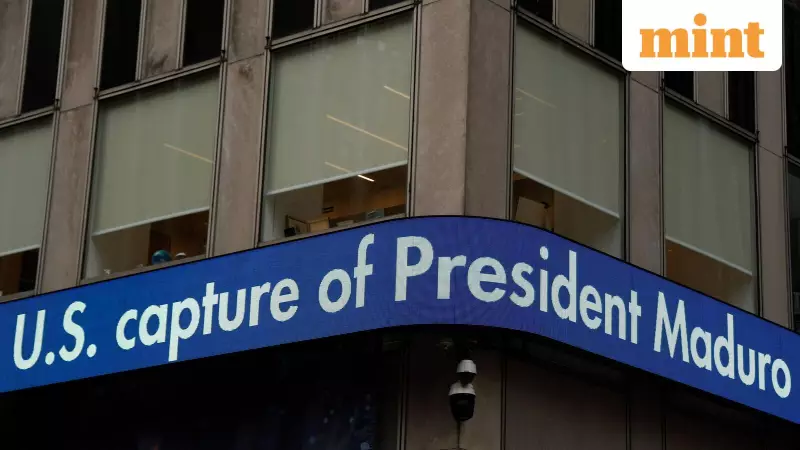
The dramatic capture of Venezuelan President Nicolás Maduro by U.S. military forces has sent shockwaves through global politics, but its most significant long-term impact may be felt in the intricate world of oil markets. For years, Venezuela's vast petroleum potential has been sidelined by sanctions and political turmoil. Now, with the U.S. pledging deep involvement in fixing the nation's "badly broken" oil infrastructure, the energy sector is recalibrating for a future where Venezuelan crude could steadily return to international markets.
Near-Term Winners: A Boon for U.S. Gulf Coast Refineries
The most immediate beneficiaries of a U.S.-aligned Venezuela are set to be the complex refineries lining the U.S. Gulf Coast. These facilities were specifically engineered to process heavy, sulfur-rich crude oil—the exact type that Venezuela holds in abundance. Years of sanctions on Caracas and Moscow forced these refiners to seek alternative, often costlier, supplies, squeezing their profit margins.
Even a modest but reliable resumption of Venezuelan flows would offer these plants greater flexibility and improved economics. They can typically purchase such heavy grades at a discount. Data from October highlights the existing, though limited, trade: U.S. refiners imported roughly 4.2 million barrels of Venezuelan crude that month.

Valero Energy led the imports with about 1.6 million barrels, followed by Paulsboro Refining (PBF Energy) at 1.2 million barrels, Chevron at 1.0 million barrels, and Phillips 66 at approximately 0.5 million barrels. Crucially, these volumes are currently dwarfed by imports from other heavy-crude suppliers like Mexico, Colombia, and Guyana, indicating there is significant room for Venezuelan barrels to re-enter the mix without overwhelming the system.
The key for refiners is not volume alone, but reliability. Bankable, insurable, and tradable Venezuelan crude would simply widen the menu of options for complex refiners, improving their feedstock economics at the margin.
Long-Term Strategic Shift: The Canadian Conundrum
While U.S. refiners may gain in the short term, the most compelling narrative unfolds for Canada's oil sands industry. Venezuela's prolonged absence from Western markets allowed Canadian heavy crude to become the dominant supplier to U.S. refineries configured for such grades. Canada now exports about 3.3 million barrels per day to its southern neighbor, accounting for roughly a quarter of all U.S. refinery throughput.
A normalization of Venezuelan exports under U.S. influence reintroduces direct competition. Both Venezuelan and Canadian oil sands crude are heavy, high-sulfur grades targeting the same complex U.S. refineries. This could challenge the unusually favorable market position Canada has enjoyed.
This dynamic hits at a core strategic vulnerability long recognized in Ottawa: Canada's overwhelming dependence on the U.S. oil market. Efforts to diversify, such as the recently operational Trans Mountain pipeline expansion to the Pacific coast, aim to open access to Asian markets. However, ambitious projects to reach Atlantic tidewater remain stalled. For now, the U.S. is still the dominant buyer.
This creates a long-dated risk for major Canadian producers like Suncor, Cenovus Energy, Canadian Natural Resources, and Imperial Oil. Renewed competition from Venezuela could cap the price premiums for heavy crude, eroding the scarcity benefit that has supported oil sands margins. This comes just as Canada struggles to achieve meaningful export diversification.
Global Oil Balances and Insulated Players
It is vital to note that Venezuela's return will not rapidly alter global oil prices. The country currently produces only about 1 million barrels per day, a mere 1% of global supply. Decades of mismanagement at state-owned PDVSA mean any production recovery will be slow and capital-intensive. Near-term price drivers will remain OPEC+ policy, Russian export levels, and global demand.

Notably, U.S. shale producers are largely insulated from this shift. Their output is predominantly light, sweet crude, which is not a direct substitute for Venezuela's heavy oil. Their economics depend on drilling costs and productivity, not competition in the heavy crude segment.
In summary, the regime change in Venezuela sets the stage for a gradual recalibration of heavy oil markets. U.S. Gulf Coast refiners are poised for a feedstock advantage, while Canadian producers must confront a future where their main market has more options. The ripple effects of this geopolitical shift will be measured not in weeks, but in years, reshaping long-held supply relationships in the Western Hemisphere.





