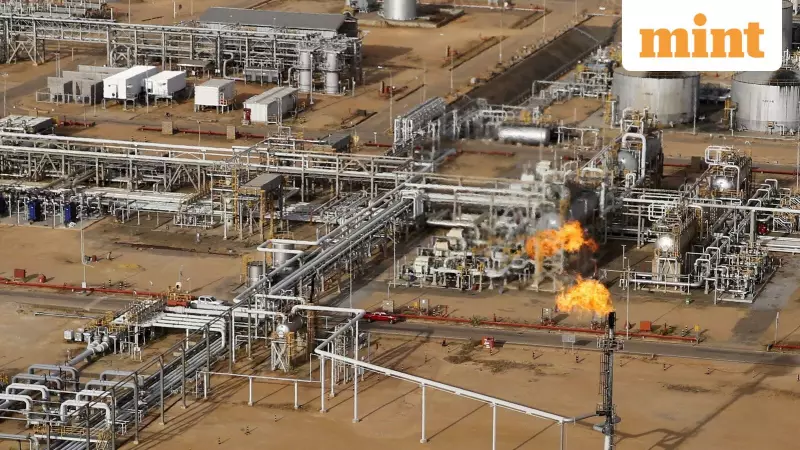
The dramatic capture of Venezuelan leader Nicolás Maduro has sent political shockwaves, but global energy markets have responded with notable calm. This muted reaction underscores a harsh reality for the South American nation: its profound economic challenges, often termed the 'resource curse,' run far deeper than a change in political leadership.
Market Restraint Amid Political Drama
Despite President Donald Trump's announcement that the U.S. would "run" Venezuela to ensure a transition and that American oil firms would enter to rebuild its energy sector—using military force if needed—the financial world has not panicked or celebrated. Brent crude oil continues to trade below $60 per barrel, a price more than $10 lower than when Trump began his term a year ago. Shares of major integrated oil companies like Chevron and Exxon Mobil have seen only modest gains.
This restraint signals that investors are wisely separating headline-grabbing geopolitics from the underlying supply fundamentals. The immediate event has not altered the outlook for oil equities, highlighting Venezuela's diminished role in global oil supply. The country now ranks as the world's 21st-largest producer, pumping roughly one million barrels per day, which accounts for less than 1% of global output.

The Structural Roots of Venezuela's Oil Crisis
The core constraint on Venezuela's oil production has always been structural and institutional, not merely political. For decades, the state-owned oil company, PDVSA, was treated as a cash cow for the government. Under both Hugo Chávez and Nicolás Maduro, it functioned primarily as a fiscal engine to fund state programs. This led to repeated contract revisions, chronic underinvestment, and a severe erosion of operational capacity.
The country's infrastructure is degraded, and years of mismanagement have driven away skilled labour. Furthermore, Venezuela's crude is heavy and expensive to refine. Its production base is neither large enough nor flexible enough to influence global oil prices on its own. This scenario is a classic example of the resource curse, where abundant natural resources, paired with incentives for short-term profit extraction, ultimately destroy long-term value and investment potential.
As former Venezuelan oil minister and OPEC co-founder Juan Pablo Pérez Alfonzo famously warned, oil can be "the devil's excrement," distorting institutions instead of stabilising them. The lesson for global investors is clear: resources alone cannot generate returns without the foundation of good governance, rule of law, and legitimate institutions.
Uncertainty and the Long Road Ahead
The current political shift adds another layer of complexity. Maduro's arrest does not represent a clean, organised regime change. His deputy, Delcy Rodríguez, was swiftly sworn in as interim president on Monday. While U.S. officials have indicated a willingness to work with her, Rodríguez is deeply embedded within the existing power structure. This does little to resolve the fundamental legitimacy deficit that has plagued the Maduro government and any potential U.S.-backed replacement.
For long-term capital, especially in a capital-intensive sector like energy, legitimacy and stability are non-negotiable requirements. Achieving true security and rule of law in Venezuela will likely take far longer than the remainder of Trump's current term in office.
Beyond oil, Venezuela holds vast reserves of natural gas, gold, iron ore, bauxite, and critical minerals essential for advanced manufacturing and defence technologies. This broader resource base may factor into longer-term strategic calculations, particularly as Washington focuses on securing supply chains and access to critical materials within the hemisphere.
In the immediate term, however, Maduro's removal could have a positive side effect by reducing tensions with neighbouring Guyana, a fast-growing oil producer with significant U.S. investment. Maduro had aggressively pursued Venezuela's historical claim over Guyana's oil-rich Essequibo region, threatening foreign operators. Easing this geopolitical flashpoint may ultimately benefit market stability more than any quick revival of Venezuelan production.

For now, market fundamentals remain firmly in control. There is no imminent surge in Venezuelan supply, no tightening of global oil balances, and no clear catalyst for oil prices to rise based solely on this political development. The resource story of Venezuela will unfold over a decade, not in the weeks and months that financial markets typically focus on.