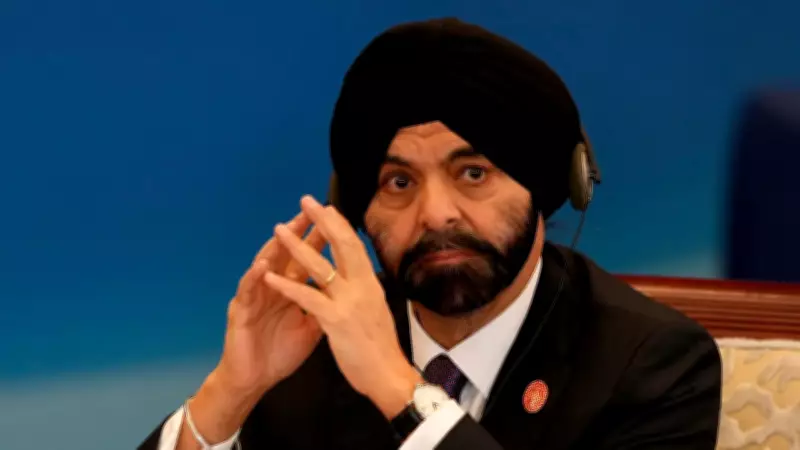
World Bank Group President Ajay Banga has called on India to shift its focus from tariffs to broader trade opportunities, emphasizing the need for strategic engagement in an evolving global landscape. Speaking during a visit to the Central Tool Room and Training Centre in Bhubaneswar on Thursday, Banga highlighted India's growing network of trade agreements as a testament to its expanding economic influence.
Strategic Shift in Trade Policy
Banga's remarks come at a time when geopolitical tensions continue to cast uncertainty over global trade prospects. He urged Indian policymakers to think less about tariffs and more about leveraging opportunities, pointing to the recently concluded India-European Union free trade agreement as a prime example of this approach. All trade deals are important in today's changing world, he stressed during his interaction with media representatives.
India's Growing Trade Footprint
The World Bank chief noted that India has signed more than 100 regional and bilateral trade pacts over the past two decades, demonstrating consistent commitment to economic integration. Think less about the tariffs, and more about the opportunities like you have done with the European Union, Banga advised, underscoring the strategic value of such agreements.

Transformation of Global Commerce
Banga provided compelling data about the dramatic shifts in world trade patterns over recent years. Global trade has quadrupled over the last two decades, while the share of emerging markets has doubled from 20 percent to 40 percent. This transformation has positioned countries like India as key components in the global trade ecosystem, according to the World Bank president.
The Landmark India-EU Agreement
The India-European Union free trade agreement, often described as the mother of all deals, represents a significant milestone in India's trade diplomacy. Finalized after negotiations spanning nearly two decades, this pact creates a combined market of approximately 2 billion people, bringing together the world's fourth-largest economy (India) and the second-largest economic bloc (the EU).
Under this comprehensive agreement:
- 93 percent of Indian shipments will gain duty-free access to the 27-nation European Union
- Imports of luxury cars and wines from the EU are set to become more affordable for Indian consumers
- Both economies stand to benefit from enhanced market access and reduced trade barriers
Broader Implications for Emerging Economies
Banga's observations highlight the changing dynamics of international trade, where emerging markets have substantially increased their participation and influence. His comments suggest that countries like India should continue pursuing strategic trade partnerships that extend beyond tariff considerations to encompass broader economic opportunities and market access.
The World Bank president's visit to Bhubaneswar and his emphasis on trade expansion comes as India continues to navigate complex global economic relationships while seeking to strengthen its position in international commerce.