

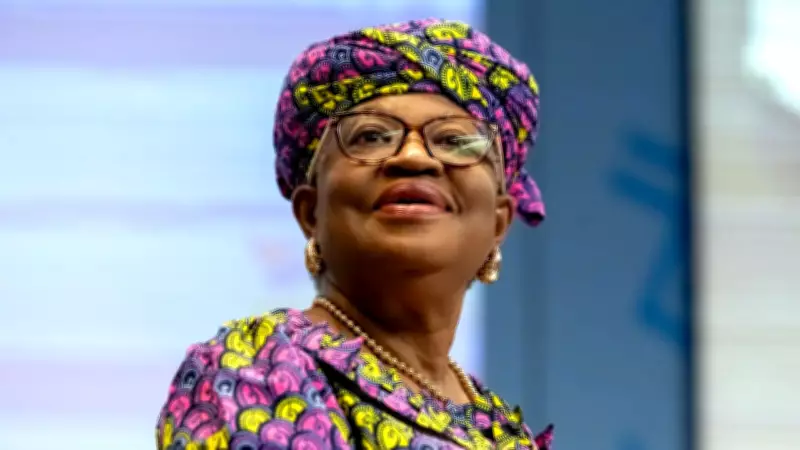
WTO Chief Warns of 'Chaos' Without Urgent Structural Reforms to Global Trading System
The World Trade Organization (WTO) is facing a critical juncture that demands immediate structural reform as the global trading system navigates rapid economic and technological transformations, according to WTO Director-General Ngozi Okonjo-Iweala. In a stark warning delivered in Geneva, she emphasized that preserving the current framework is no longer a viable option, with potential consequences including widespread instability and chaos for international commerce.
Inflection Point for Multilateral Trade
Speaking on Wednesday, Okonjo-Iweala declared that the WTO and the broader multilateral system are at a decisive inflection point. "We are meeting today at an inflection point, not just for the WTO, but... for the multilateral system," she stated. She underscored that failure to adapt and preserve the global trading framework could trigger significant instability, adding emphatically, "I don't think the status quo is an option."
Reform is expected to be a central agenda item at the upcoming WTO ministerial meeting scheduled in Cameroon next month, highlighting the urgency of addressing these systemic challenges.

Operational Challenges and Geopolitical Pressures
The WTO, which governs substantial portions of global trade flows, has been grappling with operational hurdles due to its consensus-based decision-making structure. Additionally, its dispute settlement mechanism has been significantly weakened amid escalating tensions, particularly with the United States.
Geopolitical pressures have intensified, especially following the return of former US President Donald Trump to the White House last year, which has exacerbated trade tensions and further strained the organization's functionality.
Need for Adaptation to Technological Shifts
Okonjo-Iweala stressed that global institutions must evolve in tandem with rapid technological and economic changes. "The world is moving so fast... If you look at the speed at which technology is moving, and AI is moving and quantum technologies are moving," she noted. She warned that organizations failing to adapt risk being left behind, asserting, "If your organisation doesn't adapt, then you'll be left behind."
WTO's Foundational Role Amid Challenges
Despite these growing challenges, Okonjo-Iweala highlighted the WTO's crucial role in providing trade certainty and stability. "This organisation provides stability and predictability," she said, adding that "in spite of all the knocks, it is still the bedrock for so much of world trade."
Consequences of a Breakdown
She cautioned that a collapse of the multilateral trading framework would create profound uncertainty for businesses and global commerce. "If we don't have this system, what does it mean? I'll be very honest with you: there'll be chaos," she warned.
Elaborating on the potential chaos, she described scenarios where businesses would face unpredictable tariffs and unknown regulations. "It means a business will send goods somewhere without the knowledge of how those goods will be valued when it arrives at customs... you wouldn't know how your goods will be valued before you're tariffed. You wouldn't know whether you're going to make money or not," she explained.
Further, she added, "You'll be confronted when your goods arrive with rules that you were never aware of," painting a picture of a fragmented and unstable global trade environment without the WTO's guiding framework.






