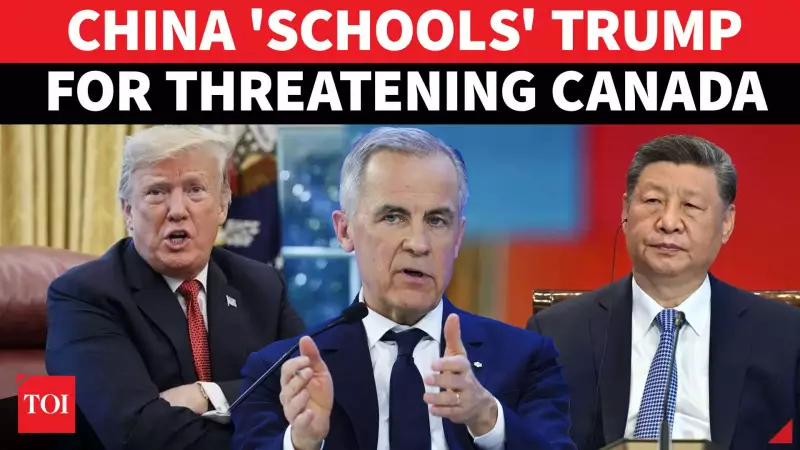
Canada finds itself unexpectedly positioned at the epicenter of a rapidly escalating global trade confrontation. The situation intensified dramatically when United States President Donald Trump issued stark warnings about imposing potentially devastating 100% tariffs, creating immediate economic uncertainty across international markets.
Divergent Approaches: Confrontation Versus Cooperation
In a striking contrast of diplomatic philosophies, Chinese leadership under Xi Jinping has presented what they term a "win-win" approach to international relations. Beijing has explicitly rejected Washington's recent warnings, instead calling for enhanced cooperation over what they perceive as unnecessary confrontation. Chinese officials have firmly denied allegations that their strengthening ties with Canada are designed to target any third nation, emphasizing their commitment to mutually beneficial partnerships.
Canada's Precarious Balancing Act
Meanwhile, Canadian Prime Minister Mark Carney has publicly asserted that Ottawa has absolutely no current plans to pursue a comprehensive free trade agreement with China. This declaration comes as Canada navigates the complex provisions of the Canada-United States-Mexico Agreement (CUSMA), which imposes significant restrictions on independent trade negotiations with non-member nations.

The Canadian government now walks an exceptionally narrow diplomatic line, attempting to maintain crucial economic relationships with both superpowers while adhering to binding trade commitments. This delicate balancing act has become increasingly challenging as pressure mounts from multiple directions.
Trade as Strategic Leverage in Great-Power Competition
This unfolding scenario vividly illustrates how international trade mechanisms are being transformed into instruments of strategic leverage within the intensifying rivalry between global powers. The traditional concept of economic neutrality appears increasingly difficult to sustain as nations face mounting pressure to align with competing geopolitical blocs.
The current standoff reveals fundamental shifts in how major economies utilize trade policy not merely for economic advantage but as tools of diplomatic influence and strategic positioning. As Trump escalates economic pressure through tariff threats and China promotes its alternative vision of international cooperation, middle powers like Canada face increasingly complex decisions about their economic alignments and diplomatic postures.
Broader Implications for Global Trade Architecture
This confrontation extends beyond immediate bilateral tensions, potentially reshaping the foundational principles that have governed international commerce for decades. The escalating rhetoric and policy maneuvers suggest that the established global trade order faces unprecedented challenges as competing visions for economic governance collide.
Observers note that the current situation represents a critical test case for how nations will navigate the emerging multipolar world order, where economic relationships increasingly reflect broader strategic competitions. The outcome of this particular standoff may establish important precedents for how trade disputes are managed in an era of renewed great-power rivalry.