CBSE Class 12 Mathematics Board Exam 2026 Successfully Conducted Nationwide
The Central Board of Secondary Education (CBSE) successfully administered the Class 12 Mathematics board examination for the academic year 2026 on March 9, 2026. The crucial exam took place from 10:30 am to 1:30 pm across numerous examination centers throughout India, adhering strictly to the pre-announced official schedule.
Question Paper Now Available for Download and Review
Following the conclusion of the examination, the CBSE has made the Class 12 Mathematics question paper for 2026 available in PDF format. This document is provided for the reference and convenience of students, educators, and parents. Mathematics remains a pivotal subject for students pursuing both the Science and Commerce streams, making this board exam a significant milestone within the Class 12 assessment framework.
It is common practice for students and teachers to analyze the question paper post-exam to evaluate the question pattern, gauge the overall difficulty level, and draw comparisons with papers from previous years.

Student Feedback: A Balanced Yet Challenging Paper
Initial reactions and feedback collected from students indicate that the 2026 Mathematics paper was generally perceived as balanced but time-intensive. Many students described the overall difficulty as moderate to moderately difficult.
Students reported to sources that while the questions were predominantly based on the prescribed syllabus, effective time management became a critical factor, especially during the final hour of the examination. A particular point of consensus among examinees was the challenging nature of Section D, which comprises long-answer questions. This section was noted for requiring extensive and detailed calculations, contributing to the paper's time-consuming character.
Detailed Breakdown of the CBSE Class 12 Maths Exam Pattern
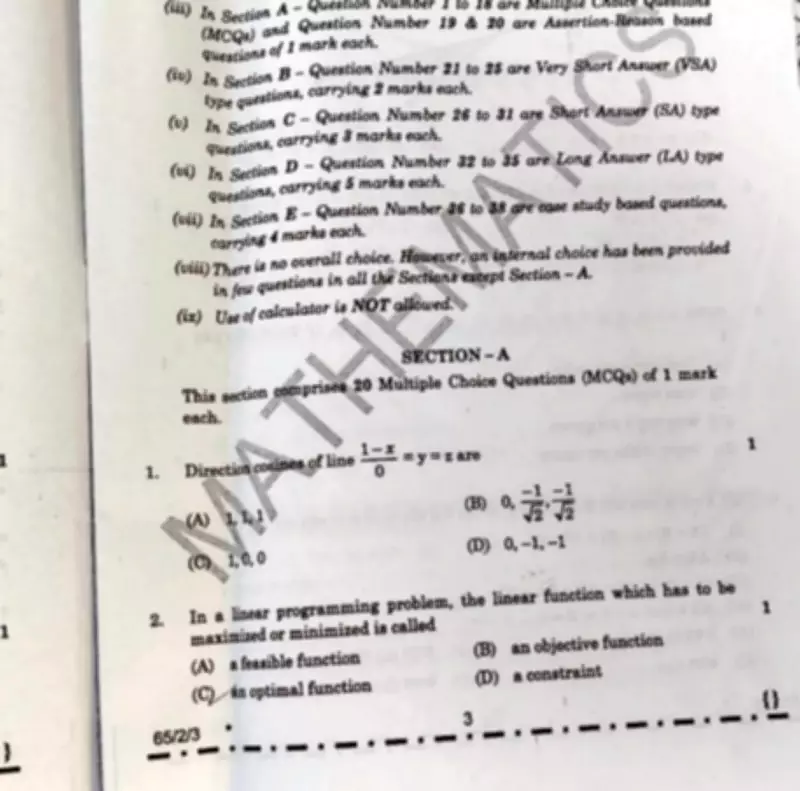
The CBSE Class 12 Mathematics question paper for 2026 followed a structured format, divided into five distinct sections:
- Section A: This section consisted of Multiple Choice Questions (MCQs).
- Section B: Comprised very short answer type questions.
- Section C: Featured short answer questions that required brief calculations.
- Section D: Contained long answer questions demanding step-by-step solutions, identified by students as particularly demanding.
- Section E: Included case study-based questions designed to apply mathematical concepts to real-life scenarios.
The examination carries a total of 100 marks. Out of this total, 80 marks are allocated to the written theory examination that students attempted. The remaining marks are typically assigned to internal assessment or practical components, as per the board's evaluation scheme.
The availability of the question paper allows for a thorough post-mortem analysis, helping future batches understand expectations and preparation strategies for this key academic hurdle.