JEE Main 2026 Day 3 Shift 1: Comprehensive Analysis and Student Feedback
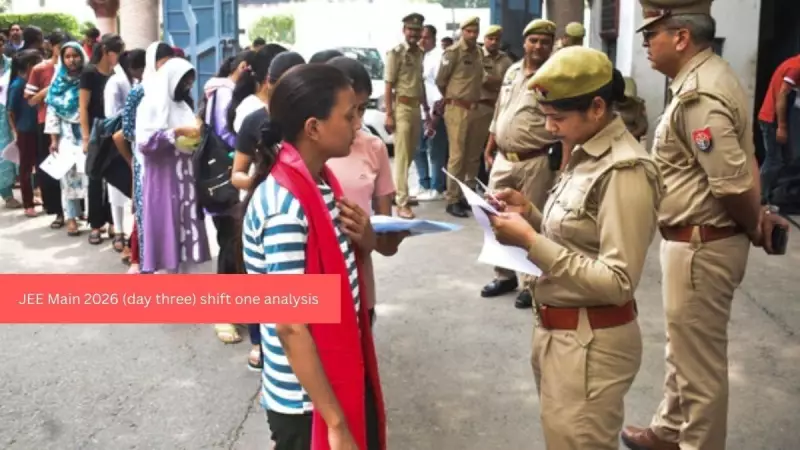
The Joint Entrance Examination (JEE) Main 2026 continued with its third day of sessions, and the first shift has concluded, drawing significant attention from aspiring engineers across India. This crucial exam, conducted by the National Testing Agency (NTA), serves as the gateway to prestigious engineering institutions like the Indian Institutes of Technology (IITs) and National Institutes of Technology (NITs). As students emerged from the examination halls, early reviews and analyses have started to surface, providing a glimpse into the paper's structure and challenge level.
Overall Difficulty Level and Paper Pattern
Initial reports from students and educators suggest that the JEE Main 2026 Day 3 Shift 1 question paper maintained a moderate to difficult overall difficulty level. The exam followed the standard pattern, comprising multiple-choice questions and numerical value-based questions across three core subjects: Physics, Chemistry, and Mathematics. According to preliminary feedback, the paper was well-balanced but posed significant challenges in specific topics, testing students' conceptual understanding and problem-solving skills under time constraints.
Subject-Wise Breakdown and Key Highlights
Physics Section: The Physics portion was noted for its emphasis on application-based questions, particularly in topics like electromagnetism, mechanics, and modern physics. Students reported that while the questions were conceptually sound, they required in-depth knowledge and quick calculations. Some numerical problems were described as tricky, demanding a clear grasp of fundamental principles.

Chemistry Section: Chemistry was divided into Physical, Organic, and Inorganic segments. Feedback indicates that Physical Chemistry questions were calculation-intensive, focusing on thermodynamics and chemical kinetics. Organic Chemistry involved reaction mechanisms and named reactions, whereas Inorganic Chemistry covered factual knowledge from the NCERT syllabus. Overall, this section was perceived as moderately difficult, with a mix of direct and application-oriented questions.
Mathematics Section: Mathematics emerged as the most challenging section for many test-takers. Questions from calculus, algebra, and coordinate geometry were reported to be lengthy and complex, requiring strong analytical skills. Students highlighted that time management was crucial here, as solving these problems within the allotted time proved demanding.
Student Reactions and Expert Insights
Post-exam, students shared mixed reactions on social media and discussion forums. Many expressed that the paper was tougher than expected, especially in Mathematics, while others appreciated the fair distribution of questions across topics. Education experts analyzing the paper noted that it aligned with recent trends, focusing on reducing rote learning and promoting critical thinking. They advised future aspirants to strengthen their basics and practice time-bound mock tests to handle such papers effectively.
Implications for Upcoming Shifts and Preparation Tips
As JEE Main 2026 progresses with multiple shifts, this analysis serves as a valuable reference for students scheduled for later sessions. Key takeaways include:
- Focus on application-based learning rather than memorization.
- Prioritize time management during the exam, especially in Mathematics.
- Revise NCERT textbooks thoroughly for Chemistry and Physics fundamentals.
- Practice previous years' papers and mock tests to build speed and accuracy.
The NTA is expected to release the official answer key and results in due course, but until then, this early review helps gauge the exam's trajectory and aids in strategic preparation for remaining attempts.