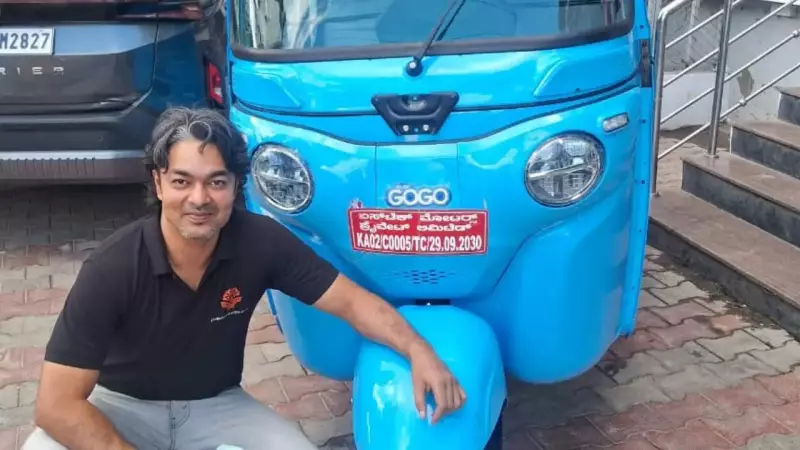
Rakesh B. Pal speaks English with a near-perfect accent and clear enunciation. He is sharp, intelligent, and an avid reader who balances martial arts training every morning with dance classes in the evening. Surprisingly, he drives an auto rickshaw for a living. What makes his story truly striking is not just where he is today, but where he once was—a successful professional in the corporate world.
A Promising Corporate Career
Rakesh spent over a decade working with several leading multinational corporations—companies that many aspire to join but few manage to enter. He began his career as a voice and accent trainer with an American firm based in Bengaluru and steadily climbed the corporate ladder through hard work and dedication.
The Dark Side of Corporate Hierarchies
"The higher I went, the more difficult it became," he recalls with candor. "I even switched jobs, but the manipulation was everywhere. You join a profession believing hard work will be rewarded. But what happens when your boss feels insecure? Instead of supporting you, he begins to undermine you. How long can anyone endure that?"

Sharing his painful experience, Rakesh raises uncomfortable but important questions about corporate structures. "You are often made to take on work that isn't yours. Senior leaders may privately appreciate your hard work, but when it comes to taking a stand against your immediate boss, they choose hierarchy over fairness."
He describes how certain managers can slowly erode an employee's confidence—pointing out mistakes without offering guidance, taking credit for others' work, and using intimidation as a management tool. "You call them managers? These are not managers," he says emphatically. "They are demotivators."
A Breaking Point at the Bank
While working at a well-known global bank, Rakesh encountered a manager who felt deeply insecure about his own position. "He began spreading false rumors about me. I tried to set boundaries, but it's not easy when the power equation is stacked against you." When Rakesh escalated the issue to higher management, the response proved disappointing. "They chose to protect him instead of addressing the problem."
Ironically, his role at the bank demanded precision and integrity—similar to the fraud-prevention role portrayed by Tom Hanks in Catch Me If You Can. Rakesh's job involved scrutinizing the smallest discrepancies, down to punctuation errors or inconsistencies in signatures. "If I noticed an anomaly, I had to call the person involved and question it," he explains. "Yet false mistakes were later pinned on me to block promotions."
Personal Struggles and Health Challenges
At the same time, Rakesh was dealing with a serious health issue. He had hearing problems and wore a visible hearing aid. "There were people in my team who whispered, judged, and excluded me. I wondered what problems people would have with someone with a hearing problem, till I stopped wearing one after my surgery. Even these things can impact your peace in a corporate environment. People can be ruthless!"
The Descent into Depression
Over time, the pressure became unbearable. "Targets in companies simply crush you down. They are always excessive and come with crushing pressure," Rakesh observes. "Targets had nothing to do with talent or individual capacity. People were treated like resources, nothing more."
Eventually, the toxic environment pushed him into clinical depression. He did not want to quit his job, but he could not continue under a boss who seemed hell-bent on making his life difficult. For months, Rakesh barely left his room. He ate on his bed, avoided people, and lost all sense of self-worth. He gained significant weight, felt disconnected from his family, and sought psychiatric help.
"One day I looked at my reflection and didn't recognise myself. I had piled up a huge amount of weight. I knew I wouldn't survive if I didn't change something." That moment became his turning point toward recovery and transformation.
The Road to Recovery and Reinvention
Rakesh began intermittent fasting, limiting his meals to a six-hour window each day. The weight loss was quick, but more importantly, it restored his confidence. "For the first time in a long while, I felt capable again," he shares.

Slowly, he stepped back into the world. He took up a job as a gym trainer—often doing cleaning work alongside training sessions—for a modest salary of ₹5,000 per month. "I didn't want my five-year-old daughter to ask for a chocolate I couldn't afford." He took on odd jobs, including food delivery, and saved every rupee diligently.
A New Beginning Behind the Wheel
When he finally had enough for a down payment, he made a decision that marked his independence: he bought an auto rickshaw. Today, Rakesh drives for a living—not as a symbol of failure, but of survival, dignity, and conscious choice.
When asked how he feels about driving an auto after quitting a high-paying white-collar job, Rakesh's response is hard-hitting and reflective. "I was doing a job which almost took away my sanity. For a few thousand rupees, I had sold my soul to a company that would not care for me or side with me if something unfair happened. My talent was being judged by a boss who was incapable and insecure. I had no time for my family and child, and no time for things I earlier loved to do. Would you call such a job worthwhile or even decent?"
"Now I drive an auto for 6-7 hours a day. I have an Instagram account and, above all, I am a happy person. Like no one actually cares about you, you should not care too much about what others think of you."
"I lost a career," he says quietly, "but I found myself."