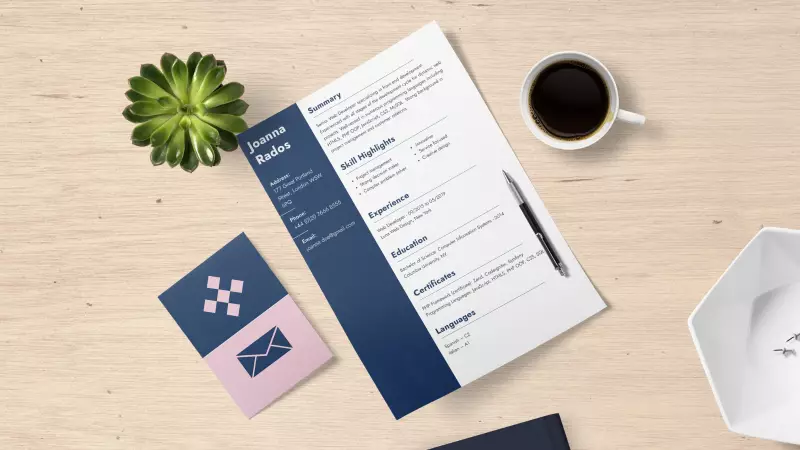
For decades, the resume has been the undisputed passport to a professional career. That crisp document, summarizing years of work into neat bullet points, was the critical first impression for any job seeker. But a quiet revolution is transforming the global hiring landscape, moving the focus from polished paper credentials to demonstrable, real-world ability.
The Decline of the Resume and Rise of Proven Skills
The corporate world's faith in the traditional resume is waning. This change is not merely a passing trend led by Generation Z or driven solely by artificial intelligence. Instead, it represents a fundamental rethink by companies across industries and continents. Hiring managers are increasingly bypassing the question of where you have worked to ask a more direct one: What can you actually do for us? The emphasis is shifting decisively from credentials to proven competence.
Data from TestGorilla’s The State of Skills-Based Hiring 2023 report underscores this transformation. The study, which surveyed 3,000 employers and employees globally, found that nearly 75% of companies now use skills-based assessments in their hiring process. This is a significant jump from 56% just a year before. While many organizations still request CVs, their role is diminishing; they are now seen as providing context, not concrete evidence of capability.

Measurable Impact: Better Hires, Lower Costs
The results of this shift are compelling and quantifiable. Employers who have adopted skills-based hiring report dramatic improvements in their recruitment outcomes. According to TestGorilla's findings, these companies saw an 88% reduction in mis-hires. Furthermore, the time spent searching for candidates fell by 82%, and overall hiring costs dropped by 74%.
Perhaps more tellingly, 92% of the employers surveyed stated that skills-based assessments were more effective than simply screening traditional resumes. Over 80% agreed that this method was more predictive of future job performance and led to better employee retention. The logic is straightforward: when candidates are tested on tasks that mirror the actual job, guesswork is eliminated. Job titles and prestigious company names lose their sheen, while raw ability and skill take center stage.
Creating a Fairer and More Inclusive Job Market
Contrary to what some might assume, job seekers are not resisting this change. Research indicates that most workers believe skills testing creates a fairer process and improves their chances of landing a meaningful role that matches their abilities. This impact is particularly powerful for groups often overlooked in traditional hiring.
The report highlights that nearly three-quarters of Black, Asian, and Arab professionals surveyed felt that skills-based assessments helped them access new job opportunities. The resume's historical bias towards pedigree, elite education, and polished self-presentation weakens when on-the-job performance becomes the primary metric. This trend aligns with moves by major tech giants like Google, Microsoft, IBM, and Apple, which have removed formal degree requirements for many roles to widen their talent pools and reduce barriers to entry.
The resume is not yet obsolete, but its era of dominance is ending. In today's evolving labour market, the future belongs to those who can demonstrate tangible value, adapt quickly, and prove their skills in real time. For job seekers and employers alike, the defining question of a career is no longer about one's past on paper, but about what one can deliver now.