New Delhi | December 24, 2025 01:14 PM IST
The UPSC Essentials initiative presents its 134th week of Mains answer writing practice, focusing on crucial topics from the General Studies Paper 2 syllabus. This segment is designed to enhance conceptual clarity and structured answer-writing skills for aspirants of the UPSC Civil Services Mains Examination. This week's practice features two pivotal questions concerning India's foreign policy and strategic agreements.
Question 1: The Strategic Fit of the India-Oman Trade Deal
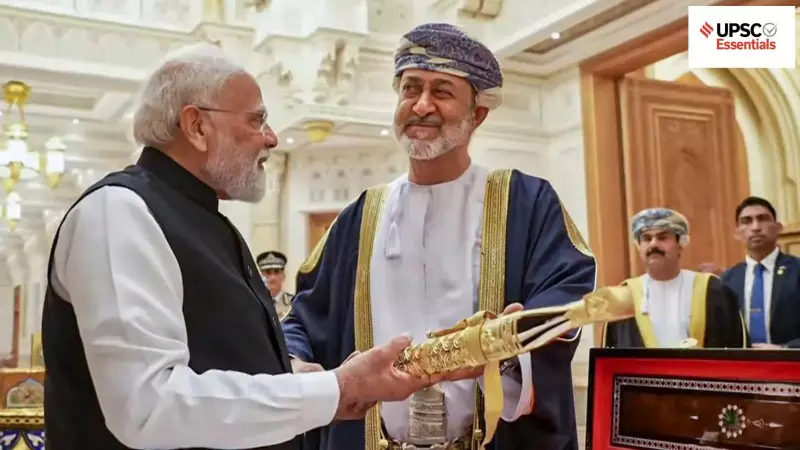
The first question prompts a discussion on how the recently concluded India-Oman trade agreement aligns with and advances India's broader strategic objectives in West Asia. This deal emerges against a backdrop of increasing trade barriers, such as tariffs in the United States and the Carbon Border Adjustment Mechanism (CBAM) in the European Union.

Analysts note that this pact is a key component of India's accelerated push for Free Trade Agreements (FTAs). It aims to secure alternative export markets and diversify trade partnerships amidst global economic uncertainties. A significant driver for this agreement is the Indian exporters' demand for better access to Arab markets, which often have less stringent standards compared to the EU, thereby reducing compliance costs and non-tariff barriers.
Key Dimensions of the Oman Agreement
While bilateral talks for a comprehensive trade deal with the Gulf Cooperation Council (GCC) have stalled, India has now secured agreements with two of its members: the United Arab Emirates and Oman. Although Oman's market is smaller and less diversified than the UAE's, its strategic geographical location offers a crucial gateway for Indian products to reach other markets in the region and Africa.
A notable aspect is Oman's existing FTA with the United States, operational since 2009. This allows a range of Omani products, including industrial supplies and jewellery, duty-free access to the US market. For India, this presents an indirect advantage, especially for sectors like gems and jewellery facing tariff pressures elsewhere.
The deal grants Indian products zero-duty access on approximately 98 per cent of Oman's tariff lines, potentially boosting the competitiveness of Indian industrial exports. Oman's primary exports to India, such as crude oil, liquefied natural gas, and fertilisers, are already critical for India's energy security and enjoy low tariffs under other pacts.
On the services front, Oman's global services imports are valued at around $12.52 billion. India currently holds a 5.31 per cent share in this basket. The agreement includes substantial Omani commitments across sectors like computer services, business services, audio-visual, R&D, education, and health, opening new avenues for Indian service providers.
Question 2: Regional Security Implications of India-Russia RELOS
The second practice question examines the impact of the India-Russia Reciprocal Exchange of Logistics Support (RELOS) agreement on security dynamics in the Indian Ocean Region (IOR) and the wider Indo-Pacific.
The RELOS pact establishes formal procedures for the movement and logistical support of military formations, warships, and aircraft between the two nations. It facilitates mutual use of airspace and port calls, creating a structured framework for military cooperation.
Operational Reach and Strategic Access
For India, RELOS provides an institutional mechanism for access to Russian naval and air bases across a vast expanse—from Vladivostok in the Pacific to Murmansk in the Arctic. This access for refuelling, repairs, and maintenance significantly enhances the operational reach and readiness of the Indian Navy and Air Force, particularly for platforms of Russian origin.
The agreement is tailored for use during joint exercises, training, and humanitarian assistance and disaster relief (HADR) operations. Reciprocally, Russian forces gain greater access to Indian ports and airfields, deepening bilateral defence interoperability.

In the broader strategic context, RELOS supports India's Indo-Pacific strategy by leveraging Russia's extensive base network. Access to over 40 Russian facilities allows Indian forces to sustain longer deployments far from home shores. This agreement exists alongside similar foundational pacts India has with the United States—LEMOA, COMCASA, and BECA.
While these agreements collectively strengthen India's capabilities as a key partner in forums like the Quad, they also position India as a more capable actor in balancing influences and contributing to a free and open Indo-Pacific, aligning with broader regional security objectives.
Essential Tools for UPSC Aspirants
This answer-writing practice is a value-addition for serious candidates. Incorporating the outlined thought processes, key data points, and structured arguments can significantly improve answer quality. Aspirants are encouraged to attempt these questions, engage with the suggested 'Points to Ponder', and participate in discussions for comprehensive preparation.