For aspirants of the Union Public Service Commission (UPSC) Civil Services Examination, staying abreast of current affairs and their analytical dimensions is paramount. The Indian Express UPSC Key for December 29, 2025, curated by Roshni Yadav, dissects several critical issues relevant to both the Preliminary and Main stages of the exam. The analysis spans governance, polity, economy, and international relations, offering a comprehensive study resource.
Governance & Technology: Replicating PRAGATI in States
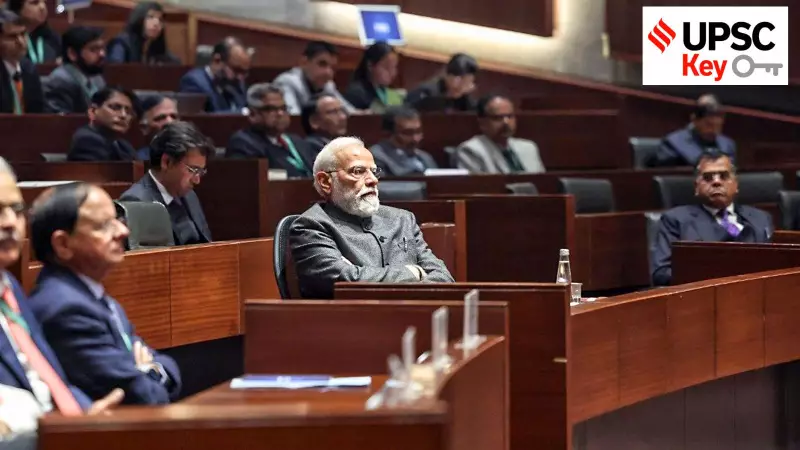
At the fifth National Conference of Chief Secretaries in New Delhi, Prime Minister Narendra Modi emphasized leveraging technology for effective governance. A key directive was for states to replicate the Centre's PRAGATI (Pro-Active Governance and Timely Implementation) platform. Launched in 2015, this digital system integrates data management, geo-spatial mapping, and video-conferencing to enable the PMO, Union Ministries, and State Governments to monitor critical infrastructure projects.
The platform is credited with expediting long-stalled projects like sections of National Highway 8 in Maharashtra, the Chenab Bridge in Jammu & Kashmir, and the Bogibeel Bridge in Assam. For UPSC aspirants, this topic touches multiple areas:

Prelims Relevance: Current events of national importance, and Polity & Governance.
Mains Relevance (GS-II): Government policies for development, e-governance applications, transparency, accountability, and cooperative federalism. PRAGATI serves as a potent case study for questions on eliminating bureaucratic delays, injecting accountability, and using technology for project monitoring.
PM Modi also advised Chief Secretaries to establish data strategy units and deregulation cells, streamline video conferences to free up field time for District Collectors, and prioritize the upcoming National Manufacturing Mission to boost 'Made in India' products.
Political Funding: The Quest for a Level Playing Field
The editorial page highlighted the persistent challenges in political funding and its impact on democratic competition. The discussion gains context after the Supreme Court struck down the Electoral Bonds scheme. The focus now shifts to Electoral Trusts, introduced in 2013, which are required to report donations and beneficiaries to the Election Commission.
While more transparent than bonds, concerns remain. The public cannot see which company donated to which party via a trust, information only available to the EC and Income Tax department. The article argues that the current system, reliant heavily on corporate donations, creates a quid pro quo environment and undermines financial parity among political parties. This disadvantages smaller or non-ruling parties.
Key points for aspirants include the debate on state funding of elections, the need for bringing parties under the Right to Information (RTI) Act, and enforcing internal democracy within them. The topic is crucial for GS-II (Governance) and questions on the Representation of the People Act.
Global Geopolitics: A Year of Reset and India's Stance
The year 2025 was analyzed as a period of significant global realignment. For India, key developments included:
Strained US Ties: The second term of US President Donald Trump saw the imposition of high tariffs on India and claims of credit for halting India-Pakistan conflicts, affecting strategic trust.
New Redlines with Pakistan: After the Pahalgam terror attack, India's Operation Sindoor established that any future terror attack would be treated as an act of war, rejecting nuclear blackmail.
Neighbourhood Flux: Regime changes in Nepal driven by Gen Z protests and ongoing political turmoil in Bangladesh tested India's 'Neighbourhood First' policy.
Strategic Autonomy: As relations with the US cooled, India engaged with China and Russia, hosting President Vladimir Putin and meeting President Xi Jinping, asserting its independent foreign policy.
This segment is vital for GS-II (International Relations), covering bilateral ties, regional groupings, and the impact of developed world policies on India's interests.

RBI's Rupee Policy: Balancing Competitiveness and Stability
Economists analyzed the Reserve Bank of India's management of the Indian rupee, which crossed the 90-mark against the US dollar. The article acknowledges that the current RBI regime has managed the currency more flexibly than during a previous period of a rigid peg, which drained over $150 billion in reserves.
However, it criticizes renewed intervention in mid-2025 to defend the rupee, arguing that a weaker currency is essential to protect export-oriented, labour-intensive sectors (like garments and gems) hit by US tariffs. The piece suggests that a further 10% depreciation might be necessary to offset competitive disadvantages against countries like China and to counter high tariffs, potentially bringing the rupee to 100 against the dollar.
For GS-III (Economy), this discussion covers exchange rate mechanisms, the Real Effective Exchange Rate (REER), export competitiveness, and the trade-offs in currency management.
Healthcare Meets Privacy: The Data Protection Rules, 2025
The recently notified Digital Personal Data Protection (DPDP) Rules, 2025, operationalizing the 2023 Act, bring significant implications for the healthcare sector. Every clinic, hospital, and health app becomes a 'data fiduciary', while patients are 'data principals' with rights to access, correct, and erase their information.
While promoting transparency, the rules create practical dilemmas. For instance, a patient's right to withdraw consent or request data erasure clashes with a hospital's legal obligation to maintain medical records for treatment and future care. The rules also lack specific data retention timelines for healthcare, creating uncertainty.
This topic is key for GS-II (Governance & Social Justice) regarding the design and implementation of new policies and their sectoral impacts.
Also in Brief: President Droupadi Murmu undertook a submarine sortie on INS Vaghsheer; nuclear scientist Anil Kakodkar discussed the viability of Small Modular Reactors (SMRs) and pathways to India's thorium-based energy independence; and a study warned that the sweetener sorbitol can be converted into fructose in the liver, posing health risks similar to sugar.