As the calendar turns to 2026, it is time to reflect on the pivotal events that defined the year 2025. From seismic political shifts in the neighbourhood to landmark achievements in space and contentious debates over law and art, these stories not only dominated headlines but also shaped the discourse for competitive examinations and informed citizens alike. Here is a look back at the top ten issues that captured the nation's attention.
Political History and Governance Milestones
The year 2025 marked the 50th anniversary of the National Emergency in India. Imposed on June 25, 1975, by the government of Prime Minister Indira Gandhi, the 21-month period saw the suspension of civil liberties, press censorship, and rule by decree until its lifting on March 21, 1977. This dark chapter in modern Indian political history sparked renewed discussions on constitutional safeguards and democratic resilience.
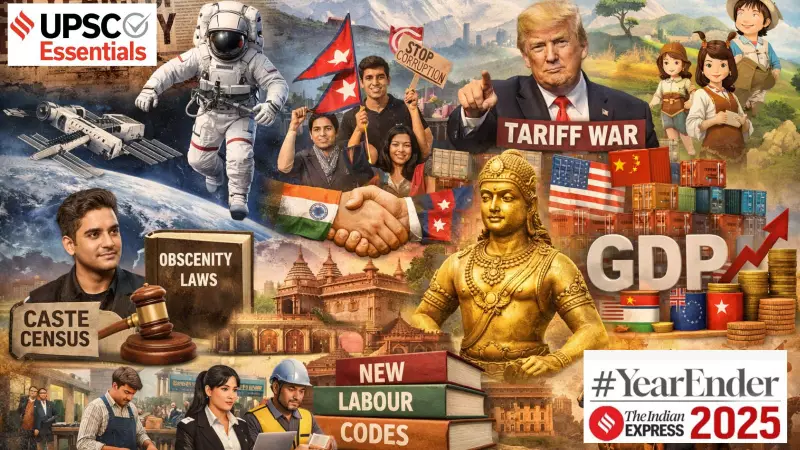
In a significant governance move, the Cabinet Committee on Political Affairs (CCPA) approved the inclusion of caste data in the upcoming population census on April 30. Announced by Union Minister Ashwini Vaishnaw, this decision revived a long-standing national debate on the role of caste enumeration in policy-making and social justice. This follows a history where the first synchronous census was conducted in 1881 by W.C. Plowden.

Furthermore, after a delay of over five years, the government implemented the four new labour codes effective November 21. These codes – covering wages, industrial relations, social security, and occupational safety – aim to streamline 29 central laws, easing compliance for employers while standardising wage and social security frameworks for workers.
Global Affairs and Economic Shifts
On the international stage, US President Donald Trump announced "reciprocal tariffs" on April 2, which he termed America's "Liberation Day." The policy involved a base 10% tariff on all countries, a sharp rise from the previous average of 2.5%, plus additional country-specific duties. Following global pushback, a 90-day pause was announced before the tariffs eventually kicked in on August 27.
Economically, India solidified its position as a global powerhouse. According to the International Monetary Fund's (IMF) World Economic Outlook of April 2025, India emerged as the world's fourth-largest economy, on par with Japan. The IMF also projected India to remain the fastest-growing major economy over the next two years, highlighting its resilient growth trajectory.
Science, Culture, and Society in Focus
India's space ambitions reached a new high with the successful Axiom-4 mission. Indian astronaut Group Captain Shubhanshu Shukla, along with three colleagues, splashed down in the Pacific Ocean on July 15 after an 18-day stint on the International Space Station (ISS). The mission, involving 288 Earth orbits, featured significant experiments led by Shukla, bolstering India's profile in human spaceflight and collaborative space research.
The cultural sphere witnessed a major controversy involving content creator Ranveer Allahbadia. During an episode of the show 'India's Got Latent', a crude joke led to public outrage and FIRs in Maharashtra and Assam. The incident brought legal concepts like the Hicklin Test – a legal standard for obscenity from the 1868 English case Regina vs Hicklin – back into public discussion. Allahbadia issued a public apology, and host Samay Raina removed all related videos.
In the realm of art and technology, the "Ghibli trend" went viral after ChatGPT's upgrade to its 4o model on March 25, which included advanced image generation. Users began creating photos in the distinctive style of Japan's Studio Ghibli, sparking viral social media trends. This phenomenon raised critical ethical and legal questions about AI training on copyrighted artwork and the future of human artists, echoing legendary animator Hayao Miyazaki's 2016 criticism of AI-generated art as an "insult to life itself."

India also celebrated its rich historical heritage, with Prime Minister Narendra Modi visiting Gangaikonda Cholapuram on July 27. He unveiled a commemorative coin and an exhibition honouring the 1,000th anniversary of Rajendra Chola I's maritime expedition to Southeast Asia. The Chola dynasty, one of the longest-ruling in world history, was lauded for its achievements in governance, society, and architecture.
Regional Upheaval and Youth Power
Perhaps one of the most dramatic stories of the year unfolded in neighbouring Nepal. On September 8 and 9, a Gen Z-led movement against social media bans and corruption escalated into massive, leaderless protests across Kathmandu. The intensity of the demonstrations led to the resignation of Prime Minister Khadga Prasad Oli on September 9, the dissolution of Parliament, and the subsequent swearing-in of former Supreme Court justice Sushila S Karki as interim Prime Minister on September 12.
These ten issues, spanning politics, economy, international relations, science, and culture, defined the news cycle of 2025. They provide crucial context for understanding the evolving landscape as we step into 2026, offering valuable insights for aspirants and keen observers of current affairs.