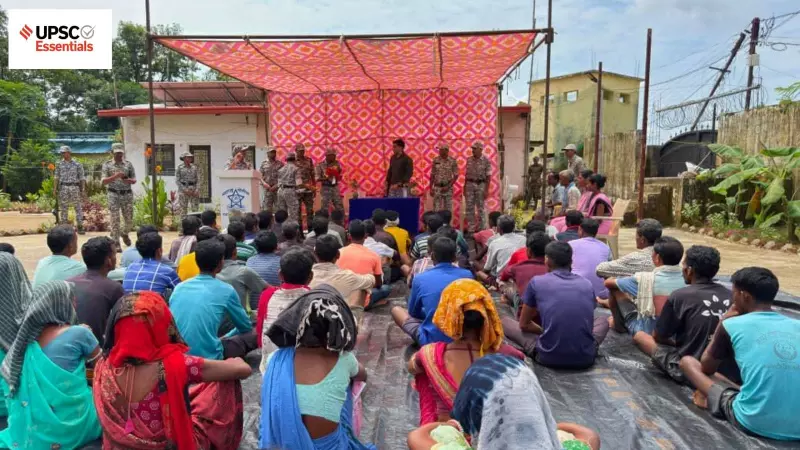
Are you gearing up for the UPSC Civil Services Examination (CSE) Prelims in 2026? Consistent revision through subject-wise quizzes is a proven strategy to solidify your grasp on static portions of the syllabus. This edition of the daily quiz focuses on Polity and Governance, covering crucial topics like the Panchayats (Extension to Scheduled Areas) Act, constitutional provisions on awards, emerging jurisprudence on personality rights, and landmark environmental cases.
Polity and Governance Quiz: Questions and Detailed Explanations
Attempt the following questions to assess your current understanding and identify areas that need more revision. The explanations provided will help clarify concepts and legal provisions.
Question 1: Understanding PESA Rules
With reference to the Panchayats (Extension to Scheduled Areas) Act (PESA) rules, consider the following statements:

- It is meant to recognise, empower and promote the social, economic, cultural and political way of life of the Scheduled Tribes.
- It directs the district magistrate to endow powers and authority to make Gram Sabhas and Panchayats function as Institutions of Local self-governance.
- Autonomous councils are covered by PESA.
How many of the statements given above are correct?
Explanation: The PESA Act is a landmark legislation for tribal self-governance. Statement 1 is correct as the core objective of PESA is indeed to recognise, empower, and promote the traditions of Scheduled Tribes. However, statement 2 is incorrect. The Act directs the state government, not the district magistrate, to delegate powers to Gram Sabhas and Panchayats. Statement 3 is also incorrect because PESA primarily applies to Fifth Schedule areas. Most North-Eastern states under the Sixth Schedule, which have their own autonomous councils, are not covered by PESA. Therefore, only one statement is correct.
Question 2: Constitutional Provisions on National Awards
Consider the following statements:
- The National Awards are considered as “titles” within the meaning of Article 18(1).
- Civilian awards such as Padma Shri and Bharat Ratna are not to be used as a prefix or suffix to names of the awardees.
Which of the statements given above is/are correct?
Explanation: This question tests knowledge of Article 18 of the Constitution, which abolishes titles. The Supreme Court, in the Balaji Raghavan/SP Anand v. Union of India case, clearly held that National Awards like the Bharat Ratna and Padma series do not amount to "titles" under Article 18(1). Hence, statement 1 is incorrect. The Court also ruled that these awards should not be used as prefixes or suffixes to names, a position reiterated by the Bombay High Court. Thus, statement 2 is correct.
Question 3: The Legal Landscape of Personality Rights
With reference to personality rights, consider the following statements:
- India has a statute defining these rights.
- These safeguard an individual’s name, image, likeness, voice, signature and other identifiable traits from unauthorised commercial exploitation.
- The Indian Constitution does not recognise the moral rights of an individual.
How many of the statements given above are correct?
Explanation: Personality rights are increasingly relevant in the digital age. Statement 1 is incorrect because India lacks a standalone statute specifically for personality rights. They are protected through a combination of intellectual property law and constitutional principles (like Article 21). Statement 2 is perfectly correct, defining the scope of personality rights. Statement 3 is also correct. While the Copyright Act recognises moral rights of performers (Section 38B), the Constitution of India itself does not have a specific provision on the moral rights of an individual. Therefore, two statements are correct.
Question 4: Landmark Environmental Cases in India
With reference to the following cases, consider the following pairs:

- T.N. Godavarman Thirumulpad v Union of India – Initially to protect forest land in the Nilgiris but soon expanded to cover forest conservation across India.
- M.C. Mehta v Union of India – Initially focused on the Taj Trapezium Zone and Delhi pollution but later became the primary vehicle for protecting the Aravallis in Delhi and Haryana.
Which of the pairs given above is/are correctly matched?
Explanation: Both pairs are accurately matched. The T.N. Godavarman case, filed in 1995, started with the Nilgiris but evolved into a nationwide mechanism for forest conservation, famously leading to the Supreme Court's broad definition of "forest." The M.C. Mehta case, initiated in 1985 concerning the Taj Mahal and Delhi's air, has been used extensively by the Court over decades to pass orders for the protection of the Aravalli range, acting as a crucial environmental shield. Hence, both pairs 1 and 2 are correct.
Question 5: Language to be Used in Parliament
With reference to the Language to be used in Parliament, consider the following statements:
- Business in Parliament shall be transacted only in Hindi.
- The Chairman of the Business Advisory Committee may permit any member to address the House in his mother tongue.
Which of the statements given above is/are correct?
Explanation: Article 120 of the Constitution governs the language in Parliament. Statement 1 is incorrect. Business in Parliament is transacted in Hindi or in English, not exclusively in Hindi. Statement 2 is also incorrect. The power to permit a member to address the House in their mother tongue (if they cannot adequately express themselves in Hindi or English) rests with the Chairman of the Rajya Sabha or the Speaker of the Lok Sabha, not the Chairman of the Business Advisory Committee. Therefore, neither statement is correct.
Conclusion: Key Takeaways for UPSC Aspirants
This quiz underscores several high-yield areas for the Polity and Governance section. PESA and tribal governance remain perennial topics. Understanding the nuances of constitutional articles like Article 18 is essential. Emerging areas like personality rights and their legal basis reflect the dynamic nature of the syllabus. Furthermore, knowledge of landmark Supreme Court judgments and their evolving scope, as well as precise details of parliamentary procedure from the Constitution, are indispensable for clearing the Prelims. Regular practice with such quizzes helps in consolidating facts and improving answer accuracy.