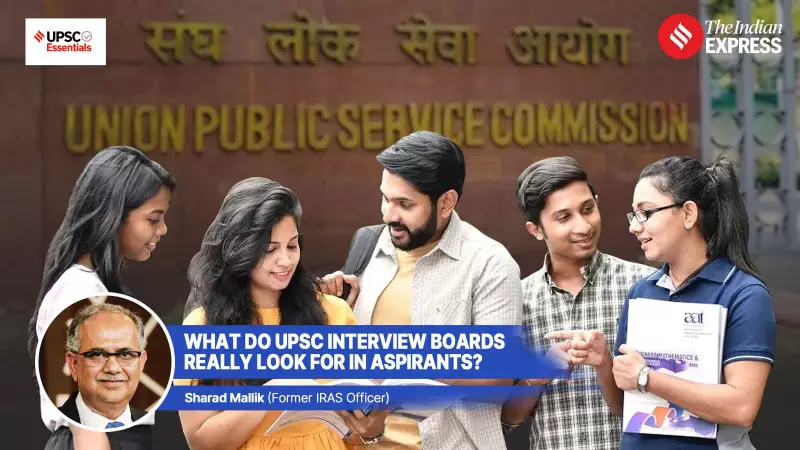
The final hurdle in the gruelling UPSC Civil Services Examination, the Personality Test, often shrouded in mystery, is currently underway for the 2025 cycle. To demystify this crucial stage, The Indian Express launched a special three-part expert series. In the first part, former Indian Railway Accounts Service (IRAS) officer Sharad Mallik decodes the interview's core purpose and offers actionable strategies for aspirants.
Beyond Knowledge: What the UPSC Board Really Seeks
Sharad Mallik, who brings over three decades of government experience, emphasizes that the Personality Test is not an assessment of knowledge, which has already been evaluated in the Prelims and Mains. Instead, the board, which conducts interviews at Dholpur House in Delhi, looks for deeper personality traits essential for a career in public service.
"A personality test evaluates important traits of your personality suitable for a career in public service," Mallik states. He lists critical qualities like balance of judgment, clarity of thought, social awareness, moral integrity, and composure under pressure. The ultimate goal is to gauge administrative temperament, sensitivity to diversity, decision-making ability, empathy, and emotional stability.

His central advice to candidates is to focus on presenting their "real self, not a rehearsed version." Communication is key; answers must be clear, concise, and confident, reflecting honesty and ethical grounding.
Transforming Your DAF from a Form into a Strategic Asset
The Detailed Application Form (DAF) is the interview's roadmap. Mallik warns against overloading it with information and advises providing only simple, explainable details. Common mistakes, however, are made even in seemingly simple sections.
On Hobbies: Generic entries like "music" or "reading" are ineffective. Be specific: mention "Hindi classical music" or "biographies of leaders." This demonstrates genuine engagement and allows for a meaningful dialogue, showcasing self-awareness and personal growth.
On Home State: Move beyond tourism. Aspirants must prepare to discuss their state's economic, social, and environmental issues, as well as flagship government schemes.
On Academic Background: Know the fundamentals of your degree and be ready to explain your choice of subject. Crucially, link your academic training to administrative skills. For instance, an engineer can highlight their problem-solving approach of breaking complex issues into manageable parts.
Crafting the Perfect Answer to "Why Civil Services?"
This deceptively simple question is a staple in the interview room. Mallik stresses that clarity, sincerity, and depth are paramount. Avoid clichéd, rehearsed, or overly idealistic answers like a vague desire "to serve the nation."
He recommends a three-part structured response:
- Personal Motivation: Draw from authentic life experiences—family influence, a teacher's inspiration, internships, or personal challenges that built empathy.
- Academic Interest: Highlight a genuine curiosity about society, public policy, or development issues.
- Professional Motivation: Align your demonstrated skills (leadership, analysis) with the demands of the civil services.
"Combining these three parts yields mature and convincing answers," Mallik asserts. He cautions against mentioning job security, power, or blaming past organizations. The board seeks self-awareness and a realistic, purpose-driven alignment with constitutional values.
Addressing Gap Years with Maturity and Honesty
Gap years in academic or professional journeys are a common point of inquiry. Mallik clarifies that the board is not judging the gap itself but the candidate's honesty and maturity in handling it.
Aspirants should be truthful and crisp, avoiding excuses, emotional stories, or claims of doing "nothing." Instead, take responsibility and highlight productive activities undertaken during the gap—skill-building, volunteering, or extensive reading.

"The board wants to know you didn't stagnate mentally," he explains. Demonstrating how the period contributed to personal growth, clarity of purpose, and emotional stability reflects well on the candidate's character.
The UPSC Personality Test for the 2025 cycle began on December 8, 2025, and carries 275 marks. With expert insights like Mallik's, aspirants can approach this final stage not with fear, but with a strategy to authentically showcase their potential for India's premier public service.