For aspirants preparing for the UPSC Civil Services Examination 2026, a deep understanding of history and culture remains a cornerstone. The latest edition of the daily subject-wise quiz, UPSC Essentials Week 140, delves into pivotal themes connecting India's past with its intellectual evolution. The quiz, curated by Manas Srivastava, challenges candidates on figures like Swami Vivekananda, the impact of colonial science, and pioneering Indian scientists.
Colonial Science and the Indian Intellectual Response
The quiz opens with a profound exploration of how colonial rule used science as an instrument of power and control. From the East India Company to the British Raj, scientific methods like surveys, censuses, and botanical studies were deployed to render India "knowable, manageable, and controllable." This established a damaging colonial paradox: Western science was presented as the universal marker of civilization, while indigenous knowledge systems were dismissed as pre-scientific superstition.
This created intense anxiety among Western-educated Indian elites, prompting a robust intellectual response. They sought to reclaim scientific legitimacy by asserting India's own rich legacy. The quiz highlights the debate between James Fergusson, the British authority on Indian architecture, and Indian scholar Rajendralal Mitra. While Fergusson argued Indian stone architecture derived from Greek models, Mitra fiercely countered that it was "perfectly self-evolved, self-contained, and independent," equivalent to Greek classicism.

Similarly, reformers like Swami Dayananda Saraswati, founder of the Arya Samaj, reinterpreted the Vedas as repositories of all modern scientific knowledge. In his work Satyarth Prakash, he presented Vedic rituals like the sacred fire (homa) as scientific processes for atmospheric purification, arguing for the eternal, rational truths within ancient texts.
Prafulla Chandra Ray: Bridging Laboratory and Legacy
A key figure examined is Prafulla Chandra Ray, celebrated as the Father of Indian Chemistry. The quiz outlines his dual intellectual journey. In the laboratory, from 1885 onwards, he conducted groundbreaking experimental research, with his work on mercury nitrite compounds published in leading European journals.
Concurrently, Ray immersed himself in Sanskrit alchemical texts. Between 1902 and 1904, he published "A History of Hindu Chemistry," an ambitious project to reconstruct the scientific spirit of ancient Indian philosophy. Inspired by French chemist Marcelin Berthelot, Ray used this historical research to establish the legitimacy of Indian scientific modernity by rooting it in a recovered classical past, alongside his efforts to build a future for Indian industry through Bengal Chemicals and Pharmaceuticals.
Nationalist Figures and Commemorative Days
The quiz also tests knowledge on important nationalist personalities and days of significance. It highlights Hakim Ajmal Khan (1863–1927), a renowned Unani physician and nationalist. Initially associated with the Muslim League's founding in 1906, he later became a staunch supporter of the Non-Cooperation Movement. He renounced his British title Haziq-ul-Mulk and was honoured with the title Masih-ul-Mulk by the public.
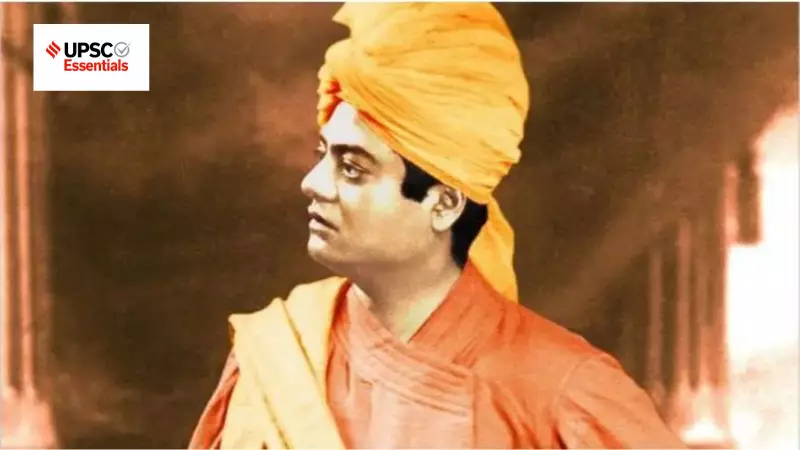
He played a pivotal role in founding Jamia Millia Islamia in 1920 and served as the Acting President of the Indian National Congress in 1921 after the arrest of C. R. Das. The quiz further clarifies important commemorative days: Digvijay Diwas marks Swami Vivekananda's iconic speech at the World Parliament of Religions in Chicago on September 11, 1893, while Pravasi Bharatiya Divas commemorates Mahatma Gandhi's return from South Africa to India.

Vivekananda's Global Legacy
Connecting history with enduring ideas, the quiz asks about the biography 'Life of Vivekananda and the Universal Gospel.' This work was authored by the French Nobel laureate Romain Rolland, who won the Nobel Prize in Literature in 1915. Rolland was a great admirer of Indian spiritual figures and also wrote 'The Life of Ramakrishna.' The inclusion of Vivekananda underscores his lasting relevance in discussions on national unity, tolerance, and universal humanism, especially in today's complex global context.
The UPSC Essentials daily quiz initiative is designed to help aspirants systematically revise static portions of the syllabus. This week's focus on History and Culture interlinks personalities, ideas, and the complex negotiation of identity and knowledge during the colonial period, providing crucial insights for Prelims preparation.