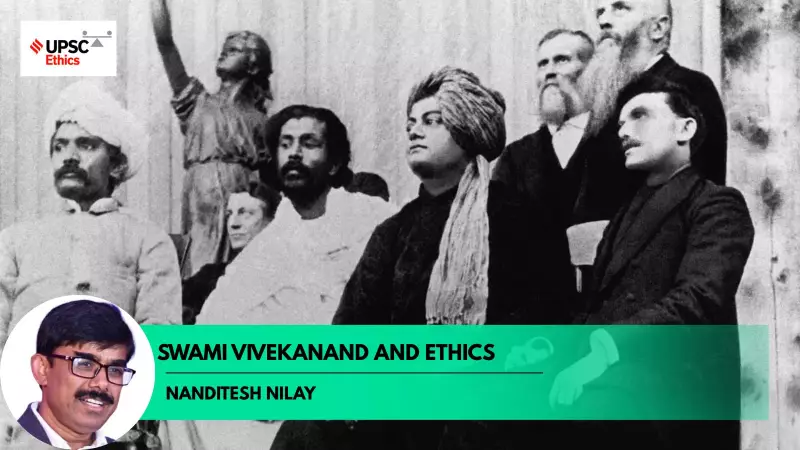
As aspirants prepare for the demanding UPSC examinations, the life and teachings of Swami Vivekananda offer a profound ethical compass, relevant not just for the GS-IV paper but for the very essence of public service and human existence. Marking his birth anniversary on 12 January, ethicist Nanditesh Nilay revisits the enduring message of a sage whose journey from a chance train meeting to a world-stunning speech in 1893 redefined India's spiritual identity on the global stage.
The Universal Call: An Ethical Awakening in Chicago
The year was 1893. India, under colonial rule, was often viewed with disdain by the Western world. Yet, in this climate, a monk from the East stepped onto the platform at the World’s Parliament of Religions in Chicago. His opening address, "Sisters and brothers of America," was not merely a greeting but a radical declaration of universal fellowship that earned a deafening applause. This moment prompts a pivotal ethical inquiry: How did Swami Vivekananda, amidst colonial domination, captivate the West?
The answer lies in a series of seemingly serendipitous yet deeply meaningful encounters. It began with an elderly woman, Kate Sanborn, offering help during a train journey, leading to hospitality in Massachusetts. Her subsequent introduction to John Henry Wright, a Harvard scholar, proved fateful. Wright's recommendation letter to the Parliament Chairman was unequivocal, stating Vivekananda was "more learned than all our learned professors put together." This trust was rooted in Vivekananda's profound understanding of the self, the purpose of life, and Hinduism—an understanding that dismantled prejudices and remains critically relevant today.

Core Philosophy: Breaking the Prison of Individuality
Vivekananda's philosophy presents a transformative ethical framework. He argued that divinity cannot be external to creation; to experience it, one must shed the "narrow prison of individual fragility and ego." For him, the freedom celebrated in the West differed from the ultimate freedom found in realizing infinite bliss. At the Parliament, amidst diverse faiths, he felt no need to enumerate Hinduism's deities. Instead, he presented it as a process of realizing God, with the ultimate aim of casting off "this little prison of individuality."
His vision was radically inclusive. The world was a home, and life's aim was to "recognise divinity in every man and woman" and to aid humanity in realizing its own true, divine nature. This shifts ethical responsibility from a personal moral code to an active, universal duty—a cornerstone concept for future civil servants.
Nationalism Rooted in Spirituality and Service
Swami Vivekananda's concept of nationalism was inseparable from spirituality and humanism. He viewed the nation's destiny with the intimacy of the soul's connection to the body. His nationalism was a call to remember a glorious Bharat that colonialism had obscured. "Each nation has a destiny to fulfil; each nation has a message to deliver; each nation has a mission to accomplish," he proclaimed.
He urged Indians to understand their historical role in fostering racial harmony. Critically, he warned against insularity, stating, "As long as 'touch-me-not-ism' is our creed and the cooking pot is our deity, we cannot rise spiritually." Thus, his nationalism was not a narrow 'ism' but a blend of selfless service (Karmayoga), human dignity, and moral courage aimed at national integration. He elevated patriotism to a humane and universal plane, grounded in the Vedantic principle of the inherent divinity in all.
The Karmayogi Ideal for Modern Leadership
For UPSC aspirants and serving bureaucrats, Vivekananda's embodiment of the Karmayogi ideal is a powerful model. He believed that leadership embracing this ideal could free a nation from self-inflicted bondage and dogma. The essence of Hinduism, for him, was this message of unity and inherent divinity. "Do not care for doctrines, dogmas, sects, or churches; they count little compared with the essence of existence in each man, which is spirituality," he advised.

His voice, described by French opera singer Emma Calvé as possessing "low vibrations that one cannot forget," continues to resonate. The greatest tribute on his birth anniversary is to internalize his call: to expand our humanity, break the inner ego, refine ourselves, and strive to become good human beings committed to doing good. Becoming truly human, as Vivekananda demonstrated, is a lifelong process of ethical becoming.
POST-READ QUESTION FOR UPSC ETHICS: "True nationalism is rooted in humanism and universalism." Discuss this statement in the light of Swami Vivekananda’s ethical thought.