Indian-origin mathematician Manjul Bhargava delivered a powerful message from Pune. He emphasized that India cannot afford to neglect foundational mathematics. This warning comes at a crucial time when artificial intelligence, data science, and other emerging technologies dominate the global economic landscape.
India's Mathematical Challenge: Isolation Over Talent
The Canadian-American mathematician, who won the prestigious Fields Medal in 2014 for his work in number theory, spoke to reporters on Monday. He was attending the inaugural day of the Indo-European Conference on Mathematics at Savitribai Phule Pune University.
Bhargava stated clearly that the subject does not suffer from a lack of talent in India. The real problem lies elsewhere. He pointed to a significant absence of conversation and collaboration within the country's mathematical community.

Breaking Down Academic Silos
According to Bhargava, India lags in both fundamental and applied research for a specific reason. Mathematical institutes across the nation often work in complete isolation from one another. This fragmented approach creates a major barrier.
The research conducted by these elite institutes fails to reach the vast majority of students. Bhargava noted that 90% of students are enrolled in state universities and affiliated colleges. These institutions typically lack the necessary resources and infrastructure to support meaningful research activities.
"Indian institutes need to talk to each other and to the world," Bhargava asserted. He stressed the critical importance of conferences like the current one in Pune. Such gatherings allow mathematical communities to unite, share groundbreaking ideas, and collectively advance the field globally.
The Power of Collaboration: A Historical Lesson
To illustrate his point, Bhargava referenced a famous historical partnership. He spoke about the legendary collaboration between Indian mathematician Srinivasa Ramanujan and British mathematician G.H. Hardy.
"If Ramanujan and Hardy had not met and worked together for those few years, if they had only exchanged letters or read each other's papers, it would not have produced the world-changing mathematics that it did," he explained. This story underscores the transformative power of direct, personal collaboration.
Funding and Reaching the Majority
Bhargava called for a concerted national effort to fund research properly. He insisted this funding must specifically reach state universities. These institutions enroll 90% of India's PhD students and 90% of its overall student population.
He offered a stark comparison. "Most universities are not of the quality of Pune University. There is hardly any research happening in Indian state universities, unlike in the US and Europe. One can only imagine the immense amount of talent being wasted," he said with concern.
A Glimmer of Hope: The ANRF and NEP
The mathematician acknowledged some positive developments. He mentioned the Anusandhan National Research Foundation (ANRF). Its proposed funding for state universities could potentially bring about much-needed change.
"We are far behind in India," Bhargava admitted. "Only if there is good foundational research will it successfully translate into applied research."
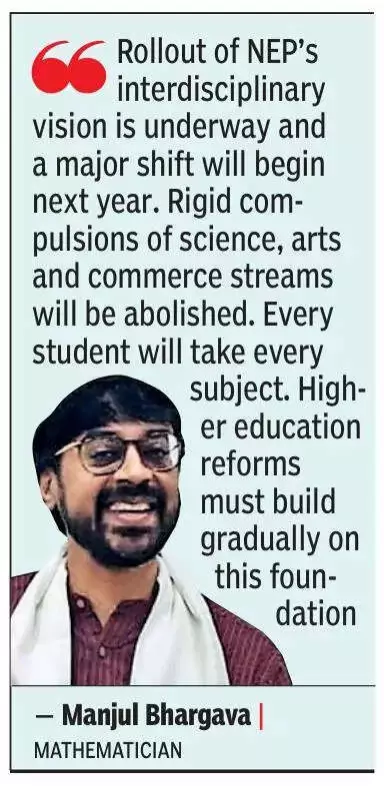
He also discussed the ongoing rollout of the National Education Policy (NEP) and its interdisciplinary vision. Bhargava revealed that a major shift is set to begin at the school level next year. The rigid compartments separating science, arts, and commerce streams will be abolished.
"Every student will take every subject," he said, outlining a more holistic approach. He added that higher education reforms must build gradually upon this new foundational model.
Celebrating India's Mathematical Heritage
Bhargava passionately argued for the accurate inclusion of India's contributions to mathematics in educational materials. He reminded everyone that India's mathematical history dates back thousands of years and is both profound and world-changing.
"It should be included in textbooks and public discourse without putting down any other country. This is India's soft power, and it will inspire youngsters," he stated.

A Vision for the Future: Building Communities
Looking ahead, Bhargava shared his personal vision. He is actively thinking about starting a nationwide network of mathematics circles for young people. This initiative would eventually develop into a vibrant, supportive community.
"Children will make stronger contributions to their subjects if they start early and grow up together," he explained. India must provide opportunities for young people passionate about mathematics. He suggested avenues like summer camps or gatherings that bring talented students together.
He cited his own experience founding the New York City Mathematics Museum as an example. That institution attracts hundreds of visitors every day. "Such places help the public interact with the subject in a meaningful way," he added, highlighting the importance of public engagement.
The five-day Indo-European Conference on Mathematics is a joint effort. It has been organized by the European Mathematical Society and the Indian Mathematics Consortium. Savitribai Phule Pune University and the Indian Institute of Science Education and Research, Pune are co-organizers. The event features talks by several award-winning international mathematicians, fostering the very collaboration Bhargava advocates for.